Sales tax calculator
Use this U.S. sales tax calculator to look up how much sales tax to charge wherever you’re selling, down to the ZIP code. Powered by TaxCloud’s API, it pulls accurate, up-to-date data from over 13,000 U.S. jurisdictions.

Written by Joe Stanton
CEO

Updated
Calculate your sales tax rate
Enter a U.S. address to find the sales tax rate for that location, or allow us to 📍Use your current location to look up the rate instantly.
- State
- -.--%
- County
- -.--%
- City
- -.--%
- District
- -.--%
Minimum combined sales tax rate for

Sales tax rates by state
Sales tax rates vary significantly by jurisdiction. And in many states, local rates add on top of the state base rate. Select your state for a detailed breakdown of rates, nexus thresholds, and filing requirements.
- Alabama
- Alaska
- Arizona
- Arkansas
- California
- Colorado
- Connecticut
- Delaware
- Florida
- Georgia
- Hawaii
- Idaho
- Illinois
- Indiana
- Iowa
- Kansas
- Kentucky
- Louisiana
- Maine
- Maryland
- Massachusetts
- Michigan
- Minnesota
- Mississippi
- Missouri
- Montana
- Nebraska
- Nevada
- New Hampshire
- New Jersey
- New Mexico
- New York
- North Carolina
- North Dakota
- Ohio
- Oklahoma
- Oregon
- Pennsylvania
- Rhode Island
- South Carolina
- South Dakota
- Tennessee
- Texas
- Utah
- Vermont
- Virginia
- Washington
- West Virginia
- Wisconsin
- Wyoming
Why U.S. sales tax rates vary by location
There are a number of different types of sales taxes that might apply to any order. We break them down below.
The rate your customer pays isn’t just the state sales tax rate — it’s a combination of state, county, city, and district taxes that stack on top of each other. That’s why two customers in the same state can often owe very different amounts.
In Illinois, the state rate is 6.25%. But a customer in Chicago pays 10.25% once city and county t3axes are added. A customer in Springfield pays 8.75%. Same state, very different liability.
This is why charging the correct rate requires your customer’s full address. Not just their state. Depending on where your customer is located, up to three layers of sales tax can apply to a single order.
State rate
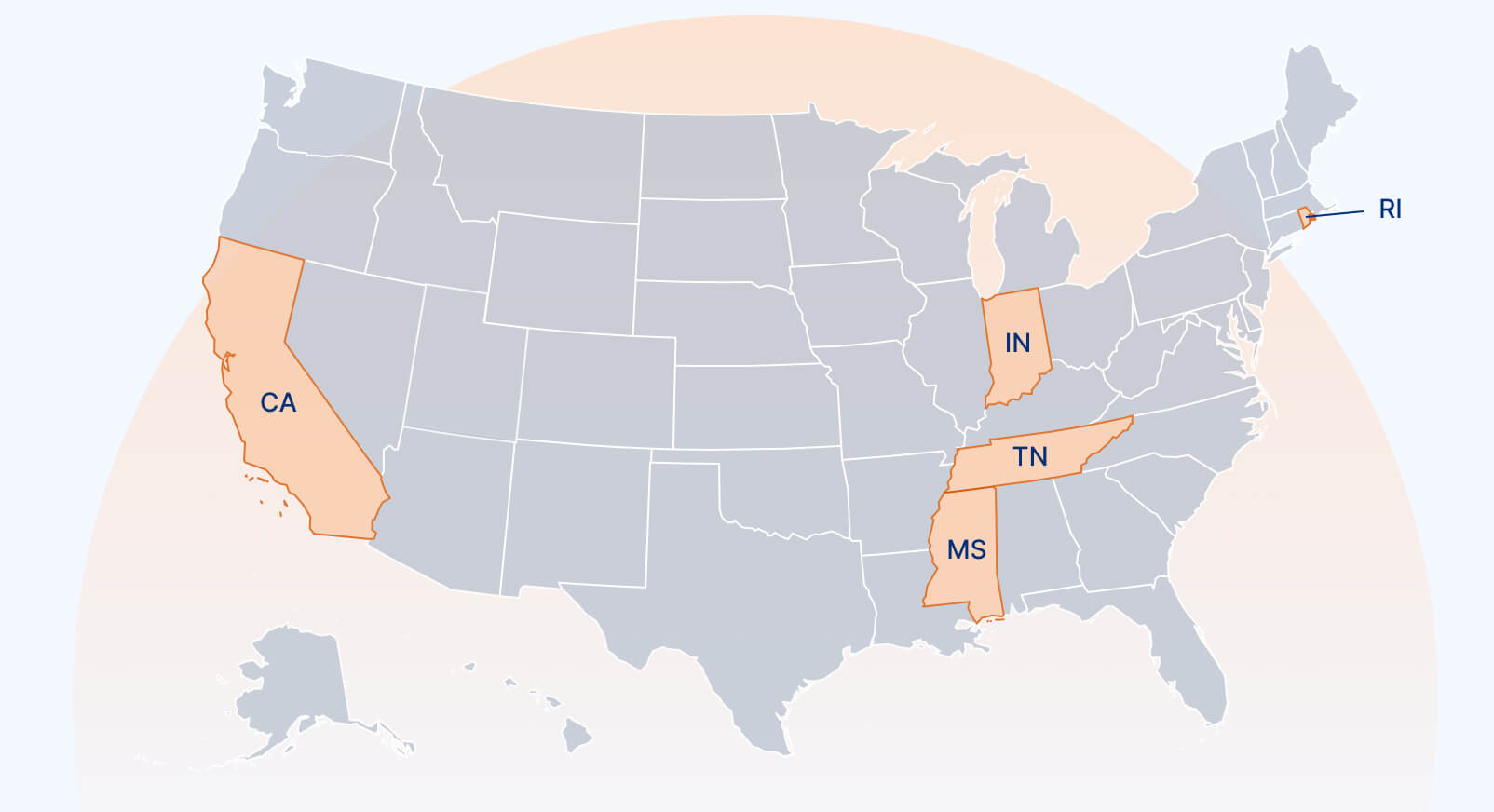
Every state that collects sales tax sets a base rate that applies statewide. The highest state rates are California (7.25%), Tennessee, Rhode Island, Indiana, and Mississippi (all 7%).
States with no sales tax
Five states have no state sales tax at all:
- Alaska
- Delaware
- Montana
- New Hampshire, and
- Oregon.
Note that Alaska allows cities and boroughs to charge local sales tax — so you may still owe tax on sales to Alaskan customers.
Local rates
Most states allow counties, cities, or special districts to layer additional tax on top of the state rate. These vary significantly — in some states the gap between the lowest and highest combined rate is 5+ percentage points, meaning your liability can look very different depending on exactly where your customer is located.
Combined rate
The combined rate is what you actually charge at checkout — the sum of every applicable state and local tax for your customer’s specific location. This is the number the calculator above returns, and the number that determines your compliance obligation.
2026 state and local sales tax rates
The table below provides a list of state and local sales tax rates in every U.S. state as of January 1, 2026. In states where you’ll likely pay local sales taxes, the table lists the lowest and highest rates you could pay.
| State sales tax rate | Local tax rate range | Total tax rate range | |
|---|---|---|---|
| Alabama | 4.00% | 0.10% – 9.00% | 4.00% – 13.5% |
| Alaska | 0.00% | 0.00% – 7.85% | 0.00% – 7.85% |
| Arizona | 5.60% | 1.50% – 4.00% | 5.60% – 9.60% |
| Arkansas | 6.50% | 0.00% – 6.125% | 6.50% – 12.625% |
| California | 7.25% | 0.125% – 4.00% | 7.25% – 11.25% |
| Colorado | 2.90% | 0.25% – 8.30% | 2.90% – 11.20% |
| Connecticut | 6.35% | N/A | 6.35% |
| Delaware | 0.00% | N/A | 0.00% |
| Florida | 6.00% | 0.50% – 2.00% | 6.00% – 8.00% |
| Georgia | 4.00% | 2.00% – 5.00% | 5.00% – 9.00% |
| Hawaii | 4.00% | 0.25% – 0.50% | 4.00% – 4.50% |
| Idaho | 6.00% | 0.00% – 3.00% | 6.00% – 9.00% |
| Illinois | 6.25% | N/A | 6.25% – 11.00% |
| Indiana | 7.00% | N/A | 7.00% |
| Iowa | 6.00% | 0.00% – 1.00% | 6.00% – 7.00% |
| Kansas | 6.50% | 0.50% – 3.00% | 6.50% – 9.50% |
| Kentucky | 6.00% | N/A | 6.00% |
| Louisiana | 5.00% | 0.00% – 7.00% | 5.00% – 12.00% |
| Maine | 5.50% | N/A | 5.50% |
| Maryland | 6.00% | N/A | 6.00% |
| Massachusetts | 6.25% | N/A | 6.25% |
| Michigan | 6.00% | N/A | 6.00% |
| Minnesota | 6.875% | 0.00% – 3.00% | 6.875% – 9.875% |
| Mississippi | 7.00% | 0.25% – 1.00% | 7.25% – 8.00% |
| Missouri | 4.225% | 0.125% – 3.00% | 4.225% – 7.225% |
| Montana | N/A | N/A | N/A |
| Nebraska | 5.50% | 0.50% – 2.00% | 5.50% – 7.50% |
| Nevada | 6.85% | 0% – 1.525% | 6.85% – 8.375% |
| New Hampshire | N/A | N/A | N/A |
| New Jersey | 6.625% | N/A | 6.625% |
| New Mexico | 4.875% | 0.375% – 4.5625% | 4.875% – 9.4375% |
| New York | 4.00% | 3.00% – 4.75% | 4.00% – 8.75% |
| North Carolina | 4.75% | 2.00% – 2.75% | 4.75% – 7.50% |
| North Dakota | 5.00% | 0.50% – 3.00% | 5.00% – 8.00% |
| Ohio | 5.75% | 0.75% – 2.25% | 6.50% – 8.00% |
| Oklahoma | 4.50% | 0.125% – 5.50% | 4.50% – 10.00% |
| Oregon | N/A | N/A | N/A |
| Pennsylvania | 6.00% | 0.00% – 2.00% | 6.00% – 8.00% |
| Rhode Island | 7.00% | N/A | 7.00% |
| South Carolina | 6.00% | 1.00% – 3.00% | 6.00% – 9.00% |
| South Dakota | 4.20% | 1.00% – 2.00% | 4.20% – 6.20% |
| Tennessee | 7.00% | 2.00% – 2.75% | 9.00% – 9.75% |
| Texas | 6.25% | 0.50% – 2.00% | 6.25% – 8.25% |
| Utah | 4.85% | 0.25% – 1.25% | 4.85% – 6.10% |
| Vermont | 6.00% | 0.00% – 1.00% | 6.00% – 7.00% |
| Virginia | 5.30% | 0.70% – 1.70% | 5.30% – 7.00% |
| Washington | 6.50% | 1.10% – 4.10% | 6.50% – 10.60% |
| West Virginia | 6.00% | 0.00% – 1.00% | 6.00% – 7.00% |
| Wisconsin | 5.00% | 0.00% – 2.00% | 5.00% – 7.00% |
| Wyoming | 4.00% | 1.00% – 3.00% | 4.00% – 7.00% |
Sales tax rates in 53 major U.S. cities (2026 update)
Explore sales tax rates in major U.S. cities. Enter a ZIP code in the calculator above for more detailed information.
Want to print or need this table in PDF format?
Download .PDF| City | State | State sales tax | City sales tax | Total sales tax |
|---|---|---|---|---|
| Albuquerque | New Mexico | 4.23% | 2.75% | 6.98% |
| Arlington | Texas | 6.25% | 2.00% | 8.25% |
| Atlanta | Georgia | 4.00% | 4.90% | 8.9% |
| Austin | Texas | 6.25% | 1.00% | 7.25% |
| Bakersfield | California | 7.25% | 1.00% | 8.25% |
| Baltimore | Maryland | 6.00% | N/A | 6.00% |
| Boston | Massachusetts | 6.25% | N/A | 6.25% |
| Charlotte | North Carolina | 4.75% | 2.00% | 6.75% |
| Chicago | Illinois | 6.25% | 4.00% | 10.25% |
| Cleveland | Ohio | 5.75% | 1.25% | 7.00% |
| Colorado Springs | Colorado | 2.90% | 4.30% | 7.20% |
| Columbus | Ohio | 5.75% | 1.25% | 7.00% |
| Dallas | Texas | 6.25% | 1.00% | 7.25% |
| Denver | Colorado | 2.90% | 4.81% | 7.71% |
| Detroit | Michigan | 6.00% | 0.00% | 6.00% |
| El Paso | Texas | 6.25% | 1.50% | 7.75% |
| Fort Worth | Texas | 6.25% | 1.75% | 8.00% |
| Fresno | California | 7.25% | 0.725% | 7.98% |
| Houston | Texas | 6.25% | 1.00% | 7.25% |
| Indianapolis | Indiana | 7.00% | N/A | 7.00% |
| Jacksonville | Florida | 6.00% | 1.50% | 7.50% |
| Kansas City | Missouri | 4.225% | 1.50% | 5.725% |
| Las Vegas | Nevada | 6.85% | 1.525% | 8.375% |
| Long Beach | California | 7.25% | 3.00% | 10.25% |
| Los Angeles | California | 7.25% | 2.25% | 9.50% |
| Louisville | Kentucky | 6.00% | N/A | 6.00% |
| Memphis | Tennessee | 7.00% | 2.25% | 9.25% |
| Mesa | Arizona | 5.60% | 2.70% | 8.30% |
| Miami | Florida | 6.00% | 1.00% | 7.00% |
| Milwaukee | Wisconsin | 5.00% | 2.90% | 7.90% |
| Minneapolis | Minnesota | 6.875% | 0.65% | 7.525% |
| Nashville | Tennessee | 7.00% | 2.75% | 9.75% |
| New York City | New York | 4.00% | 4.875% | 8.88% |
| Oakland | California | 7.25% | 4.75% | 12.00% |
| Oklahoma City | Oklahoma | 4.88% | 4.125% | 9.00% |
| Omaha | Nebraska | 5.50% | 1.5% | 7.0% |
| Philadelphia | Pennsylvania | 6.00% | 2.00% | 8.00% |
| Phoenix | Arizona | 5.60% | 3.50% | 9.10% |
| Portland | Oregon | N/A | N/A | N/A |
| Raleigh | North Carolina | 4.75% | 2.00% | 6.75% |
| Sacramento | California | 7.25% | 1.50% | 8.75% |
| San Antonio | Texas | 6.25% | 1.25% | 7.50% |
| San Diego | California | 7.25% | 0.50% | 7.75% |
| San Francisco | California | 7.25% | 1.00% | 8.25% |
| San Jose | California | 7.25% | 0.125% | 7.38% |
| Seattle | Washington | 6.50% | 3.85% | 10.35% |
| Tampa | Florida | 6.00% | 1.50% | 7.50% |
| Tucson | Arizona | 5.60% | 3.10% | 8.70% |
| Tulsa | Oklahoma | 4.50% | 4.017% | 8.52% |
| Virginia Beach | Virginia | 5.30% | 1.00% | 6.30% |
| Washington, D.C. | District of Columbia | 6.00% | N/A | 6.00% |
| Wichita | Kansas | 6.50% | 1.00% | 7.50% |
Want to print or need this table in PDF format?
Download .PDFSales tax nexus thresholds
Before you can apply a rate, you need to know where you’re required to collect. You have a collection obligation in any state where you meet the economic nexus threshold — typically $100,000 in sales or 200 transactions in a calendar year, though thresholds and measurement rules vary by state.
Use the table below to check your obligations. For a full breakdown of how nexus works and what triggers it, see our state-by-state economic nexus guide. Or see how TaxCloud tracks nexus exposure automatically so you know when you’re approaching a threshold in any state.
Want to print or need this table in PDF format?
Download .PDF| Economic nexus threshold | Measurement period | |
|---|---|---|
| Alabama | $250,000 in sales | Previous calendar year |
| Alaska | $100,000 in sales | Current or previous calendar year |
| Arizona | $100,000 in sales | Current or previous calendar year |
| Arkansas | $100,000 in sales or 200 transactions | Current or previous calendar year |
| California | $500,000 in sales | Current or previous calendar year |
| Colorado | $100,000 in sales | Current or previous calendar year |
| Connecticut | $100,000 in sales and 200 transactions | 12-month period ending Sep 30 |
| Delaware | No sales tax | N/A |
| Florida | $100,000 in sales | Previous calendar year |
| Georgia | $100,000 in sales or 200 transactions | Current or previous calendar year |
| Hawaii | $100,000 in sales or 200 transactions | Current or previous calendar year |
| Idaho | $100,000 in sales | Current or previous calendar year |
| Illinois | $100,000 in sales | 12-month period |
| Indiana | $100,000 in sales | Current or previous calendar year |
| Iowa | $100,000 in sales | Current or previous calendar year |
| Kansas | $100,000 in sales | Current or previous calendar year |
| Kentucky | $100,000 in sales or 200 transactions | Current or previous calendar year |
| Louisiana | $100,000 in sales | Current or previous calendar year |
| Maine | $100,000 in sales | Current or previous calendar year |
| Maryland | $100,000 in sales or 200 transactions | Current or previous calendar year |
| Massachusetts | $100,000 in sales | Previous calendar year |
| Michigan | $100,000 in sales or 200 transactions | Previous calendar year |
| Minnesota | $100,000 in sales or 200 transactions | 12-month period |
| Mississippi | $250,000 in sales | 12-month period |
| Missouri | $100,000 in sales | 12-month period |
| Montana | No sales tax | N/A |
| Nebraska | $100,000 in sales or 200 transactions | Current or previous calendar year |
| Nevada | $100,000 in sales or 200 transactions | Current or previous calendar year |
| New Hampshire | No sales tax | N/A |
| New Jersey | $100,000 in sales or 200 transactions | Current or previous calendar year |
| New Mexico | $100,000 in sales | Previous calendar year |
| New York | $500,000 in sales and 100 transactions | Previous four sales tax quarters |
| North Carolina | $100,000 in sales | Current or previous calendar year |
| North Dakota | $100,000 in sales | Current or previous calendar year |
| Ohio | $100,000 in sales or 200 transactions | Current or previous calendar year |
| Oklahoma | $100,000 in sales | Current or previous calendar year |
| Oregon | No sales tax | N/A |
| Pennsylvania | $100,000 in sales | Previous calendar year |
| Rhode Island | $100,000 in sales or 200 transactions | Previous calendar year |
| South Carolina | $100,000 in sales | Current or previous calendar year |
| South Dakota | $100,000 in sales | Current or previous calendar year |
| Tennessee | $100,000 in sales | 12-month period |
| Texas | $500,000 in sales | 12-month period |
| Utah | $100,000 in sales | Current or previous calendar year |
| Vermont | $100,000 in sales or 200 transactions | 12-month period |
| Virginia | $100,000 in sales or 200 transactions | Current or previous calendar year |
| Washington | $100,000 in sales | Current or previous calendar year |
| West Virginia | $100,000 in sales or 200 transactions | Current or previous calendar year |
| Wisconsin | $100,000 in sales | Current or previous calendar year |
| Wyoming | $100,000 in sales | Previous calendar year |
Want to print or need this table in PDF format?
Download .PDFFrequently asked sales tax questions
To calculate sales tax, multiply your customer’s order total by the combined sales tax rate for their location. The combined rate includes the state base rate plus any applicable county, city, or district taxes.
You can look up the combined rate for any U.S. address using the calculator above, or use TaxCloud to apply the correct rate automatically at checkout.
The rate depends on your customer’s exact address — not just their state. The combined rate includes the state base rate plus any local taxes that apply to their specific county, city, or district. Use the calculator above to look up the combined rate for any U.S. address.
If you run an ecommerce or SaaS business that sells online to customers out of state, you need to calculate and charge sales tax in all states where you have nexus.
In most states, businesses trigger economic nexus when they make over $100,000 in sales or more than 200 transactions. You can also trigger nexus if you have a physical location or remote employees in a state. Every state has different nexus threshold rules, so it’s critical to monitor your nexus exposure to ensure you’re compliant.
TaxCloud monitors your nexus exposure and notifies you when you’re approaching a state’s economic threshold. When you establish nexus TaxCloud also automates registration, so you can start collecting and remitting taxes on time.
For online purchases, sales tax is calculated at checkout based on your customer’s shipping address. The rate is determined by their exact location, down to the ZIP code, and applied automatically if you’re using a sales tax API or software integration.
TaxCloud calculates the correct rate in real time across 13,000+ U.S. jurisdictions, so the right amount is collected at checkout without manual lookup or rate maintenance on your end.
How often you should file sales tax returns for your business depends on where you sell. Most states require you to file and remit sales tax monthly or quarterly, but each state has different sales tax due dates and sales tax filing frequency requirements. Your filing schedule typically depends on your revenue or how much sales tax you collect.
TaxCloud automates sales tax filing and remittance, so you don’t have to worry about keeping up with different filing schedules or risk missing deadlines as you sell in more states.
Yes, significantly. The state rate is just the floor. Counties, cities, and special districts can add their own taxes on top, which means two customers in the same state can owe very different rates. In Colorado, the state rate is 2.90% — but a customer in Denver pays 7.71% once local taxes are added. This is why ZIP code-level accuracy matters when calculating what to charge.
Sales tax rates change frequently. States and localities adjust rates, add new taxes, or remove existing ones throughout the year. TaxCloud’s API continuously updates rate data across 13,000+ U.S. jurisdictions, so you’re always charging the current rate without having to track changes manually.
Sales tax rates in 53 major U.S. cities (2026 update)
Explore sales tax rates in the major U.S. cities. Enter a ZIP code in the calculator above for more detailed information.
- Albuquerque
- Arlington
- Atlanta
- Austin
- Bakersfield
- Baltimore
- Boston
- Charlotte
- Chicago
- Cleveland
- Colorado Springs
- Columbus
- Dallas
- Denver
- Detroit
- El Paso
- Fort Worth
- Fresno
- Houston
- Indianapolis
- Jacksonville
- Kansas City
- Las Vegas
- Long Beach
- Los Angeles
- Louisville
- Memphis
- Mesa
- Miami
- Milwaukee
- Minneapolis
- Nashville
- New Orleans
- New York City
- Oakland
- Oklahoma City
- Omaha
- Philadelphia
- Phoenix
- Portland
- Raleigh
- Sacramento
- San Antonio
- San Diego
- San Francisco
- San Jose
- Seattle
- Tampa
- Tucson
- Tulsa
- Virginia Beach
- Washington, D.C.
- Wichita