Avalara vs TaxJar: A complete comparison

Written by

Head of DemandGen, TaxCloud

Updated
TL;DR: Avalara, TaxJar, or TaxCloud? Pick your sales tax tool based on your scale and complexity
This comparison is for growing ecommerce brands weighing Avalara and TaxJar, including where neither is the right fit for US sales tax compliance.
- If you’re an enterprise with a dedicated sales tax department, choose Avalara. It’s built for complex, multi-entity tax environments, and that’s what you pay for: higher implementation overhead, modular pricing, and a platform designed for enterprise scale.
- If you’re just getting started or selling high volumes through marketplaces, TaxJar fits. It focuses on simplicity and ease of use, and that’s exactly what an early-stage ecommerce brand needs from a tax tool.
- If you’re a growing mid-market brand that’s outgrown TaxJar and doesn’t need an enterprise provider, choose TaxCloud, a sales tax compliance platform that combines accurate tax calculation, automated filing service, and pre-built ecommerce integrations, with free filing in the 24 SST states, without enterprise cost or complexity.
When evaluating sales tax software, many businesses find themselves caught between balancing capability with simplicity. In many cases, tax platforms that cater to one end of the spectrum do so at the expense of the other.
For example, Avalara delivers deep configurability and global compliance tools that work best for enterprise, but implementation is difficult, support is overseas, and response times are historically quite slow. Meanwhile, TaxJar offers a simple plug-and-play setup that’s great for SMB and marketplace sellers, but it lacks the ability to integrate deeply with ERPs, CRMs, and other tools in the company tech stack.
While many growing brands seek a more balanced approach — like the scalable pricing, human-powered support, and end-to-end configurability that TaxCloud provides — brands that focus on either complexity or simplicity can be a great fit in the right situation.
In this article, we’ll take a closer look at how Avalara and TaxJar handle compliance, integrations, pricing, and implementation.
Before we move into a deeper head-to-head comparison of the tools, we’ve put together a quick table to give you an overview of how they compare across the key areas.
Avalara vs. TaxJar vs. TaxCloud at a glance
| Avalara | TaxJar | TaxCloud | |
|---|---|---|---|
| Best suited for | Businesses that need a broad tax compliance platform, including companies with complex or global requirements | Startups and marketplace sellers looking for automated sales tax calculation, reporting, and filing | Growing mid-market ecommerce and SaaS businesses managing sales tax across multiple states |
| Sales tax calculation | Yes | Yes | Yes |
| Automated filing and remittance | Yes | Yes | Yes |
| Integrations | Broad range of enterprise-level ERP, ecommerce, accounting, and other business-system integrations | Ecommerce, marketplace, accounting, and API integrations, with availability depending on plan | Ecommerce, accounting, billing, and API integrations, including Shopify, BigCommerce, WooCommerce, QuickBooks Online, and Stripe |
| Pricing basis | Pricing is not publicly available; unclear structure and hidden fees | TaxJar Starter starts at $39/month; Professional starts at $99/month, with pricing scaling based on order volume | TaxCloud Starter starts at $19/month; Premium starts at $79/month, with pricing scaling based on order volume |
| Key consideration | Broad product suite can suit businesses with more complex tax requirements | Plan costs increase with order volume, and filing fees vary by plan | Primarily focused on U.S. sales tax rather than global tax compliance |
| Product-level taxability handling | Yes | Limited | Yes |
| Economic nexus monitoring | Yes | Yes | Yes |
| Exemption certificate management | Yes (additional fee) | Limited | Limited |
| Public developer APIs | Yes | Yes | Yes |
| Self-service setup | Limited | Yes | Yes |
| Self-service onboarding | No | Yes | Yes |
| Transparent entry-level pricing | No, pricing is complex and unclear | Yes | Yes |
| Global enterprise tax infrastructure | Yes | No | Yes |
| Supports the Streamlined Sales Tax (SST) Project | Yes | No | Yes |
| Fast, reliable support from real experts | No | No | Yes |
Accuracy note: This comparison is based on publicly available information, product documentation, and independent user reviews.
Platform capabilities and pricing regularly change over time, so be sure to verify specific details directly with vendors if you’re switching to a different tax compliance solution.
What is Avalara?

Avalara is a tax compliance platform that caters primarily to enterprise organizations (Netflix, Adidas, Acer, Comcast, etc.) with complex regulatory requirements and multi-regional operations. The platform supports sales tax, VAT, and GST across a wide range of jurisdictions, which makes it an appealing choice for brands operating at scale in multiple countries or geographically diverse markets.
As a platform, Avalara’s approach centers on managing tax complexity through modular products, configurable systems, and a broad library of integrations. ERPs, e-commerce, and financial systems can integrate directly with Avalara, allowing organizations to gain the visibility and control required to support complex, interconnected systems.
While Avalara has supported smaller brands in the past, recent changes to its core design and implementation model now align the platform more closely with organizations that have dedicated, in-house tax and finance teams. Setup, configuration, and ongoing maintenance often require international expertise in order to keep the system compliant across all markets. This makes the platform better suited for companies that need tax compliance to function as an active, operational process administered by in-house teams.
Key differentiators
- Built for complex, multi-entity tax environments. Avalara is built to handle large-scale compliance across multiple jurisdictions, entities, and transaction types. The scalability and flexibility make it a strong fit for enterprise organizations.
- Deep ERP, CRM, and POS integrations. Native connections to systems like NetSuite, SAP, Salesforce, and Retail Pro, allow Avalara to fit into custom sales stacks in ways that smaller brands simply can’t manage. However, Avalara charges for integration access.
- Highly configurable tax logic and product taxability. Avalara customers can customize how products are taxed across jurisdictions. While critical for companies with nuanced tax rules, this approach also adds additional maintenance and overhead requirements.
What is TaxJar?

TaxJar is a sales tax automation platform designed primarily for early-stage ecommerce brands that have just established nexus and need to begin calculating taxes and filing with state authorities.
The platform provides simple, easy-to-use functionality for businesses that are beginning to understand and manage their sales tax obligations. However, as those businesses grow and transaction volumes increase, pricing scales alongside usage. Teams planning for higher-volume operations should take this into account, as TaxJar’s costs are higher than many competitors after its 2026 price increase.
Overall, TaxJar prioritizes simplicity over configurability. Prebuilt integrations with ecommerce platforms (Shopify, WooCommerce, Magento, etc.), payment systems, and marketplaces (Etsy, eBay, Amazon, etc.) allow businesses to connect their system quickly and begin automating tax workflows without extensive setup or in-house tax expertise. The emphasis on ease of setup makes TaxJar especially appealing to smaller teams and growing brands that want to standardize and automate tax compliance.
TaxJar’s streamlined approach comes with some limitations. Compared to more configurable platforms, TaxJar offers less flexibility in areas like product taxability or exemption certificate management. While TaxJar offers some functionality in these areas, it falls short when compared with highly configurable platforms. For those reasons, TaxJar is better suited to brands with relatively straightforward tax requirements.
Key differentiators
- Designed for simplicity and fast onboarding. TaxJar prioritizes ease of use and self-setup. Users can get up and running quickly without heavy implementation requirements or internal tax expertise.
- Better suited to smaller brands. Unlike Avalara, TaxJar works best for smaller companies and non-enterprise organizations that don’t need international coverage, where configurations are more straightforward and don’t require complex or custom setups.
- Accessible pricing options. TaxJar offers two plans — Starter and Professional — with transparent but high-cost pricing for each tier. Filings and registrations are purchased separately from the main plan.
How should you choose between Avalara, TaxJar, and TaxCloud?
Avalara and TaxJar can both automate core sales tax tasks, but they are built for somewhat different needs. Avalara offers a broader tax compliance suite and may be relevant for businesses with more complex, multi-entity, or international requirements. TaxJar focuses more specifically on small businesses who sell on marketplaces.
TaxCloud is another option to consider if you’re a growing U.S. ecommerce or SaaS business managing sales tax obligations across multiple states. Like Avalara, TaxCloud is a Certified Service Provider under the Streamlined Sales Tax program, which can significantly change the cost of compliance for eligible remote sellers in participating SST states.
The best fit depends on your sales channels, transaction volume, state footprint, integration requirements, and whether you need U.S.-only or broader global tax compliance.
Below, we take a closer look at the key features and functionality of each tool.
Core tax compliance capabilities
While their approaches differ, both Avalara and TaxJar offer solutions to help businesses stay compliant with regulatory requirements around sales tax. Both platforms overlap in several key areas that most buyers expect from a modern sales platform.
Common capabilities offered by both platforms include:
- Real-time sales tax calculations across U.S. jurisdictions.
- Product taxability determination based on category and location.
- Economic nexus tracking and threshold monitoring.
- Automated filing and remittance (service levels vary).
- Exemption certificate capture and management.
- Ongoing rate and rule updates to maintain compliance.
At a high level, both platforms aim to reduce the manual headaches involved in tracking tax rates, monitoring nexus obligations across all sales channels, or filing returns. However, the way that each solution delivers these capabilities and the amount of effort required from businesses differ significantly.
Avalara approaches tax compliance as a complex, configurable system that can be tailored to a wide range of use cases. The platform supports advanced product taxability rules and detailed reporting systems that can capture data from a variety of sales channels. ERP and CPQ systems can be connected to ecommerce storefronts and financial systems to create an all-in-one, integrated tax solution. Unfortunately, many of Avalara’s capabilities (including integrations) are sold as modular products, meaning that a business will need to purchase several components separately in order to build a complete, end-to-end solution.
TaxJar focuses on delivering core compliance functionality in a more streamlined way. Tax calculation, nexus tracking, and filing are built to work with menial configuration and are offered as part of a standardized plan. Businesses can automate key processes quickly and will have all the tools required to do so without building custom solutions via a sales rep, a requirement to get started with Avalara. The downside to this approach is that TaxJar is less flexible by comparison, and brands may find themselves bumping into TaxJar’s limitations as they grow.
For many users, the choice between Avalara and TaxJar will come down to company size and how much complexity they need to manage. Smaller ecommerce organizations will find that TaxJar has everything they need without the setup and high costs associated with Avalara.
While searching for the right fit, keep in mind that Avalara and TaxJar aren’t the only two options available.
TaxCloud takes a more balanced approach by offering scalable pricing, human-powered, U.S.-based support, integrations, and automated filing/reporting options. Plus, TaxCloud’s position as a Certified Service Provider within the Streamlined Sales Tax program means that users can take advantage of free filing in up to 24 states.
For mid-market brands who have outgrown simpler platforms like TaxJar but who aren’t ready to climb into an enterprise system, TaxCloud’s end-to-end platform service is a better fit.
Integrations and platform capability
In many cases, integrations will play a critical role in how tax compliance software fits into the company tech stack. For ecommerce and SaaS brands, the ability to connect tax automation tools directly to online storefronts, marketplaces, billing systems, and accounting tools significantly reduces the manual work required to stay compliant.
Both Avalara and TaxJar offer a range of integrations across the digital landscape, but those connectors vary between brands.
In general, Avalara has a more extensive integration library with connections for highly complex internal systems. TaxJar integrations tend to be more turnkey, offering a plug-and-play approach that works well with most ecommerce platforms.
Avalara integrations
Boasting over 1,400 signed partner integrations, Avalara offers one of the most extensive integration ecosystems in the tax compliance space, outmatched in niche areas only by other enterprise solutions like Sovos or Vertex. The platform connects with major ERP systems like NetSuite, SAP, Oracle, and Microsoft Dynamics, as well as a wide range of ecommerce platforms, billing systems, and CRM tools.
Avalara’s connectivity solutions make it a strong fit for organizations with complex, multi-channel sales environments where tax management requires consolidating data from multiple sources. The platform’s APIs and developer tools allow for highly customized implementations, enabling businesses to tailor tax workflows based on operational needs.
However, there are a few downsides to Avalara’s approach. Most integrations require heavy configuration — to the point that an entire ecosystem of network engineers and third-party consultants exist to assist with Avalara setups. Additionally, Avalara charges for integration access, further driving up usage costs.
For mid-sized teams without dedicated, in-house technical resources, connecting and maintaining the systems can introduce additional time, cost, and overhead that could be otherwise avoided by working with an off-enterprise compliance provider.
TaxJar integrations
TaxJar offers a more streamlined approach to integrations, but it does so by trading versatility and connectivity for simplicity. While Avalara offers 1400+ integration options, TaxJar offers around 40+ integrations, including those created by third-party partners.
For brands needing to connect to ecommerce marketplaces like Amazon or eBay, TaxJar provides direct, plug-and-play connections that can be configured in a matter of minutes. This is a great option for teams who want tax automation to run in the background without requiring ongoing maintenance and configuration. The downside is that, while these integrations are easy to implement and maintain, customizations are limited.
TaxJar’s approach works well for companies with relatively straightforward tech stacks, but it might be limiting for teams that rely on complex ERP platforms or require deep customization across multiple systems. While these needs can sometimes be offset via API usage, TaxJar simply isn’t built to handle the complexity that enterprise users often require.
Real-time sales tax APIs
Many tax platforms — including Avalara, TaxJar, and TaxCloud — offer API endpoints that can be used to build more complex setups. This becomes more relevant as businesses scale and systems grow more complicated.
| API features | Avalara | TaxJar | TaxCloud |
|---|---|---|---|
| Best fit | Large enterprises | SMBs & startups | Mid-market brands |
| API ease of use | Moderate to complex; often requires a specialized dev team | High | High |
| Sandbox / Testing | Available upon request through sales and developer support | Yes | Developer-friendly environment / sandbox (fully free to use in the 30-day trial) |
| Pricing model | Custom pricing; typically higher due to global coverage | Starts at $99/month (Professional plan); API may require additional costs | API included in Premium plan ($79/month); no separate API fee |
| Global support | Extensive (190+ countries) | Primarily U.S.-focused | U.S. & Canada; additional regions supported via partner (zip.tax) |
Usually, API deployments carry their own plans, requirements, and limitations. Due to those extra costs, replacing pre-built integrations that are included with a specific plan with an API-only deployment may not be viable.
All three solutions offer a developer sandbox, but eligibility varies by plan. Specifically with TaxCloud, it’s possible to access the sandbox during a 30-day free trial, so you can test viability and build complete workflows before making a final purchasing decision.
Which is the better fit?
When factoring for integrations, both connectivity and complexity play a role in finding the best fit.
While businesses with complex infrastructure and multiple, interconnected systems may gravitate toward Avalara, brands not currently operating at enterprise or near-enterprise levels are likely to have better luck with alternative solutions. Between the higher costs and configurability requirements, Avalara’s setups simply won’t make sense for most brands below a certain size.
Similarly, TaxJar won’t make sense for huge organizations with multi-faceted compliance requirements and sales channels. Ecommerce-focused teams with straightforward setups will find TaxJar’s deployment options more accessible and much easier to manage, especially without dedicated, in-house support.
Pricing and cost structure
Pricing is one of the most important factors when evaluating tax software, especially for growing brands looking to balance functionality with long-term cost control. Even though most platforms offer similar core capabilities, the way those features are packaged, priced, and scaled varies significantly.
Both Avalara and TaxJar use subscription-based models, but their approach to pricing differs. Avalara relies on custom quotes, modular products, and licensing fees while TaxJar offers tiered pricing bundles with a flat baseline price with add-on features.
Here’s a closer look at how each brand handles pricing considerations:
- Subscription structure and pricing transparency. Avalara offers no publicly available pricing. Instead, every customer must work with a sales rep in order to receive a custom quote, which is determined based on factors like transaction volume, integration needs, and required services. This is a far more complicated approach than the one offered by solutions like TaxJar or TaxCloud, where pricing is publicly available and bundled into a pre-set plan.
- Modular services and add-on costs. With Avalara, core capabilities like returns filings or exemption certificate management are split into different products. In order to access these services, users need to pay for each individual product, as well as any additional features or usage limits involved. TaxJar includes most of its core features within its base plans, while filing services are treated like an add-on and can be purchased on an as-needed basis.
- Integration expenses. While Avalara offers a robust integration library, users can’t access all integrations as part of their plan. Instead, the company charges thousands for access to specific integrations and closes access to the rest. By comparison, TaxJar’s integrations are included in its plan costs and are self-service modules with minimal setup requirements.
- Implementation costs. In most cases, setup with Avalara requires extensive onboarding and specialized configuration support. The setup is so complex that Avalara keeps an active partner network filled with consultants, integrators, and developers to assist with setup and ongoing maintenance. While that’s useful for large enterprises, smaller brands won’t need that level of support. TaxJar users can self-configure the platform and start collecting taxes without the extra hassle that accompanies enterprise implementation.
- Usage and scaling charges. Both platforms increase pricing based on transaction volume, but Avalara’s costs tend to scale less predictably due to its modular structure and contract-based pricing. With TaxJar, pricing scales in a more linear fashion, and its publicly listed thresholds make it easier for users to see where usage will trigger a price increase.
- Support costs. Avalara users may need to invest in premium support plans or managed services in order to resolve issues in a reasonable amount of time. By contrast, TaxJar support is included in its standard plans, and no additional or premium upgrades are available.
Avalara is well-suited for organizations that need flexible, customizable pricing aligned with complex compliance requirements. Even so, the platform’s enterprise focus and emphasis on complex configurations equates to higher prices and less transparency for users. That’s especially true for mid-market brands, who won’t need every available add-on or configuration on offer but will still pay premium costs due to Avalara’s enterprise focus.
TaxJar offers a more predictable and accessible pricing model, which makes it easier for ecommerce brands to get started and scale without navigating complex contracts. The downside is that, while pricing is much simpler, TaxJar’s features are more limited when compared to Avalara and other enterprise solutions.
Of course, keep in mind that other options also exist and follow different pricing models. For example, TaxCloud offers two baseline plans and optional add-ons for additional transactions and filing needs, so costs scale as the business grows. Other options charge higher costs per filing or registration but don’t charge for transaction volume.
Ultimately, teams will need to weigh total cost of ownership against features received. For enterprise solutions, Avalara or a similar solution is the only choice. Mid-market and smaller brands have more cost effective alternatives beyond TaxJar, and these solutions can provide strong automation options while keeping overhead low.
Read more:
- TaxJar pricing guide
- Understanding Avalara pricing and costs
Implementation and ease of use
Outside of a tax platform’s core features, teams must also consider how much time, effort, and internal expertise is required to get the system up and running. Maintenance and upkeep are also factors that contribute to the total cost of ownership.
Some platforms are easier to deploy than others, and this largely comes down to the complexity of the required integrations. Platforms like TaxJar or TaxCloud can be deployed in a matter of hours or days while Avalara may take weeks or months to properly connect to all internal systems.
Key implementation considerations include:
- Setup complexity and onboarding timeline. Avalara implementations tend to involve multiple steps, including integration mapping, system configurations, and tax calculation verification across multiple jurisdictions. The setup is inherently more complex, which extends onboarding timelines. TaxJar, on the other hand, tends to offer turnkey integration setups that can be deployed quickly but lack the complexity that Avalara provides.
- Internal expertise and resource requirements. Most enterprise solutions like Avalara assume that the end user has some level of in-house tax, finance, or IT support to manage configurations and keep the system running. TaxJar, like TaxCloud and other solutions geared for off-enterprise brands, are built for teams without those resources and ongoing oversight requirements.
- User interface and day-to-day usability. While Avalara does offer access to more powerful tax tools, the interface is proportionally complex and designed to support detailed reporting and configurations. TaxJar offers a simplified, more intuitive dashboard that prioritizes ease of use and accessibility for non-expert users.
- Ongoing maintenance and system management. Because Avalara is connected to so many major systems, the platform will require ongoing maintenance as systems are updated and tax rules change. With TaxJar, maintenance is minimal because the system is only connected to a few storefronts or financial solutions. Integrations are less complex and data doesn’t pass through as many systems, making updates simpler and more straightforward.
When switching to any tax platform, the factors above deserve major consideration. For companies already using a tax solution, keep in mind that one platform will likely need to remain active while a replacement is configured and deployed.
Example: Users currently on Avalara who might consider switching to TaxJar may need to coordinate closely with TaxJar’s support team in order to get the system up and running before the contract with their existing provider expires. This process is made more difficult if the platform that the team intends to exit blocks access to tax data once the contract expires.
A final factor to consider is onboarding support. Many tax platforms, including TaxCloud, offer paid onboarding services to ease transitions and streamline deployments. With TaxCloud, our team of onboarding experts can help transitioning users map tax fields correctly, import any existing tax data to the TaxCloud platform. They can even work closely with eligible users to cut costs via enrollment in solutions like the Streamlined Sales Tax (SST) program.
Other platforms may offer similar solutions, which can be highly useful when teams are committed to other aspects of the business and can’t handle a platform transition on their own.
Thinking about switching to a new provider?
A practical guide to switching sales tax providers while maintaining peace of mind.
Customer support and service models
Because mistakes in tax compliance can lead to penalties and audits, customer support can be a critical factor when choosing a platform. Users need to know how quickly they can get help and whether support is accessible when issues arise.
Unfortunately, with Avalara and TaxJar, support is a mixed bag.
- Avalara aligns support with enterprise needs and gates fast support behind tiered service levels. At higher tiers, support can be handled by phone and may even be resolved during the live interaction. For standard users, however, support responses are much slower.
- TaxJar support relies primarily on self-service knowledgebases and AI chatbots. If sending an email, TaxJar tries to issue a reply within 24 hours, which means that fixing an issue can take several days of back-and-forth emails before reaching a resolution.
Growing companies need quick answers and reliable guidance, especially when compliance issues are time-sensitive. Delays, escalations, and unclear support paths can turn what should be a straightforward resolution into a major issue that detracts from daily operations.
Smaller teams need access to the right level of support without enterprise contracts or complex service tiers like Avalara provides. TaxJar tries to offset this somewhat on the Professional plan by adding a customer success manager and dedicated onboarding support. Other solutions, like TaxCloud, offer phone support or something similar on higher-end plans.
Unfortunately, bad support experiences aren’t uncommon, especially for larger compliance solutions. Below, you’ll find real reviews from real TaxJar and Avalara users talking about their platform experience.
Final verdict: Avalara vs TaxJar vs TaxCloud
Ultimately, choosing between Avalara and TaxJar comes down to how a brand approaches tax compliance. Companies who want a more hands-on approach and have the resources to support it may be a better fit with Avalara, while teams who want tax compliance on autopilot will fit better with TaxJar.
In reality, both platforms can solve most core sales tax challenges, but each is designed for a different level of complexity, operational involvement, and internal resources. Understanding where each platform fits in the compliance ecosystem can save time and avoid any unnecessary complexity or limitation.
Avalara: Best for enterprise-scale tax complexity
Between Avalara and TaxJar, Avalara is the better fit for organizations operating at an international scale. Past a certain threshold, TaxJar simply doesn’t have the resources to accommodate the tax needs of larger brands.
Avalara provides added configurability, reporting, and integrations that smaller competitors lack, and the platform can connect to all sales channels and internal software tools to give a full view of a company’s tax obligations.
At the same time, companies that haven’t expanded onto an international stage are likely to find that the benefits of an enterprise solution are far outweighed by the costs, long implementation timelines, and ongoing management requirements. These issues make Avalara a less practical solution for companies lacking enterprise-level infrastructure.
TaxJar: Best for simple ecommerce tax automation
As a platform, TaxJar is a better fit for ecommerce brands looking for a straightforward way to automate sales tax without heavy implementation costs or ongoing maintenance.
Between its fast setup, transparent pricing, and easy-to-interpret UI, TaxJar is a viable solution for smaller teams who want a compliance solution that can operate in the background. As discussed above, TaxJar’s approach does come with some limitations, but this platform is a strong fit for smaller teams lacking a clear need for enterprise-level deployments.
TaxCloud: Best for mid-market tax compliance

In this comparison, TaxCloud sits somewhere between TaxJar and Avalara.
Our platform is an ideal solution for growing, mid-market brands that need more than basic automation but not the costs or complexity of an enterprise solution. We combine all the standard compliance features — tax calculations, automated filing, marketplace integrations, etc. — with a focus on minimizing the regulatory requirements that can interrupt daily operations.
TaxCloud works well for companies operating in the U.S. and Canada and is capable of delivering reliable compliance with or without dedicated, in-house tax resources. Implementation cycles are relatively short while pricing is both transparent and affordable.
Other compliance solutions
While we’ve mostly discussed Avalara and TaxJar in this article, keep in mind that other compliance solutions may be better suited for specific use cases.
- Enterprise alternatives like Vertex or Sovos can offer similar depth and configurability to Avalara.
- Solutions like TaxCloud is a strong alternative to TaxJar.
- For brands seeking managed services, solutions like TaxValet can also offer a completely hands-free tax experience.
Before making a final decision, take a closer look at the broad selection of alternatives on the market and see which one works best for you.
Get scalable tax compliance without enterprise overhead
Tax compliance becomes more complex as a business grows. However, a compliance platform doesn’t need to increase that complexity on its own. Unfortunately, growing brands often partner with a new tax provider only to discover that costs have increased and staying compliant is more difficult.
TaxCloud is designed specifically for that middle ground. By combining the core components of modern compliance software with scalable pricing and automation, TaxCloud can run in the background without the need for constant oversight or upkeep.
Behind the scenes, our team works constantly to keep our tax engine updated and validate tax submissions before they’re filed. We also offer human-powered support and typically respond within a few hours, so you can get knowledgeable help from experts without lengthy delays.
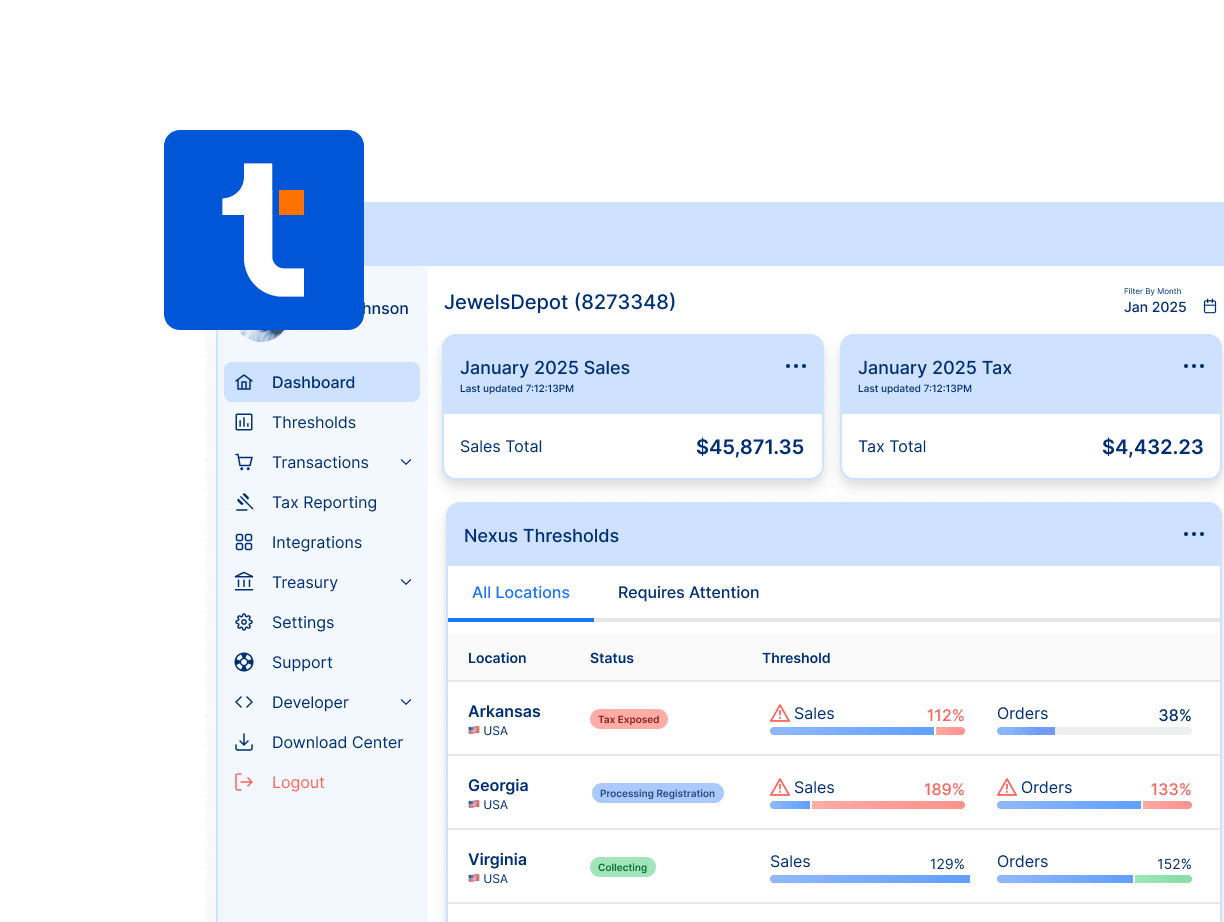
Want to give TaxCloud a try?
Get in touch with a product expert for a personalized demo.
Avalara vs TaxJar — FAQs
Unfortunately, there isn’t a one-size-fits-all answer. Avalara and TaxJar are both viable solutions, but each is built to serve companies at different stages of growth.
Avalara leans heavily into the enterprise market. The company offers robust integrations and API solutions that allow it to connect to online storefronts, internal systems like ERPs, and much more. It can also handle international and global tax compliance more easily.
TaxJar is focused on plug-and-play capabilities that will be more appealing to smaller ecommerce brands with simpler tech stacks. Setup is fast and relatively easy, but the platform has an upper limit when it comes to complex integrations. TaxJar also doesn’t offer international tax support.
For many companies, the decision between the two will come down to complexity vs simplicity. For brands that fall somewhere in the middle of these two endpoints, a solution like TaxCloud might be a better fit.
While capability is one major factor (discussed above), the other is compliance at scale.
Avalara is built to manage complex tax environments using configurable systems and deep integrations. The system is highly configurable and can deploy to cover most situations. While this is attractive to multinational organizations, it’s overkill for smaller brands. This level of compliance also comes with its own complications, as Avalara deployments can take months and may require upkeep from dedicated specialists.
TaxJar simplifies compliance and can be configured with a “set it and forget it” mindset. While you’ll still need to check on it occasionally, the system will connect to your ecommerce marketplace or storefront, calculate taxes, and can file on your behalf using AutoFile.
In most cases, Avalara tends to be more expensive than TaxJar.
Avalara uses a quote-based pricing model with modular add-ons for services like filing, integrations, and exemption certificate management. This modular pricing structure can increase costs exponentially as a company grows.
By contrast, TaxJar offers more transparent, tiered pricing with fewer add-ons and both monthly and annual commitment options. Companies will have a better understanding of what they’re paying for and how to predict costs over time.
Both companies factor transaction volume and required features into their cost calculations. As tax needs grow more complex and companies expand into new jurisdictions or markets, costs will increase.
TaxJar was acquired by Stripe in 2021 and currently serves as a counterweight to Stripe Tax.
Essentially, if your business only uses Stripe as a payment processor, Stripe Tax is the intended tax solution. It’s built into the Stripe platform, can be turned on instantly, and calculates tax on a global scale. However, Stripe Tax only works with Stripe Payments and no other payment processors.
If your business doesn’t use Stripe or uses multiple payment processors, TaxJar is a more versatile option. The platform integrates well with online marketplaces, but note that it’s limited to automated filing and remittance in the U.S. and doesn’t offer international support.
TaxJar is generally considered easier to use than Avalara, but with the understanding that TaxJar operates at a smaller scale. Avalara offers more advanced capabilities and configurations at the cost of a steeper learning curve, difficult implementation, and a support experience that customers often find lacking.
For companies that don’t need enterprise-level customization or international tax compliance solutions, Avalara’s implementation process can slow down adoption and inflict higher costs on an organization.
The best solution depends on the level of tax complexity that a business is required to manage.
Avalara can support mid-market brands, but changes since its acquisition in 2022 have led the company to remove much of its support for smaller businesses in pursuit of the enterprise market. For example, Avalara discontinued its Returns for Small Business (RSB) program in 2024 and offers fewer products suited to small business needs.
Similarly, TaxJar could support small businesses and ecommerce-focused teams, but it can be limited as compliance needs grow. In early 2026, TaxJar raised its prices, with some plans increasing well over 100% in cost for effectively the same service.
For many mid-market brands, TaxCloud offers a more balanced approach by combining automation, filing, and support in a platform designed to scale without adding unnecessary complexity or increased costs.