Ecommerce sales tax software: best options compared


Ecommerce sales tax software automates the calculation, collection, filing, and remittance of sales tax for online sellers across multiple states and jurisdictions. This guide compares 11 ecommerce sales tax options side by side: full-service compliance platforms, enterprise tax engines, and platform-native solutions built into Shopify and Stripe.
Essential insights on choosing sales tax software:
- TaxCloud is the strongest option for growing mid-market ecommerce and SaaS businesses. Pricing starts at $19/month with free filing in 24 states through the Streamlined Sales Tax (SST) program. US-based phone and email support.
- Avalara is the most established option for enterprises with complex, multi-entity, or global tax needs. No public pricing.
- TaxJar fits smaller ecommerce sellers who want self-service automation. Starts at $39/month. Owned by Stripe.
- Stripe Tax and Shopify Tax work well if you sell on a single platform and file in only a few states.
How we evaluated these tools
We compared each platform across five areas that matter most to ecommerce businesses managing sales tax:
- Multi-state filing coverage. Does the tool file returns in all 50 states, or just a subset? Does it handle home-rule jurisdictions like Colorado?
- Pricing transparency. Is pricing published? Are there hidden fees for filing, registration, or onboarding?
- Support quality. Can you talk to a real person who understands your account? Or is support limited to a chatbot and a help center?
- Integration depth. Does it connect to your ecommerce platform, ERP, and accounting software natively?
- Compliance automation. Does it handle the full workflow (calculation, nexus tracking, filing, remittance, registration) or just pieces of it?
No vendor paid for placement in this guide. TaxCloud publishes this comparison and is included as one of the 11 tools reviewed.
The 11 best sales tax software at a glance
| Software | Best for | Pricing | Support |
|---|---|---|---|
| TaxCloud | Overall best for mid-market brands | Usage-based from $19/mo; free SST filings; additional services available | US-based phone and email included in all plans |
| TaxJar (by Stripe) | Small and marketplace sellers | From $39/mo | Self-service primarily |
| Zamp | Fully managed filing | Custom (quote-based) | Dedicated specialist |
| Avalara | Large global enterprises | Quote-based; not transparent | Tiered by plan |
| Vertex | Enterprise with complex ERP | Custom enterprise; varies by deployment | IT consultant model. Technical ERP onboarding required |
| Sovos | Large enterprises with in-house tax teams | Custom enterprise | Dedicated. Tiered by plan |
| Numeral | Small sellers in few states | Pay-as-you-go; $75 per SST or non-SST filing | Dedicated support |
| Kintsugi | Startups wanting quick setup | Usage-based; $75 per SST or non-SST filing; free tier available | Support is outsourced via chat or email |
| Anrok | Well-funded SaaS and startup companies | ~$399/mo | Chat and email |
| Stripe Tax | Businesses needing to start fast with a no-code solution | Usage-based per transaction; 0.5% per transaction | Chat and email |
| Shopify Tax | Shopify-only sellers | Included, then $0.35/order | Chat and email |
1. TaxCloud

Best for
Mid-market ecommerce and SaaS businesses selling across the US and Canada that want full-service compliance with transparent pricing.
TaxCloud is a sales tax compliance platform that automates calculation, filing, and remittance across all 50 U.S. states while providing dedicated human support. As a Certified Service Provider (CSP) for the Streamlined Sales Tax (SST) program, TaxCloud handles filing and registration at $0 in the 24 SST member states for eligible remote sellers.
More than 2,000 growing businesses use TaxCloud to manage sales tax across all 50 US states, with Canadian sales tax handled through the Shopify integration and the TaxCloud API. The platform covers the full compliance workflow: real-time calculation, economic nexus tracking, automated filing and remittance, multi-state registration, exemption certificate management, reporting, and audit support.
Key features
- Automated filing and remittance across all 50 states, including home-rule jurisdictions like Colorado and Louisiana
- Free filing and registration in the 24 SST member states for eligible businesses
- Economic nexus tracking that monitors sales across every channel and alerts you as you approach state thresholds
- Marketplace order support: sales from Amazon, Etsy, Walmart, and other marketplaces are imported for nexus tracking and reporting without adding billable filing volume
- Real-time and data-import integrations with Shopify, BigCommerce, WooCommerce, Magento, QuickBooks Online, Stripe, and Chargebee, plus CSV upload
- Sales tax API with developer documentation and sandbox access included in the free trial
- US-based phone and email support, dedicated onboarding, and guided migration that moves your historical data from providers like Avalara and TaxJar
- Audit support: If you’re using SST, audits are handled at no cost through the SST program. Also, TaxCloud audit defense is available as an additional service.
- Exemption certificate storage and management
- Multi-client account management for accountants and CPA firms
Pricing
TaxCloud offers two plans (parallel options for different use cases, not upgrade tiers):
- Starter: From $19/month. Built for Shopify-based ecommerce with simpler compliance needs.
- Premium: From $79/month. Built for multi-channel ecommerce, SaaS, and more complex compliance environments.
Filing starts at $39 per return and drops to $20 per return with volume. Filing is free in all 24 SST member states on both plans. Pricing is public, with no hidden fees, and a 30-day free trial is available with no credit card required.
Strengths
Transparent pricing that rewards scale instead of penalizing it. The SST program delivers real savings: filing and registration at $0 in 24 states, which no non-CSP platform can offer. US-based human support from people who know your account. Full 50-state coverage plus Canada.
Limitations
Does not run checkout calculation on Shopify (Shopify Tax handles that) or Stripe (Stripe Tax calculates). No deep ERP integrations for SAP or Microsoft Dynamics. Not built for global enterprises.
What customers say
“Sales tax compliance isn’t a riddle anymore. The stress is gone from the entire process, and I’m confident that it’s working.”

2. TaxJar (by Stripe)

Best for
Small and marketplace sellers who want a self-service tool with clean integrations.
TaxJar is an automated sales tax platform owned by Stripe. It provides rate calculations, multi-channel sales data aggregation, and AutoFile for automated return submission. TaxJar is popular with Amazon, Shopify, and Etsy sellers who need basic compliance coverage.
Key features
- Multi-channel data aggregation from Amazon, Shopify, Etsy, and other marketplaces.
- AutoFile service for automated filings (state-by-state activation)
- Paid state registration available for $299 per state (whereas TaxCloud charges $249 for non-SST, free for SST states)
Pricing
- TaxJar starts at $39/month (Starter) and $99/month (Professional).
- TaxJar AutoFile costs $50 to $55 per state return filed. Annual billing offers a discounted rate.
Strengths
Clean ecommerce integrations. Transparent subscription pricing. Well-known brand with a large user base.
Limitations
You own all compliance outcomes, including AutoFile errors. Limited access to human support. Since the Stripe acquisition, investment has shifted toward Stripe Tax: the support team was reduced, the partner program was eliminated in 2024, and prices increased in February 2026. TaxJar’s Shopify App Store rating has dropped to 2.5 stars as of July 2026.
3. Zamp
Best for
Businesses that want fully managed sales tax compliance without touching the details.
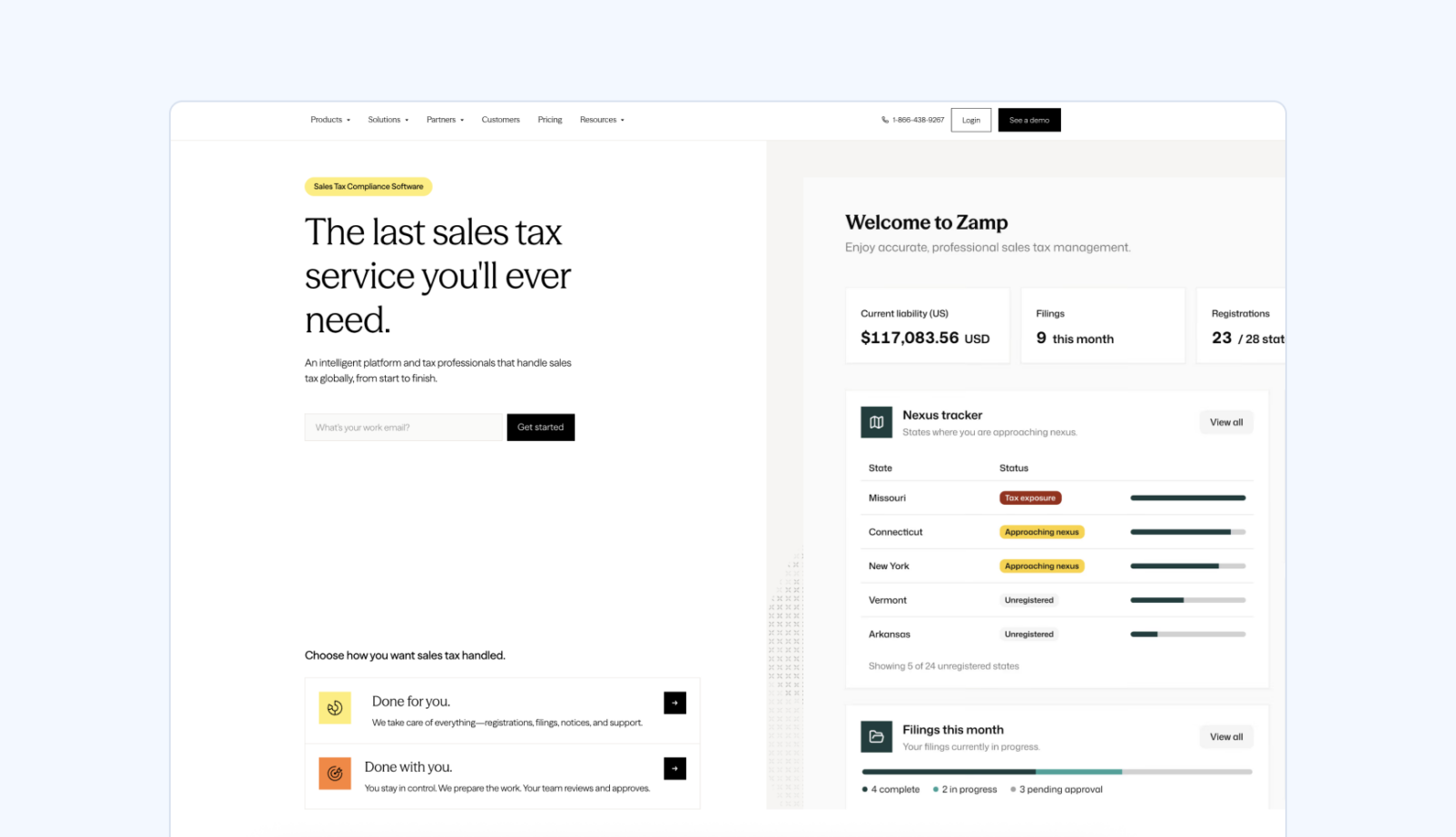
Zamp is a managed compliance platform built by former TaxJar employees. It combines automated calculations with managed filing and hands-on onboarding, positioned as a “set it and forget it” solution.
Key features
- Fully managed filing across the US.
- Nexus monitoring and threshold alerts.
- Multi-channel integrations with Shopify, Amazon, BigCommerce, NetSuite, and QuickBooks.
- Dedicated onboarding specialist.
Pricing
Zamp does not publish pricing. The pricing page shows a Free plan for nexus and taxability assessments, while pricing for its U.S. and U.S. + Canada plans is customized based on each business’s compliance needs. Its U.S. plan includes tax calculations, ongoing nexus monitoring, registrations, filing and remittance, notice management, and access to sales tax experts.
Strengths
Strong ecommerce integrations. Hands-on onboarding experience.
Limitations
No public pricing makes comparison difficult. Primarily focused on ecommerce verticals.
4. Avalara

Best for
Large global enterprises with complex ERP environments and dedicated tax staff.
Avalara is an enterprise sales tax platform that provides automated rate calculations across thousands of U.S. and international jurisdictions with deep ERP integrations. As the largest and most established provider in the market, it serves companies with complex, multi-entity, and global tax compliance needs.
Key features
- Automated tax calculations across 12,000+ US and international jurisdictions.
- 1,200+ pre-built integrations, including deep ERP connectors for SAP, Microsoft Dynamics, and NetSuite.
- Exemption certificate management.
- Global indirect tax coverage (VAT, GST).
Pricing
Avalara does not publish pricing. Plans are quote-based and typically involve annual contracts. Filing, registration, and managed services are often billed separately.
Strengths
Unmatched integration library. Global coverage. The default choice for enterprise and mid-market companies with complex, multi-entity tax environments.
Limitations
Expensive, especially when filing and support services are included. Setup is complex and time-consuming. Support is outsourced and impersonal at lower tiers. Annual contracts with limited flexibility.
5. Vertex

Best for
Enterprise companies with complex ERP setups running SAP, Oracle, or Salesforce.
Vertex O Series is an enterprise tax determination platform that provides real-time tax calculations for complex, multi-entity businesses with deep ERP integrations. It supports indirect tax calculations across multiple jurisdictions and countries, making it ideal for multinational organizations.
Key features
- Native integrations with SAP, Oracle, and Salesforce.
- Real-time tax calculations for complex, multi-entity structures.
- Automated returns via the Vertex Returns module.
- Global indirect tax content updates.
Pricing
Vertex does not publish pricing. Enterprise contracts typically require significant implementation investment and often involve third-party consultants. Onboarding can span multiple quarters.
More about Vertex pricing:
Strengths
The deepest ERP integration in the category. Strong for multinational businesses with global indirect tax needs. Comprehensive audit reporting.
Limitations
Requires IT and development resources and dedicated consultants to implement. No managed filing by default. Cost and complexity put it out of reach for most growing mid-market businesses.
6. Sovos

Best for
Large enterprises with in-house tax teams and cross-border compliance needs.
Sovos is a global tax compliance platform that covers sales tax, VAT, e-invoicing, and 1099 reporting. It serves companies whose compliance requirements extend well beyond US multi-state sales tax.
Key features
- End-to-end US sales and use tax compliance with multi-state filing.
- Global VAT, GST, and e-invoicing modules.
- 1099 and information reporting.
- Continuous transaction controls for regulated markets.
Pricing
Sovos pricing is custom and quote-based. It varies by product module, transaction volume, and geographic scope. No standard pricing is published.
More about Sovos (Taxify) pricing:
Strengths
Comprehensive global compliance coverage. Regulated industry expertise. Managed services team that prepares and files returns.
Limitations
Complex onboarding. Designed for enterprise scale. No public pricing at any tier.
7. Numeral

Best for
Small sellers selling in a few states who prefer usage-based pricing.
Numeral is a newer sales tax platform with usage-based pricing. It positions itself as a modern alternative to legacy providers, with a focus on growing ecommerce and SaaS brands.
Key features
- Managed filing across US states.
- State registration handling.
- Nexus monitoring in all 50 states.
- Integrations with Shopify, Amazon, QuickBooks Online, and others.
Pricing
Numeral lists $75 per filing and $150 per registration.
Strengths
Usage-based model means you only pay for what you use. Modern interface.
Limitations
Per-filing costs add up quickly once you file in more than a few states. At 10 or more states, the math often favors subscription models with SST access. Shopify App Store rating is 3.7 as of July 2026, with recent reviews reporting issues.
8. Kintsugi
Best for
Startups that want quick setup with a heavily automated compliance workflow.
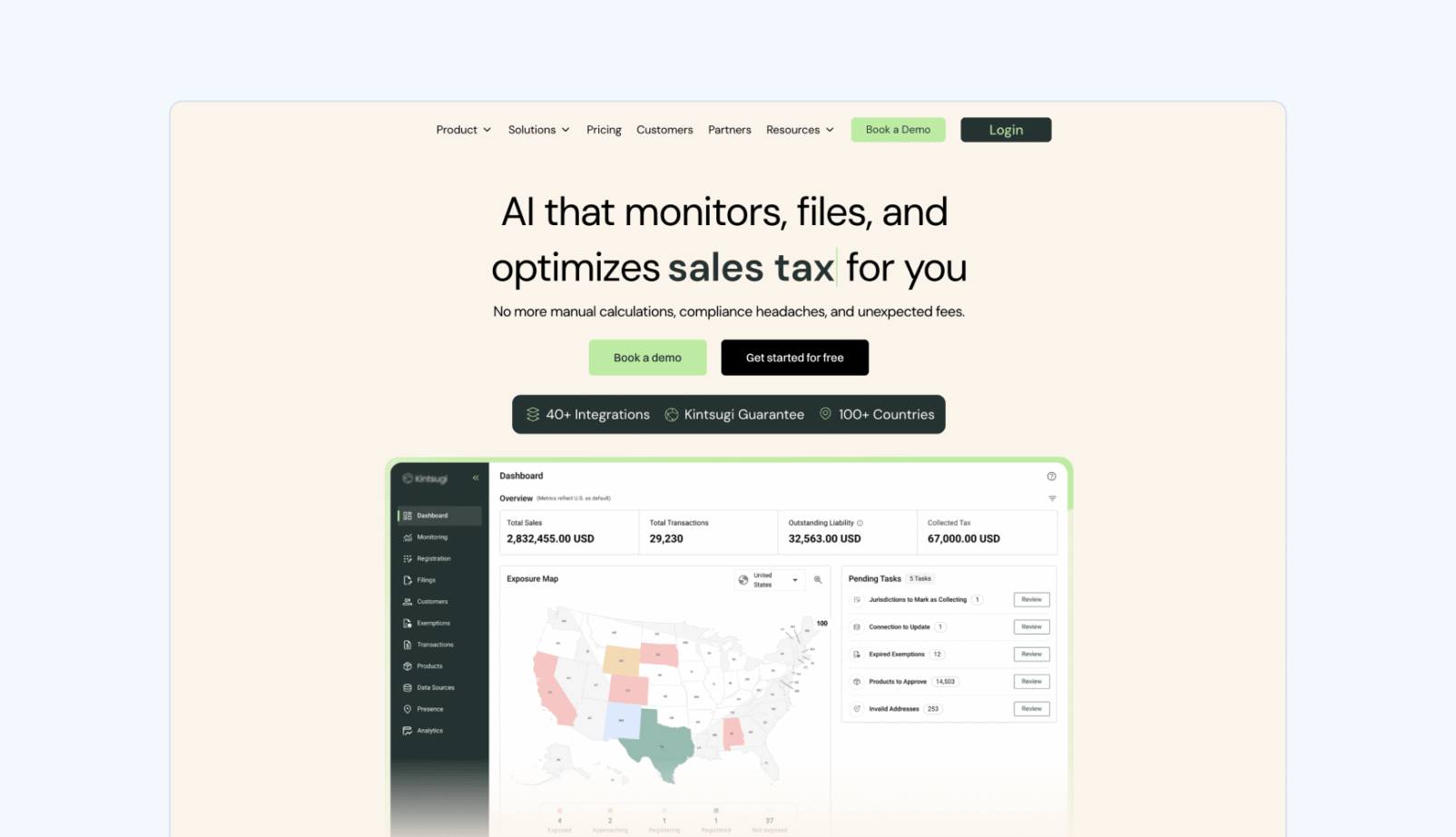
Kintsugi positions itself as an automation AI-first sales tax platform, emphasizing full automation from nexus tracking to filing.
Key features
- Automated nexus detection and registration.
- Tax calculation and filing.
- Automated product classification.
- Integrations with Shopify, Stripe, QuickBooks, and others.
Pricing
Kintsugi pricing starts at $75 per filing and $75 per registration.
Strengths
Heavily automated.
Limitations
Automation-first means less human oversight. There have been customer reports of the platform auto-registering businesses in states where registration was not needed. Not an SST Certified Service Provider.
9. Anrok

Best for
Well-funded SaaS and startup companies selling subscriptions and digital products.
Anrok is a sales tax platform purpose-built for SaaS businesses. It focuses on product taxability classification for digital goods and integrates natively with the billing platforms modern software companies use most.
Key features
- SaaS-specific product taxability determination.
- Real-time calculations across US jurisdictions.
- Native integrations with Stripe Billing and Chargebee.
- Economic nexus monitoring.
Pricing
Anrok pricing is quote-based. A Startup plan starts at approximately $399/month for businesses with ARR under $5 million. Beyond that threshold, pricing shifts to a percentage-of-revenue model, which means compliance costs grow alongside your top line.
Strengths
Built specifically for SaaS product types. Clean billing platform integrations. Modern interface.
Limitations
Very narrow industry focus. Limited for ecommerce, manufacturing, or wholesale. Customers file their own returns. Revenue-based pricing above the startup tier can erode margins as you scale.
10. Stripe Tax
Best for
Businesses that need to start fast with a no-code tax solution on Stripe.
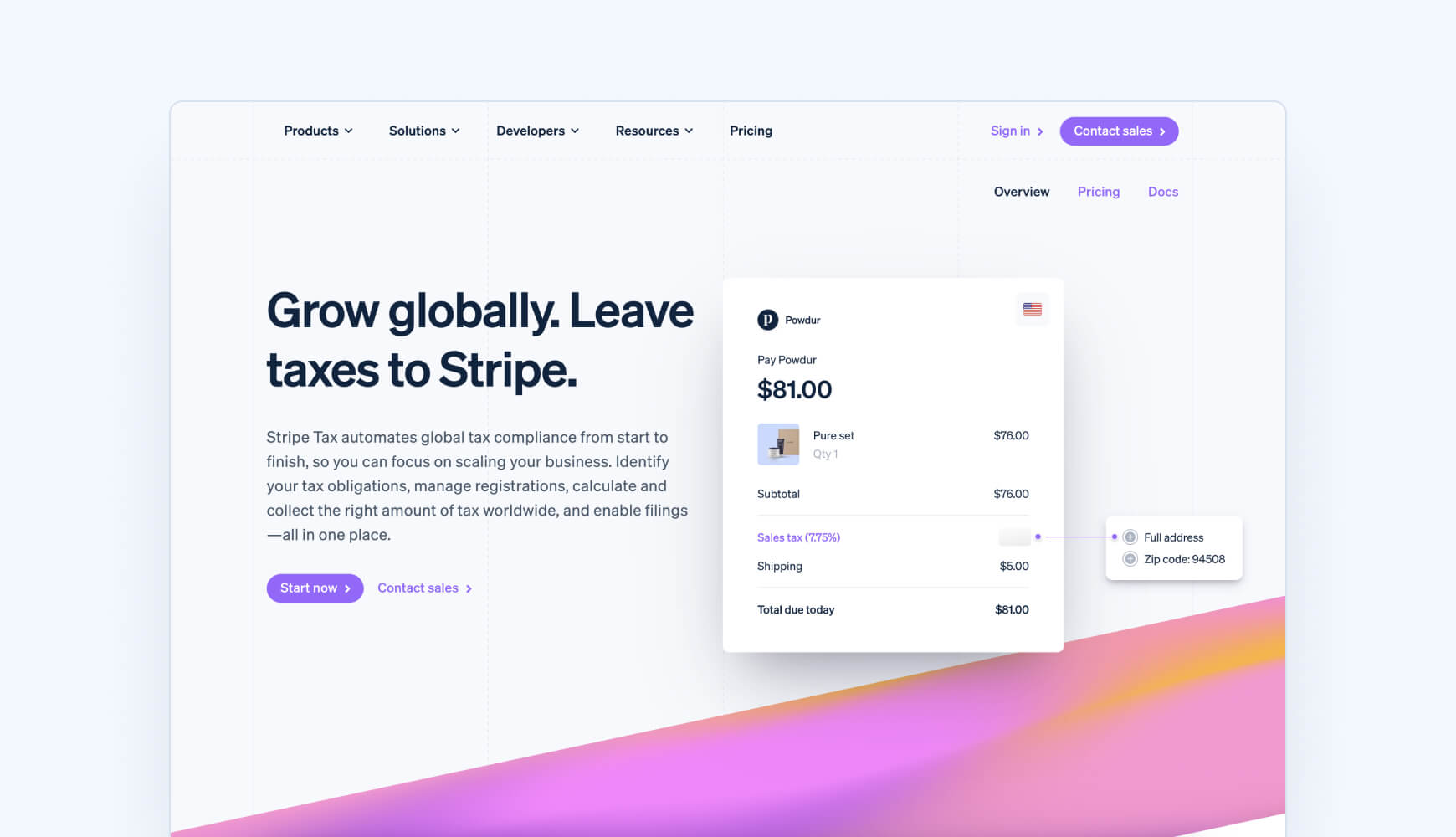
Stripe Tax is a built-in feature of the Stripe payments platform. It adds sales tax calculation to your existing Stripe integration with a few lines of code or a dashboard toggle.
Key features
- Automatic tax calculation at checkout for Stripe transactions.
- Tax reporting dashboard within Stripe.
- Nexus monitoring for Stripe transactions.
- Coverage across US and international jurisdictions.
Pricing
- Stripe Tax Basic uses pay-as-you-go pricing, charging 0.5% per transaction with a no-code integration or $0.50 per transaction with an API integration.
- Stripe Tax Complete starts at $90/month and includes 200 transactions per month, with plans scaling up to $1,500/month or custom pricing.
Strengths
Fastest setup for Stripe users. No separate platform to manage. Handles both US and international tax.
Limitations
Stripe Tax is primarily built around tax calculation and collection within Stripe. For additional compliance needs, including filing, Stripe offers a marketplace of partner services. This means businesses may need to work with separate providers to manage different parts of their sales tax compliance rather than having everything handled through one service. Multi-channel businesses may also need to account for transactions happening outside of Stripe.
11. Shopify Tax

Best for
Shopify sellers who need basic tax collection with no additional cost.
Shopify Tax is built into every Shopify plan. It handles sales tax calculation at checkout for Shopify stores, including rooftop-level accuracy in the US.
Key features
- Automatic tax calculation at Shopify checkout.
- Product categorization for taxability.
- Sales tax liability reporting.
- Economic nexus monitoring.
Pricing
Shopify Tax is free for the first $100,000 in annual sales. After that, it charges 0.35% per transaction, or 0.25% for Shopify Plus, capped at $0.99 per order and $5,000 per year per region.
Strengths
Zero setup for Shopify merchants. No additional subscription. Accurate US rates built in.
Limitations
Calculation only. No filing, no registration, no remittance. You need a separate service to handle everything after checkout. Only covers Shopify transactions. No human support for tax questions.
How to choose the right sales tax software for your setup
There is no single best tool for every business. Here is how to narrow the field:
If you are on Shopify and file in fewer than 5 states, start with Shopify Tax for calculation and evaluate TaxCloud or Numeral for filing as your footprint grows.
If you’re a growing ecommerce business filing in 5 to 50 states, the decision is usually between platforms built specifically for growing mid-market businesses, like TaxCloud, and well-known providers like TaxJar. TaxCloud’s SST access provides a significant structural cost advantage: eligible businesses pay $0 to file in 24 SST states, while filing in the remaining states starts at $39 per return.
If you are a SaaS company on Stripe or Chargebee, evaluate TaxCloud or Anrok. All two handle digital goods taxability.
If you are an enterprise with SAP or Oracle, the realistic options are Vertex and Avalara. Both offer the deep ERP integration and global coverage that enterprise tax teams require.
If cost is the primary concern, keep the SST program in mind, as it can be one of the best ways to reduce sales tax compliance costs for eligible businesses. Also compare how volume discounts work across different providers to make sure you’re not going to overpay as your business grows. Look for discounts that are publicly mentioned on the pricing pages and easy to understand, and consider whether the platform offers a free trial. Some providers may effectively give you your first month free, which reduce the initial cost of getting started.
Why ecommerce businesses choose TaxCloud
Sales tax doesn’t have to be painful. The right system makes compliance predictable.
TaxCloud brings everything together — calculation, nexus tracking, filing, and remittance — on one platform backed by automation and fast, U.S.-based support. It’s designed for multi-channel sellers who want reliable compliance without the admin drag.
As a Certified Service Provider in the Streamlined Sales Tax program, TaxCloud also offers free filing in participating states, cutting both cost and complexity.
Make ecommerce sales tax simple and predictable
Sales tax gets harder as you add new states, products, and channels. TaxCloud brings everything into one system for ecommerce sellers. Start your free 30-day trial or talk to our team for a walkthrough tailored to your store.
Ecommerce sales tax software — FAQs
The reality is that there isn’t really a fully free sales tax compliance solution for ecommerce businesses. Sales tax software requires a tax calculation engine that needs to stay up to date as rates and rules change, along with the infrastructure needed to support registrations, filings, remittance, and other compliance work.
That said, there are a few ways ecommerce businesses can get started without paying upfront.
TaxCloud, for example, offers a 30-day free trial, so businesses can test the platform and see if it’s the right fit before committing. TaxCloud is also a Certified Service Provider (CSP) under the Streamlined Sales Tax (SST) program. Eligible businesses can have free registration, calculation, filing, and remittance services in the 24 SST member states.
There are also native ecommerce and payment solutions that include some sales tax functionality. Shopify Tax, for example, is free for the first $100,000 in global sales each calendar year before transaction-based fees apply. However, its core tax service is primarily focused on calculating and collecting sales tax. Filing and remittance are separate from that free allowance.
So while you’re unlikely to find a completely free solution that handles sales tax compliance from start to finish, free trials, native calculation tools, and programs like SST can significantly reduce the cost of getting started.
No, most ecommerce platforms only calculate and collect sales tax at checkout.
Shopify, WooCommerce, and BigCommerce can charge the correct rate to customers, but sellers are still responsible for registering, filing, and remitting taxes in each state where they have nexus.
Because sales data is often spread across multiple channels, tracking nexus can be messy. A platform like TaxCloud consolidates all your sales data in one place so your obligations stay clear and filings stay accurate.
Use your ecommerce platform’s built-in tax calculator or connect a dedicated sales tax service. For example, TaxCloud integrates with Shopify to use its existing tax calculation engine while handling filing and remittance automatically. The key is choosing a setup that updates rates automatically so you’re always charging the correct amount.
Pricing models vary widely. TaxCloud starts at $19/month with filing from $39/return. TaxJar starts at $39/month plus $50 to $55 per state filing. Numeral charges approximately $75 per filing with no subscription. Stripe Tax charges 0.5% per transaction. Enterprise tools like Avalara and Vertex are quote-based and typically involve annual contracts.
Yes. Most sales tax platforms automatically monitor your total revenue and transaction count across all connected channels and notify you when you cross a state’s economic nexus threshold. Once triggered, you’ll need to register, collect, and file in that state. Filing frequency and requirements vary, so look for software that automates reminders or filings.
It depends on your current platform. Some restrict access after cancellation, while others allow exports of filings, reports, and exemption certificates before or shortly after your account ends.
When migrating, your new provider can usually import past data to maintain compliance continuity. Overlapping subscriptions by a few weeks helps ensure a smooth transition and prevents data loss.
For details, see our migration guides for Avalara and TaxJar.