Looking for Avalara alternatives?



Key takeaways
- Avalara supports complex, multi-entity and global tax environments, which is far more than what most mid-market, U.S. focused brands actually need.
- High costs and lack of accessible support are regular complaints from Avalara customers and common reasons why companies depart from the brand.
- TaxCloud is the best Avalara alternative for mid-market ecommerce and SaaS businesses.
Avalara is one of the most recognized names in sales tax automation. The platform offers global coverage solutions and configurable compliance options built to support complex tax requirements.
However, not every business needs enterprise-grade tax infrastructure.
In fact, most don’t. Mid-market brands — especially those in ecommerce and SaaS spaces — often find that Avalara’s pricing model, implementation requirements, and operational expectations don’t align well with their own business models.
That’s doubly true for teams focused primarily on U.S. sales tax compliance. The right alternative delivers automation, predictable pricing, and accessible support without requiring a dedicated tax department or on-site deployment solution.
In this article, we’ll break down 11 leading Avalara alternatives and outline which platforms might be a good fit based on scope, cost, and complexity.
Let’s hop in.
Note: While creating this article, the featured tools were researched by our writers and verified by our in-house team. We manually reviewed documentation, pricing, and feature details to fully understand Avalara, its competitors, and the complexities related to its platform.
The data, information, and claims presented below are a result of that research and are accurate, to the best of our knowledge and capability.
Why users leave Avalara
In the vast majority of cases, Avalara users don’t leave because the software lacks in capabilities. They leave because issues like pricing, support, or implementation no longer match their internal capacity. Complaints about Avalara reflect these common grievances.
Below, we’ve added the most common pain points, as well as a few alternatives that specialize in resolving that specific issue.
| Avalara pain point | What’s missing | Best-fit alternatives |
|---|---|---|
| Pricing pressure & rising costs | Predictable pricing | TaxCloud, Numeral, Kintsugi |
| International support for digital-only services | Multi-country VAT/GST automation | Anrok, Stripe Tax |
| Limited support | Access to responsive, human-powered support | TaxCloud, TaxValet, Zamp |
| Prefer managed services | Fully managed filing and audit support | TaxValet, Zamp |
| Implementation problems | Faster deployment with less configuration | TaxCloud, TaxJar, Kintsugi |
| Different enterprise features required | Additional enterprise-grade configurability | Vertex, Sovos |
| Paying for unused or enterprise features | Right-sized compliance scope | TaxCloud, TaxJar |
| Failing to leverage SST savings | SST enrollment expertise | TaxCloud |
When facing compliance challenges, no two businesses are alike.
Keep in mind that the best alternative will depend on factors like geographic footprint, availability of internal expertise, what level of operational oversight you need, and more.
1. TaxCloud
Best Avalara alternative for mid-market brands.

- Perfect for: Mid-market, U.S.-based ecommerce and SaaS brands.
- Plans: Starter ($199/annually) or Premium ($799/annually). Monthly plans available (16% discount when paying annually). Costs scale with usage. Additional services available for purchase as needed.
- Regional focus: U.S. and Canada.
- Filing support type: Automated filing with optional managed services. Starting at $39/per return, goes down to $25.
- Support options: Email, phone (U.S.-based).
- Implementation difficulty: Low to moderate, depending on setup, clear migration documentation.
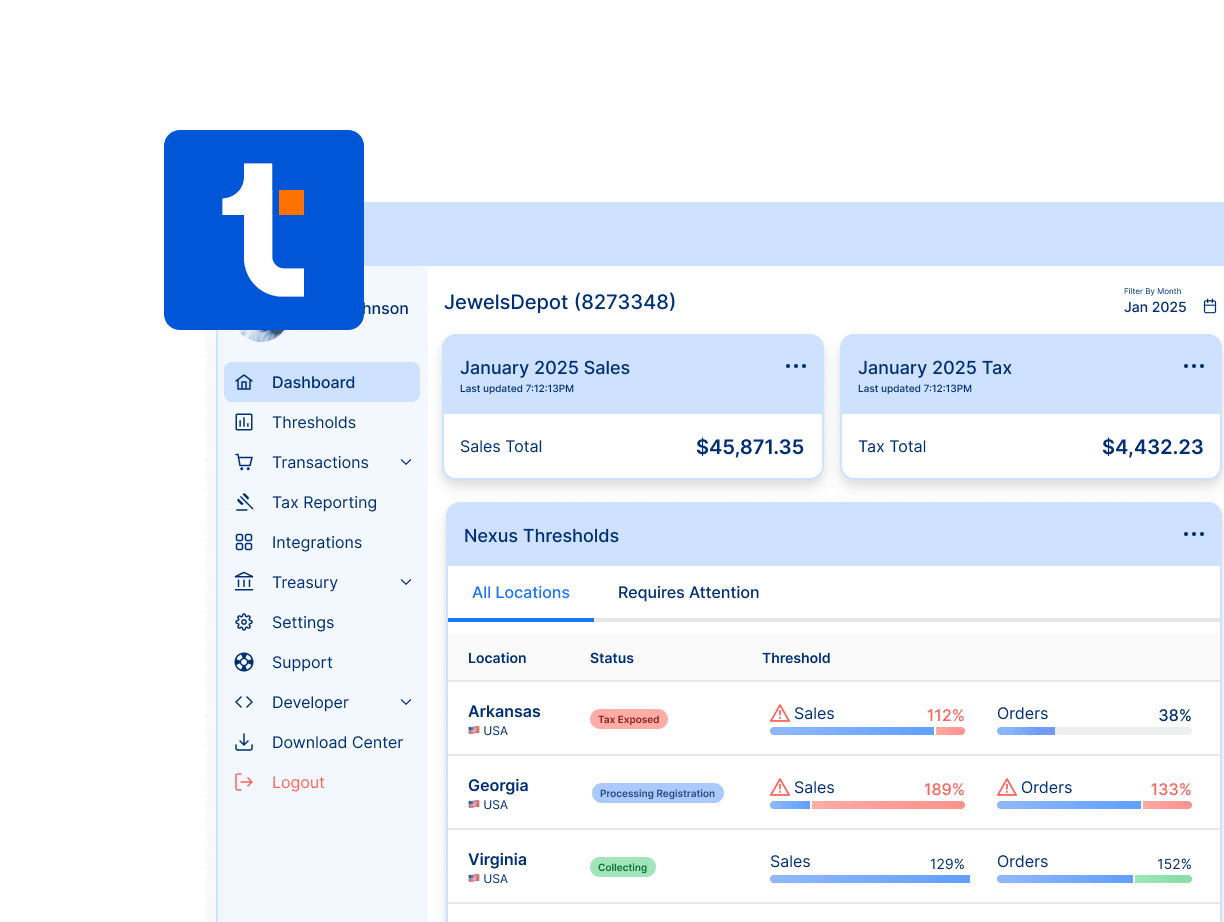
TaxCloud delivers automated sales tax compliance for mid-sized businesses that want tax handled in the background rather than managed as a formal operational function. The platform supports U.S. sales tax calculation, filing, and actively onboards users to the Streamlined Sales Tax program to save costs and ease tax burdens.
Compared to Avalara, which is structured to support complex multinational compliance, TaxCloud is intentionally built to fit mid-sized companies. With TaxCloud, focus is shifted toward the U.S. market and automation designed to reduce the need for ongoing system oversight or consultant-heavy configuration and setup.
Especially for brands without dedicated tax departments, TaxCloud offers a flexible toolkit and transparent pricing that helps brands keep compliance aligned with cost. Combined with human-powered support, a dedicated team of experts, and optional audit defense, TaxCloud is the right fit for teams seeking a scalable, long-term compliance solution.
Key benefits
- Transparent, predictable pricing. TaxCloud publishes its pricing publicly and scales costs based on usage rather than negotiated enterprise packages. Core functionality (calculation, filing, integrations, etc.) is bundled into each plan, and pay-as-you-use costs are clearly marked to prevent surprises.
- Mid-market focus by design. Unlike Avalara and other enterprise platforms, which often need to “scale down” in order to accommodate smaller brands, TaxCloud is designed specifically for growing, mid-market ecommerce and SaaS companies.
- Automatic enrollment in the SST program. TaxCloud is one of only a few Certified Service Providers in the Streamlined Sales Tax program, meaning that TaxCloud can enroll qualified customers and pass the savings from those filing costs on to you. This is something that other SST providers, like Avalara, regularly fail to do.
Notable drawbacks
- No global VAT/GST coverage. TaxCloud is primarily focused on the U.S. market (with support for Canada). Businesses requiring multi-country VAT, GST, or cross-border compliance infrastructure may need a more globally accessible platform.
- Limited enterprise-grade customization. While integrations and API access are available, TaxCloud isn’t designed for deeply customized ERP deployments or highly granular rules configuration that are commonly seen in complex enterprise integrations.
- Not built for dedicated tax departments. TaxCloud aims to automate the majority of sales tax compliance so that users can focus on other issues. Organizations with in-house tax teams seeking advanced governance controls or complex reporting frameworks — who want to use TaxCloud as a supplement to their own workflow — are likely to find better fits in enterprise grade solutions like Avalara, Vertex, or Sovos.
What customers say
We paid around $25 to $30k for TaxCloud, compared to $100 to $150k with Avalara. The pricing difference is huge, and it’s a relief to move away from the endless negotiations just to get a decent price.

Why switch to TaxCloud?
TaxCloud has 15+ years of experience building sales tax software that supports ecommerce companies. Here are a few great reasons to switch:
- Calculates sales tax rates in over 13,000+ US jurisdictions
- On average, 30% cheaper pricing after switching
- A better fit for SMB that sell in the US
- No lock-in and transparent pricing
- Customer support from real humans, based in the U.S.
- Support for the Streamlined Sales Tax Program from a Certified Provider
Get a more in-depth breakdown of TaxCloud vs Avalara.
Make the switch today
Changing sales tax providers is easy with TaxCloud. Simple setup. Lower pricing. Better support. No fixed contracts.
2. Vertex
Enterprise-grade tax infrastructure for complex global operations.

- Perfect for: Enterprise brands with niche and multi-entity tax structures.
- Plans: Custom solution. Pricing based on transaction volume, integrations, and scope.
- Regional focus: Global.
- Filing support type: Automated tax calculation engine with managed filing options.
- Support options: Enterprise support plans, account management, and consulting services.
- Implementation difficulty: Complex; typically requires integration resources and ongoing configuration.
Vertex is an enterprise-grade tax technology platform designed to support multinational corporations with complex regulatory requirements. The company has deep roots in corporate tax infrastructure and provides automated calculation, reporting, and compliance tools for sales tax, VAT, and other indirect tax categories. As a platform, Vertex is most commonly implemented within large ERP ecosystems and finance-driven environments, often in conjunction with in-house teams to support its implementation.
Like Avalara, Vertex operates primarily at the enterprise level, but usually with a more finance-centric or ERP-integrated focus. Where Avalara emphasizes broad integrations and scalable compliance cloud solutions, Vertex sees regular deployment into systems like SAP, Oracle, and Microsoft 365, where it integrates closely with financial, sales, and manufacturing tech stacks.
While these features are ideal for major corporations, mid-market brands are likely to encounter similar challenges to those experienced with Avalara. Vertex is built for large, complex enterprise systems and companies with dedicated tax departments, legal teams, and a global footprint. The company does offer some mid-sized solutions targeted at SaaS and ecommerce brands, but this isn’t the company’s primary focus. That, combined with the modularity of their product line can generate high costs for unsuspecting customers.
Key benefits
- Deep enterprise integrations. Vertex integrates directly with major ERP systems like SAP and Oracle, allowing tax calculation and reporting to operate natively as part of complex operational workflows.
- Advanced rule configurability. The platform offers granular tax rule configuration and customization, making it suitable for organizations handling complex compliance requirements or entities that have split themselves across multiple corporate entities.
- Global compliance coverage. Vertex supports indirect tax solutions across multiple countries, including VAT and GST, making it a viable option for multinational organizations with a global footprint.
Notable drawbacks
- Lengthy implementation timelines. Because Vertex is usually deployed within an ERP or similar system, implementation can take months and may require ongoing maintenance for technicians and experts as tax rules and configurations evolve.
- Higher cost structure. Pricing is generally aligned with other enterprise solutions and, like Avalara, is based around transaction volume. Costs may increase as additional modules, integrations, and service layers are added in.
- May require dedicated internal tax expertise. As with many enterprise tax brands, Vertex’s requirements toward active oversight can make it less practical for organizations who lack those specialized resources.
3. Sovos
Comprehensive compliance platform for multi-jurisdictional businesses.

- Perfect for: Mid-to-enterprise organizations managing multi-jurisdictional compliance.
- Plans: Public pricing unavailable. Custom pricing based on product models and service levels.
- Regional focus: Global.
- Filing support type: Automated filing or managed services.
- Support options: Service teams and account management (depends on plan).
- Implementation difficulty: Moderate to high, depending on scope.
Sovos is a global compliance platform built to help organizations manage indirect tax, regulatory reporting, and statutory compliance obligations in multi-jurisdiction scenarios. In addition to taxes, Sovos also offers a collection of specialty products to assist with compliance in other areas, such as alcohol compliance and regulations around unclaimed property.
Similar to both Avalara and Vertex, Sovos operates at the enterprise and upper mid-market levels, giving brands access to solutions that can manage global tax compliance in a wide variety of setups and configurations. However, Sovos places an emphasis on regulatory reporting and managed services. That, combined with its tax calculation engine and indirect tax modules make it a favorable compliance partner for brands with niche tax needs.
However, like its main competitors, Sovos is equipped with a kitchen sink of features that might be too expensive or too complex for brands that aren’t large enough to need them. The company does offer solutions for growing businesses, but these solutions are scaled down and many of the key features that Sovos is known for may not be included in those packages and plans.
Key benefits
- Strong regulatory coverage. Sovos supports a wide range of compliance requirements, including VAT, GST, e-invoicing, and statutory reporting.
- Managed compliance options. In addition to automation tools, Sovos can supplement in-house tax teams with structured filing and advisory services, reducing compliance burdens through a mix of automation and additional manpower.
- Global footprint. As a platform, Sovos has a presence in many major countries and maintains a deep understanding of the compliance landscape in most regions. For teams with a global footprint or who are struggling due to broad compliance issues, a local presence in a given region can be a great advantage.
Notable drawbacks
- Complex pricing. As with many major tax brands, Sovos only offers pricing through customized enterprise agreements. Final costs are based on scope and service level.
- Heavier onboarding process. Implementation can require coordination across finance, tax, and IT teams, especially in multinational deployments. Bringing all required systems online can take weeks or months.
- May exceed the needs of U.S. focused sellers. Especially for brands selling primarily in the United States, Sovos’ broad regulatory infrastructure may introduce additional costs and complexity where it isn’t needed.
4. Anrok
Purpose-built tax compliance for global SaaS companies.

- Perfect for: SaaS companies selling digital products into global markets.
- Plans: No public pricing available. Custom plans require enterprise consultation.
- Regional focus: Global.
- Filing support type: Automated compliance with managed filing support.
- Support options: Email and account management options.
- Implementation difficulty: Moderate.
Anrok provides automated sales tax and VAT compliance tailored specifically to high-growth SaaS companies. Although the platform offers many of the same features seen with Avalara and other brands (tax calculation, e-invoicing, etc.), Anrok stands out for its ability to offer global coverage from day one and its natural compatibility with subscription-based software providers.
Just like Avalara, Anrok supports international tax regimes and automated filing workflows. However, Anrok positions itself in a narrower lane by building tools specifically for SaaS while Avalara serves a much broader market. This approach will appeal to digital-first brands — especially new startups — as the platform offers a set of tools calibrated specifically for their interests.
All that said, Anrok is built with that global-first initiative in mind. If a company is selling primarily in the United States, the platform’s pricing structure and international orientation may far exceed what users need. Brands without significant sales and exposure abroad will end up paying for features that aren’t necessary to achieve compliance.
Key benefits
- Built specifically for SaaS tax models. Anrok is designed around subscription billing, digital goods taxability, and usage-based pricing structure common to SaaS companies. This will put it head-and-shoulders above services like Stripe Tax, which offers a tax engine but no real specialization.
- Handles digital goods VAT/GST. The platform helps manage international compliance obligations, including digital services taxes and cross-border VAT requirements.
- Strong nexus tracking. Brands can use real-time nexus monitoring to get a sense of their tax obligations in the moment and use automated workflow to mitigate that risk.
Notable drawbacks
- Higher starting price. While Anrok’s plan costs are hidden, their specialized plan for startups starts at $400/month. Previous, publicly available pricing listed their entry-level plans at $499/month, climbing to well over $1,000/month for a mid-tier subscription.
- Narrower fit outside SaaS. Even though Anrok could be used by many brands outside of its niche, it quickly becomes a poor fit outside of the SaaS / digital goods space. Brands who don’t need that specific toolkit will find other platforms to be a better fit.
- May be excessive for U.S.-only sellers. Brands without international exposure or digital subscription models won’t have an immediate need for Anrok’s global infrastructure and will be effectively paying for monitoring that they won’t use.
5. Numeral
Filing-focused solution for brands seeking tax simplicity.
- Perfect for: Ecommerce brands seeking filing-focused support.
- Plans: Cost based on filing ($75/filing) and registration ($150/state).
- Regional focus: Global, but with a U.S. focus.
- Filing support type: Managed filing (state-by-state options).
- Support options: Email.
- Implementation difficulty: Low.
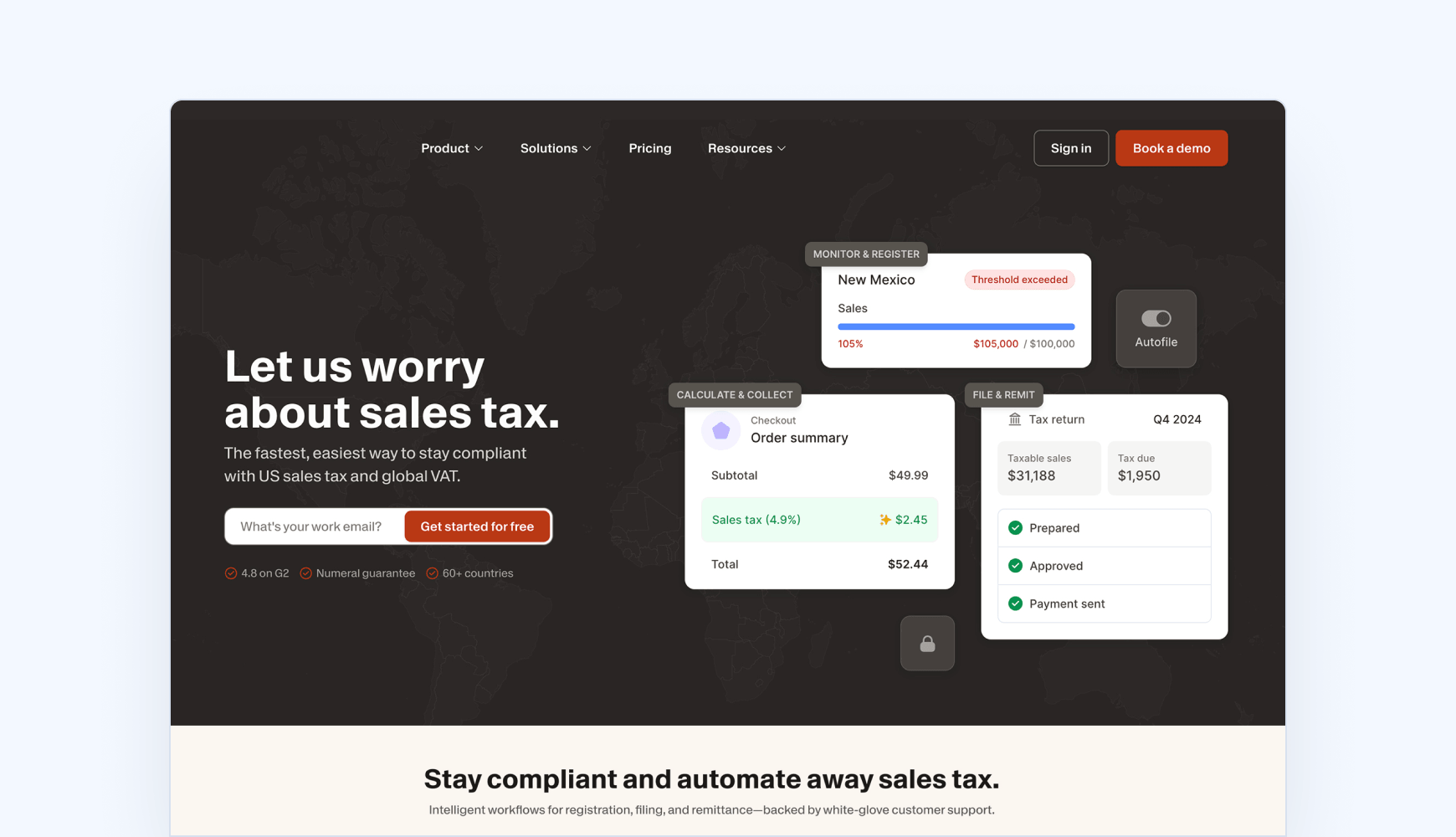
Originally a U.S. only brand, Numeral has worked hard in recent years to push its offering onto the global stage. As a solution, the platform is less invested in the configurability users will find in enterprise-level solutions and more interested in creating a streamlined workflow for tax compliance. To that end, Numeral tries to help brands calculate, file, and remit taxes without the need to deploy a heavily customized solution.
However, this approach comes with a tradeoff. Compared to Avalara, Numeral’s operational scope is much smaller. Avalara provides a broad compliance cloud with layered modules and enterprise integrations. Numeral emphasizes streamlined filing workflows, simplified onboarding, and easy-to-understand pricing.
While this approach makes Numeral appealing to ecommerce and digital brands expanding into new states or countries, the solution can fall short if additional configurability is needed. However, the simplicity of the platform makes it a great choice, especially for smaller brands with a minimal tax footprint.
Key benefits
- Simple filing-based pricing. Numeral structures its pricing around state filings and registrations, which offers cost clarity and predictable pricing that brands like Avalara simply don’t provide.
- Low operational overhead. Because Numeral handles filing and remittance directly, the platform removes much of the administrative workload associated with multi-state compliance.
- Fast onboarding. As a compliance solution, Numeral aims for fast setup and simplified workflows, making it accessible to ecommerce teams without dedicated tax departments.
Notable drawbacks
- Costs increase with many filing states. As filing obligations grow, Numeral’s costs rise exponentially. At $75 per filing over 30 states, brands will pay $2,250/month in filing costs. As companies grow, brands with lower filing costs will eclipse Numeral’s offering by providing similar services at a lower effective cost.
- Limited advanced integrations. Numeral offers roughly 20 integrations, most of which connect to larger billing and ecommerce platforms like NetSuite or Shopify. For brands operating in niche marketplaces, API integrations may be the only way to integrate with Numeral.
- Less robust for complex product taxability. Because Numeral emphasizes simplicity, the platform makes sacrifices where complexity is concerned. Brands that need to adhere to situational or complicated taxability rules will have a difficult time aligning Numeral with those needs.
6. TaxJar
Ecommerce-native sales tax automation; backed by Stripe.

- Perfect for: Small- to mid-sized ecommerce brands.
- Plans: Pricing based on order volume. Plans start at $19/month (Starter) or $99/month (Professional).
- Regional focus: U.S.
- Filing support type: Autofile.
- Support options: Email, limited chat.
- Implementation difficulty: Low.
TaxJar provides automated sales tax calculation and filing tools tailored to ecommerce businesses. As part of the broader Stripe ecosystem, the platform integrates well with most modern digital payment and commerce stacks, making activation relatively straightforward for online sellers.
When compared to Avalara, however, TaxJar is much smaller and far more limited in scope. The platform focuses primarily on ecommerce workflows within the U.S. and lacks the ability to scale into the complex compliance roles required by enterprise and larger mid-market brands. For smaller businesses who don’t need that level of depth, it’s a practical alternative with filing costs that won’t break the bank.
However, in addition to a narrow scope, TaxJar also suffers from uncertainty around future development. The platform was acquired by Stripe in 2021, and development since then has largely stalled. Stripe also owns Stripe Tax — targeted at brands on the Stripe platform — while TaxJar is aimed at businesses using other payment processors. Despite this distinction, the two Stripe-owned platforms essentially overlap in every other aspect, which brings TaxJar’s viability into question as a long-term solution.
Key benefits
- Strong ecommerce integrations. TaxJar integrates directly with major ecommerce platforms and marketplaces, including Shopify and Magento, allowing sales tax calculation and reporting to run natively within common online selling environments in a plug-and-play capacity.
- Clean user interface. The TaxJar interface is clean, simple, and easy to understand, without the hard-to-find features hidden deep in Avalara’s nested menus. As a whole, the simplicity makes the platform more accessible to users.
- Backed by Stripe. TaxJar’s AutoFile service can reduce administrative workloads by handling state-level filing and remittance, so brands can stay compliant without the need for manual reporting.
Notable drawbacks
- Future development unclear. Since its acquisition by Stripe, TaxJar’s development has mostly stalled. While the platform is still maintained, it hasn’t added any new features or expanded in any meaningful way in roughly half a decade. Because TaxJar overlaps so heavily with Stripe Tax, it’s unclear whether Stripe will keep both platforms available or eventually consolidate them into a single solution.
- Fewer enterprise controls. While TaxJar offers an approachable solution for smaller brands, it lacks the ability to handle highly customized tax logic. The platform isn’t readily equipped for advanced governance controls or the ERP-native deployments required by larger organizations.
- Pricing scales drastically with transaction volume. TaxJar’s pricing starts at $19/month for 200 transactions and scales quickly from there. Users also need to pay for additional filings at $35/return, because the Professional Plan only offers 12 free filing credits per year.
7. Quaderno
VAT and digital tax compliance for global online businesses.

- Perfect for: Digital brands needing VAT/GST compliance.
- Plans: Transaction and jurisdiction-based. Plans start at 25 transactions and 1 jurisdiction for $29/month.
- Regional focus: Global.
- Filing support type: Automated filing.
- Support options: Email.
- Implementation difficulty: Moderate.
Quaderno delivers automated VAT and sales tax compliance for businesses operating internationally. The platform places a heavy emphasis on transparent pricing and monthly contracts, so users can pick a solution that makes the most sense for them and gain a clear understanding of costs early and without any additional red tape. Overall, Quaderno is an approachable platform and a strong option for small- to medium-sized brands.
Compared to Avalara, Quaderno emphasizes a human touch and pay-as-you-go terms that don’t lock users into lengthy contracts. Quaderno is more straightforward in what it offers, featuring unlimited integrations and user seats, as well as international deployment options, but the platform lacks the ability to offer compliance at the level of Avalara’s custom configurations. (To be fair, only another enterprise solution could do that anyway.)
One notable factor for Quaderno is its relatively low threshold for enterprise pricing. Transaction volume is the only metric that Quanderno uses to scale its plans, and anything about 2,500 transactions per month merits an enterprise configuration. Filing is also handled as an add-on, not an included service, so users should expect to pay more for that functionality.
Key benefits
- Multi-country VAT/GST handling. Quaderno helps brands calculate and manage tax obligations at a global scale, including the U.S., but the company is primarily VAT/GST-focused.
- Threshold monitoring. Similar to U.S.-based nexus tracking, Quaderno tracks thresholds for VAT/GST, and includes the ability to automate global registrations as those thresholds are crossed.
- Unique integrations. Quaderno offers standard marketplace and payment integrations like Shopify and Stripe, but it also offers connectors for online courses like Teachable or Kajabi, so users can connect to these services without relying on the API.
Notable drawbacks
- Enterprise transaction threshold is very low. Quaderno’s subscription tiers are based on transaction volume, and the threshold to reach an Enterprise-tier plan is relatively low at 2,500 transactions per month.
- Limited advanced reporting. Teams that need detailed internal audit controls or highly customized reporting layers won’t find much in Quaderno and will need to turn to other solutions in order to meet those requirements.
- May not suit complex enterprise needs. Because Quaderno is optimized toward digital sellers, it lacks the configurability and governance controls required by multinational brands. Some customization is possible via the API, but those features aren’t comparable to most costly and complex enterprise-level solutions.
8. Zamp
Fully managed sales tax compliance for growing ecommerce brands.

- Perfect for: Ecommerce brands seeking outsourced compliance management.
- Plans: Cost varies based on number of states where filing is required. $2,149/year for 2 states; $4,309 for 7 states.
- Regional focus: U.S.
- Filing support type: Fully managed filing and compliance service.
- Support options: Dedicated account team.
- Implementation difficulty: Low to moderate.
Zamp is one of two solutions on our list (the other is TaxValet) that provides fully managed, done-for-you sales tax compliance services. Rather than functioning as a tax calculation engine, Zamp positions itself as an outsourced compliance partner. Their team will handle registrations, filing, remittance, and ongoing nexus monitoring on your behalf.
Compared to Avalara, Zamp’s approach is fundamentally different. Where Avalara and most other tax brands offer the software infrastructure to help teams stay compliant, Zamp simply handles tax compliance themselves and removes it from the company’s workflow. Teams who don’t want to deal with the administrative overhead that comes with compliance systems can hand that workload to Zamp and let them handle it.
That said, Zamp’s service-oriented model typically comes at a higher recurring cost than a self-serve automation platform. Brands comfortable managing tax systems internally might prefer software-driven solutions that offer more direct control and flexibility at a lower cost.
Key benefits
- End-to-end compliance handling. The Zamp team manages registration, filings, remittance, and ongoing compliance monitoring so brands don’t have to worry about those duties.
- Human oversight. Rather than using automation tools, clients work with a dedicated team that reviews filings and approvals, creating a structured process with clear checkpoints and safeguards.
- Support for API errors. Zamp will cover the costs of any uncollected sales tax, penalties, and interests if its API returns an inaccurate result and triggers a sales tax audit, offering additional peace of mind for users relying on automated systems.
Notable drawbacks
- Higher monthly cost. Fully managed services typically cost more than automation-only platforms, especially as filing obligations expand and tax footprints increase.
- Less automation control. Because compliance is handled entirely by Zamp’s internal team, clients should expect to have less hands-on control over configuration and reporting logic.
- Limited scope beyond U.S. sales tax. Zamp primarily focuses on U.S. sales tax compliance and doesn’t provide broader enterprise tax infrastructure. Large companies and those with a global tax presence will find that Zamp isn’t a good fit for their needs.
9. TaxValet
Fractional sales tax department with hands-on compliance support.

- Perfect for: Brands seeking fractional tax department support.
- Plans: $1,000 – $3,000 per month, plus a $3,500 setup fee.
- Regional focus: U.S.
- Filing support type: Fully managed filing and audit support.
- Support options: Dedicated account managers.
- Implementation difficulty: Low to moderate.
TaxValet is designed to function as a fractional tax department for growing ecommerce businesses. Similar to Zamp (above), the TaxValet team handles sales tax obligations as a managed service so that companies can stay compliant without worrying about administrative overhead. They’ll connect with existing sales channels or tax partners, collect and review tax data, and make sure reporting is accurate before filing.
Naturally, this approach is far different from Avalara, which uses automated tools to fill the entire filing niche or to supplement an in-house tax team. As a service-first model, TaxValet takes over these duties entirely, allowing brands to offload these duties without the need for configurations and setup.
However, an important distinction between TaxValet and other brands is that they act as an outsourced tax department for your team. While they will set up and configure your sales channels, supplemental tools like a tax calculation engine may still be required even when using TaxValet (although TaxValet will try to use free settings and configurations, where available).
Key benefits
- Fully managed service. TaxValet handles registrations, filing preparation, and ongoing compliance coordination, reducing hands-on administrative efforts for internal teams.
- Audit defense focus. Most tax compliance services don’t offer defense against audits and leave companies to deal with auditors on their own. TaxValet provides a full audit guarantee, will represent clients during audits, and can offer strategic guidance if and when an audit occurs.
- Personalized compliance management. Compliance needs vary between companies, even when they’re in the same industry or market niche! The TaxValet team will learn more about your business and develop a personalized tax strategy that is specific to your business and its needs.
Notable drawbacks
- No proprietary tax calculation engine. Unlike automated solutions, TaxValet doesn’t offer a calculation engine. If the team can’t configure taxes within a given marketplace or sales channel, they’ll recommend third-party services to accomplish that goal.
- Higher service costs. As a managed service, TaxValet is often more costly than automated solutions offering the same coverage, with most plans ranging from $1,000 to $3,000 per month.
- Limited to U.S. markets. TaxValet is focused on sales tax within the United States. Brands with an international footprint will need to look elsewhere for support, as the TaxValet team lacks the expertise to handle international compliance.
10. Stripe Tax
Built-in global tax automation for Stripe-based businesses.

- Perfect for: Brands collecting payments exclusively with Stripe.
- Plans: Annual plans starting at $90/month; Pay-as-you-go plans billed at .05% per transaction.
- Regional focus: Global.
- Filing support type: Automated calculation & partner filing.
- Support options: Stripe support ecosystem.
- Implementation difficulty: Low, but developmental support required in some cases.
Stripe Tax is Stripe’s built-in calculation engine for businesses already processing payments through Stripe. The platform enables automatic tax calculation across multiple jurisdictions and supports global, VAT, GST, and sales tax requirements without requiring a separate compliance engine. Implementation is easy for Stripe users, as Stripe Tax can be toggled on in the platform settings and can start collecting tax with minimal configuration requirements.
Compared with Avalara, Stripe Tax is much simpler to implement and far more narrow in scope. While Avalara provides compliance through several modules and configurable integrations, Stripe Tax calculates taxes at the transaction level for any purchases made through the Stripe platform.
For businesses operating exclusively through Stripe, Stripe Tax is an easy-to-implement solution that’s relatively straightforward. However, problems arise when brands begin using multiple payment processors or marketplaces that aren’t compatible with Stripe payments. In those scenarios, other solutions become necessary as a means to consolidate transaction records and get a full view of tax obligations.
Key benefits
- Native Stripe integration. Stripe Tax activates directly within the Stripe ecosystem, meaning that other tools aren’t necessary for tax calculations when Stripe processes the payments.
- Global VAT/GST support. Stripe’s platform supports VAT, GST, and U.S. sales tax across all jurisdictions, so businesses can expand internationally with minimal headaches.
- Simple activation for Stripe users. Businesses can enable Stripe Tax without the need for a lengthy consultation or onboarding process.
Notable drawbacks
- Limited outside Stripe ecosystem. Businesses using multiple payment processors or sales channels will require additional tools if Stripe can’t process the payments.
- Filing handled via partners. Stripe Tax only calculates taxes. In order to file and stay compliant, companies will need to use third-party filing solutions such as Taxually, Marosa, or Hands-off Sales Tax.
- Less customization for complex cases. While easy to implement, Stripe Tax doesn’t provide the deep customization options seen in more sophisticated compliance solutions. Companies with complex needs will find that Stripe Tax lacks the configurability required for custom deployments.
11. Kintsugi
Modern, AI-forward sales tax platform for growing companies.

- Perfect for: High-growth ecommerce brands seeking AI-based automation.
- Plans: $75 per filing or registration.
- Regional focus: U.S.
- Filing support type: Automated compliance with service options.
- Support options: Email or account manager.
- Implementation difficulty: Low to moderate.
Kintsugi styles itself as a modern sales tax automation platform for growing ecommerce and SaaS brands in the U.S. The company places a special emphasis on automation and AI while providing calculations, filings, registrations and other standard services to clients.
Like Avalara, Kintsugi offers multi-state compliance automation. However, the offering isn’t able to scale to the enterprise level without support. With that in mind, Kintsugi has partnered with Vertex to offer enterprise-grade solutions, which combines Vertex’s O Series tax engine with Kintsugi’s AI automation solutions.
While this combined approach can work for businesses at scale, Kintsugi’s standalone solutions are more narrowly tailored to small and mid-market brands. Depending on the implementation requirements, brands requiring international VAT, ERP-native integrations, or multi-entity governance controls might find Avalara’s broader infrastructure better aligned with their long-term needs.
Key benefits
- Modern, automation-forward platform. Kintsugi emphasizes simplified workflows and visibility into nexus exposure while leveraging AI and automation tools to expedite administrative processes.
- Transparent pricing structure. The platform promotes clear pricing models tied to filings and registration, making it easier for companies to understand monthly costs.
- Designed for ecommerce workflows. Kintsugi’s streamlined integrations with commonly deployed ecommerce and SaaS stacks make it a great fit for digital-first brands.
Notable drawbacks
- Powered by Vertex. In 2025, Vertex purchased a 10 percent stake in Kintsugi, and the company has since rolled out AI-powered automation targeting enterprise brands. It’s unclear how this partnership may impact pricing and features in the near future.
- Less enterprise depth. Organizations requiring deep ERP integrations, advanced governance controls, or complex multi-entity reporting may outgrow this platform or find themselves inadvertently on Vertex-powered systems.
- Smaller integration ecosystem. While formidable, Kintsugi’s integration library falls well short of an enterprise-grade solution like Avalara. Users should verify that matching integrations are available before making the switch.
Other Avalara alternatives
While the platforms reviewed above cover the most common Avalara alternatives, they aren’t the only options available.
Other tax solutions operate in adjacent segments of the market and may offer more niche or specialized features that align with your unique goals. The providers below are worth considering but will depend on your geographic footprint, internal resources, and industry-specific requirements.
Enterprise
- ONESOURCE is Thomson Reuters’ enterprise tax compliance platform. Similar to Avalara, it’s designed for multinational organizations with complex regulatory and reporting requirements. The suite supports both indirect and direct tax, as well as global reporting and statutory compliance across multiple jurisdictions. The platform is typically implemented within large organizations that already maintain dedicated tax departments and a formalized governance structure.
- SAP provides tax and regulatory compliance capabilities throughout its ERP ecosystem via the SAP Document and Reporting Compliance module. Like the rest of the brand, SAP’s compliance offering is targeted toward large enterprises operating at a global scale. However, this will only be a good fit for SAP-centric environments, as the platform is heavily integrated with the financial and operational workflows embedded in the software.
- Oracle offers tax and reporting solutions embedded within its ERP and financial management platforms. Similar to SAP, these tools can support global tax calculations, reporting, and compliance for big multinationals. However, Oracle tax compliance is primarily meant to align with other Oracle software and deployment requires significant internal resources to configure and maintain.
Mid-market
- DAVO automates daily sales tax set-asides and remittance for retail and restaurant businesses. The platform connects directly to a point of sale system like Clover or Square and moves collected tax into a separate holding account, helping brands avoid cash flow surprises at filing time. The platform is primarily U.S.-based and is largely focused on brick-and-mortar operations rather than ecommerce or digital sales.
- Hellotax is built around VAT compliance across the European Union and limited cross-border marketplaces. The company offers registration and filing services tailored to Amazon and marketplace sellers as they expand internationally within the European market. However, they offer little in the way for companies selling to the U.S. and other non-EU locations.
- Ziptax offers sales based tax calculation and compliance tools tailored to the United States and Canada. Unlike most of the platforms on our list, Ziptax is an API-first calculation engine and offers robust documentation options. The platform can plug directly into marketplaces, in-house software, or mobile applications, making it a strong choice for users looking for a tool that can solve any sales tax calculations challenges for developers.
Small
- Pilot delivers bookkeeping and CFO services for startups and small ecommerce brands. Sales tax support is usually handled through advisory services rather than dedicated automated infrastructure, making it a more hands-off affair that can work with early-stage companies that have limited transaction volume.
[Checklist] Which Avalara alternative is the best fit for your business?
As tax obligations expand, many growing businesses are forced to reevaluate whether their current platform still aligns with their operational objectives.
For companies managing taxes manually or using niche services, this realization usually comes with the understanding that a more robust tax compliance solution is the best path forward. However, for brands using Avalara, the conversation is altogether different.
Avalara is designed to support complex compliance environments across multiple jurisdictions and corporate entities. The platform has the capability to support any number of compliance situations. Unfortunately, small-but-growing brands regularly find that high cost, implementation demands, and a lack of strong support make Avalara a non-viable solution over the long run.
If you’re assessing whether to stay with Avalara or explore alternatives, the checklist below can help clarify where your needs fall.
Ask yourself the following questions:
- Is the majority of your revenue generated within a single region, such as the United States or the European Union?
- Do you have dedicated internal resources for tax compliance, such as a tax department or specialized IT support?
- How important is pricing transparency as transaction volume and complexity increase?
- Does your team have the capacity to manage consultant-led implementations and ongoing system configuration?
- Are you looking for automated tax calculation and filing support, or a fully managed, outsourced compliance solution?
- Does your business need enterprise-grade reporting, governance, or deep ERP integrations?
If most of your answers are focused on simplicity, a regional focus, or limited tax resources, you probably don’t need an enterprise-level solution like Avalara and may benefit from using smaller or more niche platforms like TaxCloud, Kintsugi, or TaxJar.
On the other hand, if your brand is moving toward gaining an international presence or needs custom integration solutions and dedicated compliance oversight, enterprise platforms like Avalara, Sovos, or Vertex will make the most sense.
Finally, if you just want someone else to handle your taxes and remove them entirely from your operational workload, a managed service like Zamp or TaxValet could be the best choice.
Regardless of what you choose to do, the right tax alternative should align well with your scope, internal resources, and long-term plans.
TaxCloud is the perfect fit for mid-market tax compliance
If your business doesn’t require global tax infrastructure or complex ERP governance controls, a platform built for mid-market compliance is a great choice.
TaxCloud focuses primarily on U.S.-based automation and transparent pricing while offering access to human-powered support. Our mix of automation and team expertise helps growing brands stay compliant without the need for an internal tax department.
Want to see what that looks like in practice?
Sign up for a free 30-day trial or talk with a product expert for a personalized platform demo!