Avalara vs Vertex for sales tax



Key takeaways
- Both Avalara and Vertex can provide enterprise-grade tax automation. While each brand emphasizes different aspects of sales tax compliance, both are fully capable of helping major brands handle tax obligations at a global scale.
- Avalara prioritizes automation and integrations, which enables users to simplify tax compliance through automated workflows and a large catalog of native integrations and partner support.
- Vertex focuses on tax determination and industry-specific compliance, offering specialized and custom-engineered solutions specifically for industries with complex regulatory requirements.
- TaxCloud offers a simpler alternative for mid-market brands by exchanging the complicated implementations and overhead costs seen in enterprise setups with automations and integration solutions built specifically for growing companies.
Managing sales tax across multiple regions or jurisdictions is a major hurdle for global brands. Enterprise-level tax platforms like Avalara and Vertex are designed to simplify these processes by automating calculations, monitoring nexus thresholds, and helping organizations prepare and file tax returns.
Comparatively, solutions like TaxCloud can offer a more streamlined approach from mid-market companies that may not require the complexity of enterprise platforms.
While both Avalara and Vertex offer comprehensive capabilities in this area, they take somewhat different approaches to tax compliance. While Avalara emphasizes automation and integrations across business systems, Vertex tends to focus more closely on tax determination and compliance workflows.
In this guide, we’ll break down the key differences between Avalara and Vertex and evaluate which platform — if either — is the best fit for modern businesses.
| Capability | Avalara | Vertex |
|---|---|---|
| Real-time tax calculation | ✅ | ✅ |
| Product-level taxability handling | ✅ | ✅ |
| Economic nexus monitoring | ✅ | ✅ |
| Automated return filing | ✅ | ✅ |
| Exemption certificate management | ✅ | ✅ |
| Prebuilt ecommerce platform integrations | ✅ | Limited |
| Enterprise ERP-centric tax infrastructure | Limited | ✅ |
| SAP / Oracle enterprise deployment support | Limited | ✅ |
| Public developer APIs | ✅ | ✅ |
| Implementation services required | Limited | ✅ |
| Self-service onboarding | ❌ | ❌ |
| Transparent entry-level pricing | ❌ | ❌ |
| SMB-friendly plans | Limited | ❌ |
| Global enterprise tax infrastructure | ✅ | ✅ |
Accuracy note: This comparison is based on publicly available information, product documentation, and independent user reviews. Platform capabilities and pricing may change over time, so be sure to verify specific details directly with vendors if you’re switching to a different tax compliance solution.
What is Avalara?

Avalara is a tax automation platform designed to help businesses manage sales tax and indirect tax compliance across multiple jurisdictions.
The platform can assist with tax calculation, nexus monitoring, returns preparation and filing, and more across multiple states or regions. With the right combination of products and integrations, it’s possible to connect Avalara with almost any business configuration.
While the platform’s versatility makes it a strong fit for enterprise and higher-end mid-market brands, changes after Avalara’s purchase by Vista Equity Partners, a private equity firm, in 2022 have pushed the company further away from entry-level plans aimed at smaller businesses. Because Avalara’s product line is modularized, companies will need to purchase multiple products in order to create a complete solution. This is a far different approach from what you’d see with smaller or more specialized compliance tools, where an annual plan can offer most of what a company needs for a set price.
For those smaller brands, the complex configurations that can be achieved through Avalara are overshadowed by high costs, lackluster support, and the need to assemble multiple products into a complete solution. Businesses evaluating tax compliance platforms should weigh the benefits of Avalara’s extensive ecosystem against the additional configuration, product selection, and pricing considerations that come with it.
Key differentiators
- Extensive integration catalog. Avalara supports thousands of integrations with ecommerce platforms, enterprise systems, and accounting tools. However, unlike the integrations found with TaxCloud and similar tools, Avalara sells integration access when building a custom plan.
- Strong focus on automation. This platform aims to reduce manual tax management through automated calculation, reporting, and filing. While tax teams may still be involved, Avalara tries to put the more tedious tasks on autopilot.
- Broad compliance ecosystem. Avalara offers solutions and services beyond core tax automation, including exemption certificate management and other regulatory compliance workflows. Depending on the implementation and overall goals, additional products may be required to support these capabilities.
What is Vertex?
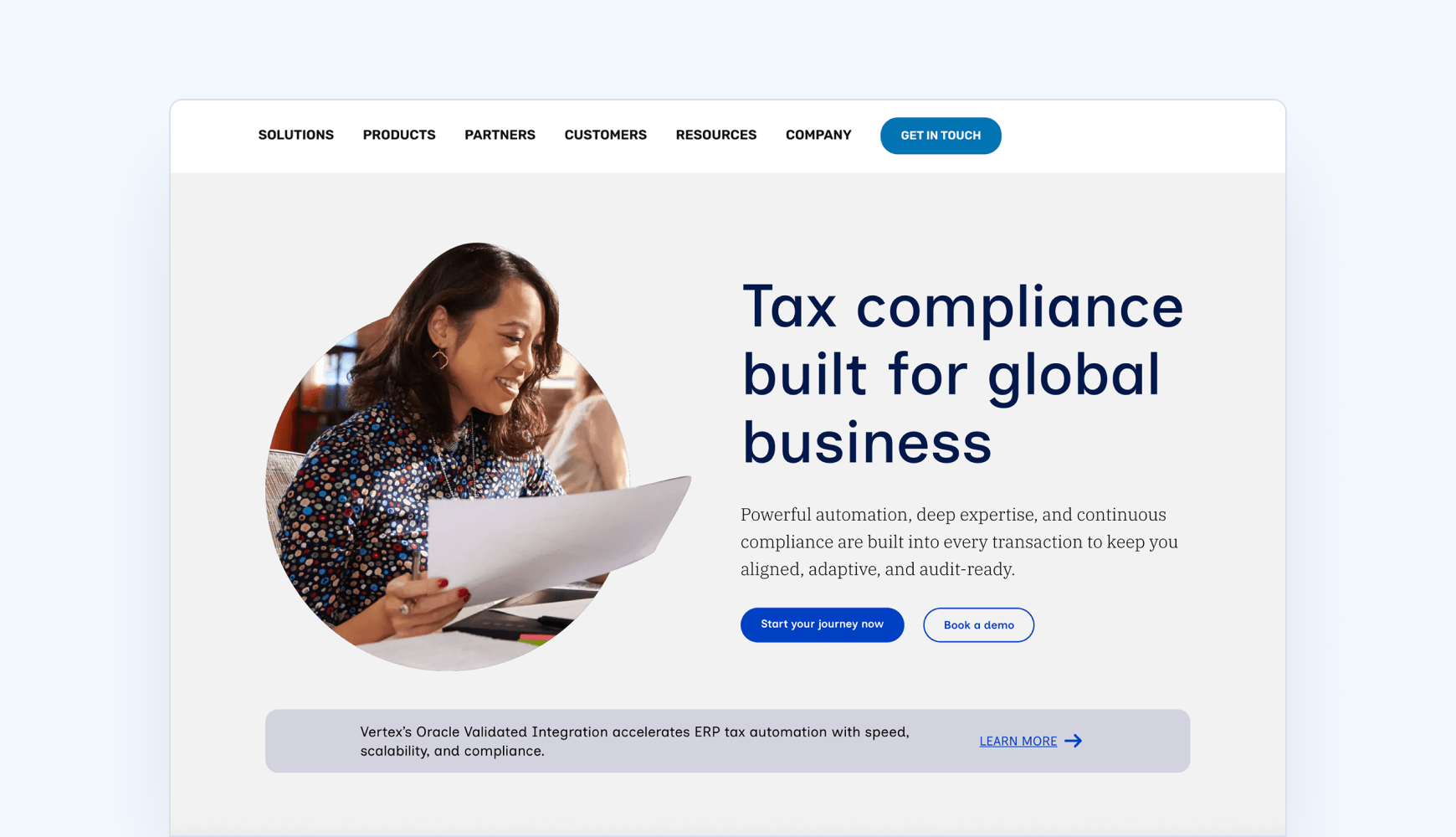
Vertex is a tax technology platform aimed at helping organizations manage sales tax, VAT, and other indirect tax obligations across multiple regions or jurisdictions. Similar to Avalara, Vertex offers modularized tools for tax calculation, tax determination, reporting, and compliance management across a wide variety of industries and business environments.
As a platform, Vertex tends to appeal most to large enterprises and organizations with an operating presence across multiple countries, industries, or regulatory frameworks. The system is usually connected to ERPs, enterprise-level financial solutions, and may be used as supplemental support for dedicated tax and compliance teams. This is a different approach from the set-it-and-forget-it methodology used by automation-focused platforms, and both its configurability and cost reflect that.
Because of this enterprise focus, Vertex deployments are usually paired with a company’s existing financial systems and may require detailed configuration during implementation. Organizations can use it to manage complex tax environments and industry-specific requirements, but Vertex is just as likely to introduce additional complexity in the process. In that way, it’s easy for brands seeking a tax solution to turn to Vertex far too early to truly benefit from what this solution has to offer.
Key differentiators
- Strong focus on tax determination. Vertex emphasizes tax determination and rule management, allowing organizations to configure how tax should be calculated across complex tax and regulatory environments.
- Industry-specific tax compliance options. Working alongside technology partners, Vertex provides specialized tax solutions for industries with complex regulatory requirements.
- Enterprise-oriented platform design. Vertex is commonly implemented within large enterprise environments where tax compliance must be aligned closely with existing financial systems and teams.
Core tax compliance capabilities
Both Avalara and Vertex provide the core functionality that most organizations need from modern tax platforms. While the two platforms emphasize different aspects of compliance, both are capable of providing a level of support that many smaller solutions simply can’t match.
Common capabilities offered by both platforms include:
- Real-time tax calculations across multiple jurisdictions.
- Product taxability handling for different goods and services.
- Economic nexus tracking, sales reports, and analytics.
- Return preparation and automated filing support.
- Exemption certificate collection and management.
Because both platforms cover these fundamental requirements, the key differences between them lie more in their implementation and approach, rather than in the features that they offer.
Avalara generally positions these capabilities around automation and workflow simplification. Using a vast integration library or API connectors, brands can automate most aspects of tax calculation and compliance within a deeply complex ecosystem. After all systems are connected, Avalara can assist with nexus monitoring, return preparation, and filing so that compliance processes can run alongside other daily financial operations.
Vertex approaches compliance with a stronger emphasis on custom configurations. Teams have the freedom to configure exactly how tax should be calculated and applied across different regulatory frameworks. While this is especially valuable for companies operating in complex industries or multinational environments, integration capabilities are more limited and deployments tend to require a greater level of customization.
In practice, both platforms can and do support enterprise-level compliance operations. For users comparing solutions, the better fit between these two platforms will come down to which compliance philosophy best aligns with the company’s overall goals.
However, it’s also worth noting that the capabilities both Avalara and Vertex provide are aimed primarily at the enterprise level. Other and similar solutions offer tax engines, nexus tracking, overview dashboards, and more but may be more limited in scope. For example, TaxCloud offers a fully automated compliance solution but is focused exclusively on U.S. and Canadian taxes for mid-market ecommerce and SaaS brands.
Integrations and platform capability
For many brands, tax compliance software needs to operate alongside the systems that power day-to-day operations. Ecommerce platforms, ERPs, accounting software, and billing systems all generate transaction data that tax engines rely on to calculate, report, and maintain compliance.
Because these systems are interconnected, integration capabilities are one of the most important factors when comparing platforms or considering a switch. It’s also a major component in determining the size of the compliance solution that a team needs.
Example: If a company needs to connect to a few ecommerce or sales channels, a solution like TaxCloud can comfortably calculate, consolidate, and remit taxes automatically. Thousands of integrations and API configurations aren’t necessary to find success. However, if the business needs to calculate accurate tax across multiple regions, follow specialized tax rules, or connect the calculation and compliance process to ERPs and financial systems, deeper integrations and connectivity become major components in that final solution.
Both Avalara and Vertex offer a broad selection of integrations, although their approach varies.
Avalara integrations
Avalara has built one of the largest integration libraries in the tax automation space. The company advertises over 1,200 prebuilt integrations, including more than 100 ERP integrations alone. These connectors span across ecommerce platforms, enterprise systems, accounting tools, marketplaces, billing software, and much more.
With such a large catalog, Avalara often finds a strong use case in enterprise-level ecommerce and digital commerce environments, where tax calculations can be embedded directly into storefronts, checkout systems, and billing platforms. Most of these integrations can be handled through pre-built connectors, but things can get complicated when passing data through multiple systems. In some cases, integrations may not be enough, prompting the use of APIs or custom configurations to better support data transitions.
However, while integrations can be a key selling point for Avalara, their approach to access is far different from other brands. With other competitors, integrations are usually included as part of the service.
For example, TaxCloud Premium plan users have access to all integrations in our library, while users on more cost-effective plans are limited to three or one, but users don’t pay an extra fee on top of their plan charge in order to use those integrations. With Avalara, users pay an access fee up front (usually several thousand dollars) in order to use the connector in the first place.
This means that, in addition to Avatax, Avalara Returns, and other products within the Avalara ecosystem, users will need to pay additional fees for the connectivity that these services require in order to properly integrate into the company tech stack.
Vertex integrations
With Vertex, the integration landscape is different. While the company supports integrations with many enterprise systems, its catalog is significantly smaller and focused more heavily toward core ERP environments and enterprise financial infrastructure. In particular, Vertex integrates closely with SAP, Oracle, NetSuite, and Microsoft Dynamics, where tax determination can be embedded directly into existing financial workflows.
Because of this enterprise focus, Vertex integrations are usually configured as part of a broader ERP implementation or financial system deployment rather than via standalone connectors. While teams may not need to pay separately for them, implementations frequently involve consulting partners or dedicated specialists and integrators, which can drive up costs in their own way.
Vertex also provides APIs for custom integrations, but many deployments are so complex that dedicated partners and consultants are needed to configure tax determination logic within enterprise environments.
A final word about integration partners and customization
Due in large part to their enterprise focus and the complex needs of global corporations when handling tax compliance, both Avalara and Vertex rely on technology partners, consultants, and third-party specialists for onboarding and configuration.
These partners can assist with connecting tax engines to existing systems, configuring compliance workflows, and making sure that tax rules are applied correctly across different regions and transaction types. Because deployments are complex, proper integration and setup can take weeks or months of work to complete.
While this approach allows either platform to integrate with almost any technology stack, additional costs and complexity will depend on the size of the deployment. In these scenarios, every build is slightly different, both in the setup and in the exact data that a team needs for the system to function properly.
Teams lacking the need for such a complex setup or those who lack the onboard IT and financial staff to maintain and take advantage of an interconnected system should strongly consider whether these enterprise solutions are a good fit when compared to other solutions that are easier to implement.
Pricing and cost structure
Pricing can be the most difficult part of evaluating enterprise tax automation platforms.
Unlike smaller compliance tools like TaxCloud, where prices are published using clear plan tiers and annual pricing, Avalara and Vertex rely primarily on custom quotes based on company size, transaction volume, integrations, and overall compliance requirements.
These factors weigh heavily on the total cost of ownership, which can vary greatly depending on how the platform is configured and which services are included.
- Both platforms use quote-based pricing. Neither Avalara nor Vertex publishes standardized pricing for their core tax automation products. Potential customers must work directly with a sales rep, who will issue a custom quote based on transaction volume, integrations, geographic coverage, and other factors.
- Modular services increase overall costs. Both companies structure their offerings around multiple products or service components. Tax calculation engines, filing services, integrations, and other compliance solutions may be priced separately or bundled together, depending on the intended configuration.
- Consulting and integration partners can introduce additional expenses. Complex deployments regularly rely on implementation partners, consultants, or system integrators to connect tax platforms to ERP systems and other financial tools. These services — as well as any ongoing maintenance fees — may add additional project costs that are separate from the initial quote offered by the compliance platform.
- Transaction-based pricing and service fees can add surcharges. Avalara prices the use of AvaTax, its tax calculation engine, in part around transaction volumes. Vertex deployments may involve consulting charges related to implementation, optimization, or system configuration. In both cases, these hidden fees can add unexpected costs over a longer term.
- Total cost of ownership is difficult to estimate. When factoring all required products, services, integrations, and support, the final cost of implementation can vary significantly from even the quoted prices. Businesses evaluating either solution should consider the full compliance workflow rather than the base platform price and make a determination on whether or not the business requires such an implementation.
There is some variation on total cost, particularly when stepping down from enterprise solutions.
In previous years, Avalara offered plans aimed at smaller companies and entry-level ecommerce brands. However, pricing increases and shifts in the company’s product strategy have gradually pushed the platform toward high-end mid-market and enterprise customers who require a much broader ecosystem of products and integrations.
Similarly, while Vertex is usually structured around enterprise deployments, it’s possible to purchase one or two software solutions like the Vertex O Series (automation and calculations) or the Vertex Certificate Center (exemption certificates), and implement them in a very circumspect way.
However, at the point where a company is looking for off-enterprise solutions, it’s worth checking other competitors to see if other platforms are a better fit. For example, Stripe Tax is easy to implement for companies processing payment through Stripe and might be a best-fit option for companies who are comfortable with Stripe’s filing partners. Meanwhile, TaxCloud can offer added versatility and filing services for brands utilizing multiple sales channels or payment platforms.
Implementation and ease of use
Considering the rules and built-in customization options, enterprise tax platforms can be complex on their own. When combined with the systems that connect to them (financial systems, ecommerce platforms, billing tools, reporting environments, etc.), deployment can quickly become overwhelming.
In most cases, implementing a solution like Avalara or Vertex can take weeks and happens as part of a full (and costly) onboarding process. Unlike smaller compliance tools like TaxCloud, working with Avalara or Vertex is likely to require coordination between a variety of in-house teams, all of which need to work with integrators and consultants to get compliance workflows operating correctly across the company’s tax footprint.
For the most part, deployment between Avalara and Vertex is very similar:
- Enterprise deployments require structured onboarding. Both Avalara and Vertex regularly require a formal implementation process before they can begin calculating tax accurately within the company ecosystem. Where onboarding for TaxCloud and other brands is focused on getting up and running quickly, the process for enterprise-level tax compliance is about connecting systems, mapping products correctly, and setting up compliance workflows that align with company sales processes.
- Implementation complexity depends on system architecture. Factors like the number of connected systems, required integrations, jurisdictions, and reporting requirements will significantly impact deployment timelines. Companies with multiple sales channels or presence in multiple countries are most likely to require additional setup and configuration before bringing the system fully online.
- Both internal and external expertise may be required to complete setup. Between the tax rules, company reporting requirements, and overall vision of the compliance network, teams regularly need help from internal departments like IT and finance while relying on system integrators and consultants to configure everything correctly.
- Ongoing maintenance is required to use enterprise-level tax platforms. Even when Vertex or Avalara are properly configured in-house teams will need to update and maintain the integration as the company continues to grow. Software updates, new product categories, or expansion into new regions all require modifications to the platform connectors. After a period of growth, these connectors may also need to be optimized to improve data flow between integrated systems.
While the points above would be true of any enterprise system, Avalara and Vertex both maintain slightly different approaches to deployment.
Avalara emphasizes automation and guided configurations from its own integration catalog. By using native connectors to various sales channels, accounting software, and other systems, the company can automate tax calculation and reporting throughout a customer’s network.
Vertex implementations are more closely aligned with financial infrastructure. Because this platform integrates directly with leading ERP systems and financial systems, deployments place a greater emphasis on rules-based configuration and alignment with existing financial processes.
In both scenarios, many of the same processes still take place. Products need to be mapped. Software must be connected. Data needs to pass and handoff seamlessly from one system to the next. For non-experts, handling the most complicated stages of this process usually requires third-party support.
Ultimately, the complexity of the deployment process depends less on the platform and more on the size and structure of the organization itself. Brands considering enterprise-level automation tools will need to consider carefully whether their in-house resources and current compliance footprint can justify this type of solution.
Customer support and service models
Compliance errors can lead to penalties, audits, and financial exposure from local governments, which makes service and support critical when evaluating any tax automation platform. Companies need access to reliable assistance when configuration questions or implementation issues arise, or when tax rules change and systems need to be updated.
Sometimes, these factors are handled internally. For example, TaxCloud’s own experts keep our tax engine updated when jurisdictional rules change anywhere in the U.S. We also track sales tax changes for things like filing and return frequency or sales tax expansions. Avalara and Vertex will have their own teams to track these changes, as well.
However, beyond that internal maintenance and updating, teams may need to coordinate closely with platform support when things break down.
Most tax solutions — including non-enterprise solutions like TaxCloud — offer similar support capabilities:
- Phone, email, or ticket-based support channels.
- Implementation and onboarding assistance.
- Access to documentation, knowledge bases, and training materials.
- Support for ongoing compliance maintenance.
- Internal updates to tax rules and compliance requirements.
However, the main factor with enterprise brands is the method that customers use to get support and how long it takes to get a response.
Let’s use TaxCloud as a baseline. With us, getting help is as easy as submitting a ticket or sending an email and waiting for a reply from one of our experts (usually) later that same day. Onboarding is a special case, in the sense that users only need to participate when migrating to the platform.
With bigger solutions, getting fast support often requires a specialized support plan. Both platforms have standard support plans, which usually include basic support and severely limit the channels that customers can use to seek help. To get faster access to support, users are encouraged to purchase specialized plans or services.
Unfortunately, both Avalara and Vertex have a mixed reputation for support. While some users have a decent experience, many online reviews go out of their way to point out how poor the service can be.
Avalara
Customer support could use some work. I understand there are thousands, if not more, of clients probably constantly reaching out for help so do understand the delays that can be had, but some of the responses we get are just the canned, ‘out of the handbook,’ responses that do not really offer any help.
The post-sales hand-off and onboarding experience is terrible. Their customer success and integration is outsourced to a team in India. It took three weeks to get a kick off call, and when we finally did the team was not adequately informed of our use case.
I like Avalara’s website because it is very easy to use. Connecting with support when needed is also straightforward. Submitting a ticket is fairly quick, and we are usually able to solve our issues quickly. Avalara provides us more time for other tax projects.
I would say the thing that doesn’t work for our company with Avalara is there’s not a really good support team. If there’s any issues with integration or if we have questions about API calls, we have not really had a prompt or strong feedback in the support field.
Vertex
Support sometimes takes longer than I would prefer to solve an issue. We have used consulting to solve an issue that was deemed a core Vertex tax link issue.
I like our customer support team, they are always helpful and answer our easy and tough questions. I also appreciate that they do not try to sell us more programs every time we chat, they help us with planning for the future and provide us guidance on how they can help us reach our goals.
At times the support process can be challenging, requiring multiple follow up interactions. The nature of support is that there is a need and we want our questions answered as quickly and with the least amount of effort.
Vertex has taken a solid customer support approach. Listens to feedback and makes adjustments accordingly to support their clients needs.
Final verdict: Avalara vs Vertex vs TaxCloud
Both Avalara and Vertex provide comprehensive tax compliance solutions capable of supporting large organizations with complex requirements.
Each platform covers core needs, including tax calculation, nexus monitoring, and automated filing. However, the systems are modular, meaning that users will need to purchase a collection of separate products and services in order to build a complete tax solution that aligns with company goals.
Overall, the primary difference between Avalara and Vertex comes down to approach and implementation.
Avalara: Best for automation and integrations
For organizations seeking to integrate tax compliance with various systems and automate those processes, Avalara tends to be the better fit. The platform’s large integration library and broad compliance ecosystem make it the logical choice for brands with multiple sales channels, platforms, or financial tools.
That said, Avalara’s modular pricing, enterprise-oriented support infrastructure, and reputation for poor support can make it a tough pairing for smaller businesses and teams that don’t need that level of complexity. In those cases, solutions like TaxCloud might be a better fit.
Vertex: Best for industry-specific compliance and custom tax configuration
If the business needs highly configurable tax determination or support for regulatory environments, Vertex is the better option. This platform will be particularly appealing for multi-national companies operating in specific verticals or for brands who tie tax compliance closely with ERP and financial infrastructure.
Of course, the configurability that Vertex provides can lead to more involved deployments, longer implementation timelines, and added consulting costs that can ultimately drive up the final price.
TaxCloud: Best for mid-market automation and non-enterprise brands
Compared to Avalara and Vertex, TaxCloud is the better fit for mid-market and smaller companies that need reliable tax compliance without the cost and complexity found in enterprise platforms.
TaxCloud offers built-in integrations, automated tax calculations, end-to-end filing support, and more. The platform and integrations are easy to configure, creating a streamlined approach to compliance that can be set up quickly and maintained with fewer internal resources.
If you don’t need an enterprise-level deployment, we’d recommend giving TaxCloud a closer look.
Other solutions and alternatives
Before deciding between Vertex and Avalara, it’s worth taking a step back to determine if the tax compliance that either solution offers is necessary in the first place.
Businesses with simpler needs, fewer integration requirements, or a focus on a specific geographic area like the U.S. may find that smaller platforms are just as capable, more efficient, and more cost effective when compared to two brands focused primarily on enterprise deployments.
A better fit for mid-market tax compliance
For many growing businesses, working with Avalara and Vertex can introduce unnecessary complexity and cost for tax compliance.
TaxCloud offers a more streamlined approach by offering automated tax calculation, simplified integrations, and built-in filing services designed specifically for mid-market ecommerce and SaaS brands. Users can review consolidated sales totals and track nexus within the TaxCloud dashboard, and filing can be automated for fast, on-time submissions.
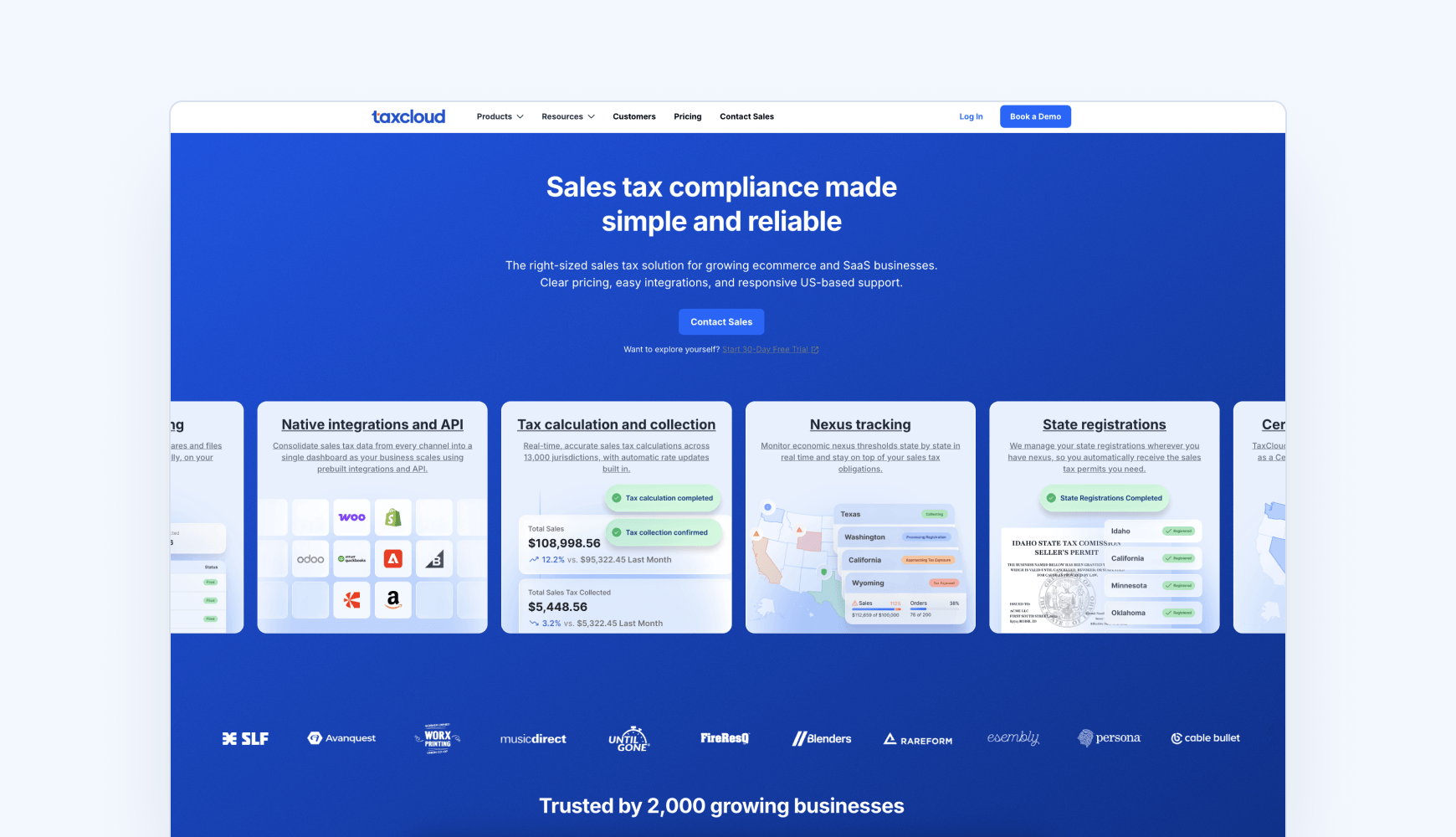
Most importantly, TaxCloud actively helps users cut costs by enrolling eligible businesses in the Streamlined Sales Tax program and offering pay-as-you-need-it add-ons for most services. Using this approach, businesses can reduce filing costs and will only ever pay for what they need.
Ready to give TaxCloud a try? Sign up for a free 30-day trial or get in touch with a product expert for a personalized demo.
Switch to TaxCloud
Get more features at a lower cost than Vertex, with better support. Or switch from Avalara and enjoy prompt responses with savings of up to 30%.