TaxJar pricing update introduces higher costs for sales tax automation users


TaxJar pricing changes in 2026
TaxJar recently updated its pricing for new users and notified existing users of pricing updates scheduled to take effect on October 1, 2026.
New users and those staying with TaxJar after the deadline will see substantial price increases — estimated at roughly 100% or greater — across all platform services, including annual subscriptions, integration costs, and AutoFile fees.
This marks the company’s first pricing change in more than six years, representing a notable shift for businesses that have relied on TaxJar’s historically stable fees. For many brands, particularly those with growing compliance needs, the increase also introduces new cost considerations.
As a result, some TaxJar customers are exploring whether the platform still aligns with their long-term needs or if alternatives like TaxCloud might be a better fit.
Key takeaways
- TaxJar has implemented its first price increase in over six years after its acquisition by Stripe with new rates already in effect for new customers and updated pricing applying for current customers as their annual subscription renews.
- Core platform costs are rising significantly — including subscription fees, integrations, and AutoFile filing costs — with some estimates exceeding a 100% jump when compared to 2025 pricing.
- This change was largely unexpected and unannounced, leaving customers scrambling to reassess compliance strategies and alternative solutions with more predictable pricing and an improved customer support experience.
Accuracy note: While TaxJar’s pricing is publicly available, the change to its pricing structure was unexpected. As a result, the TaxCloud team used current information combined with historical information from Archive.org and other sources to assess the scope of the changes.
Additionally, several details used to create this article came from TaxJar customers who have spoken to the TaxCloud sales and product team while searching for a new sales tax compliance provider.
Many have expressed shock and dismay with TaxJar’s sharp pricing increase and have shared the information they received from the company.
What’s changing with TaxJar’s pricing?
According to TaxJar’s support documentation, historical data from Archive.org, and communications to its current customers, TaxJar has raised prices to both annual subscription pricing and per-filing AutoFile fees in a move that will impact most core components of the platform.

Based on the notices that customers have received and shared with the TaxCloud team, precisely when price changes will go into effect varies by plan type:
- Customers with annual subscriptions will see increases upon renewal, but TaxJar may try to renegotiate contracts early.
- Existing month-to-month customers will retain legacy pricing until October 1, 2026. New pricing will apply after that date.
- New customers — those signing up for the service today who weren’t on a plan prior to the pricing update — will see services start at existing rates.
Because the pricing update took place in early March, all users should see a price increase by early 2027.
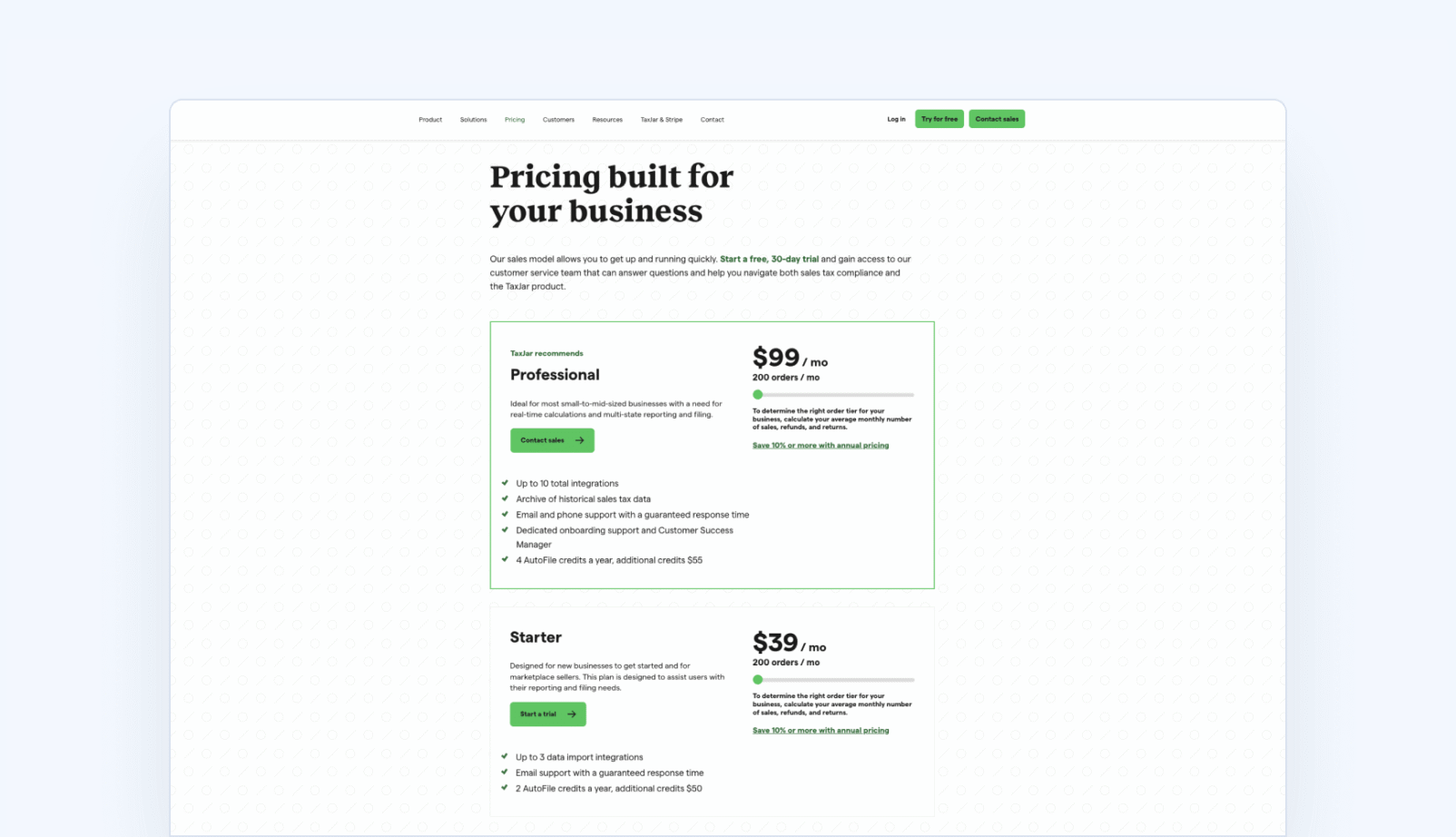
Key pricing updates include:
- An average of ~100% or greater increase in subscription costs.
- ~57% or greater increase in AutoFile costs.
- Additional free filings provided for AutoFile.
- Additional free state registrations.
While TaxJar has not publicly announced this change, the information is visible on their website, and the company has communicated with existing customers via email. Specific pricing changes vary depending on plan structure, usage, and filing volume.
Feedback from TaxJar customers and ecommerce accountants in our Partner Program suggests that all legacy clients will see a substantial increase in both monthly and annual fees. Although TaxJar has notified customers by email and added a few token incentives, many customers appear largely caught off guard by the sudden change.
Key dates in TaxJar’s pricing update plans
- January – February 2026. TaxJar enters the new year with the same pricing structure used for the previous six years.
- Late February – Early March 2026. TaxJar unexpectedly rolls out updates to its pricing and begins sending notices to current customers detailing a cost increase upon renewal.
-
- Customers on month-to-month plans are given a grace period where legacy pricing applies until October 2026.
- October 1, 2026. All month-to-month users, including those on legacy pricing, switch to updated pricing plans.
- Mid-2026 – Late February 2027. All remaining customers see price changes as their current plans expire. TaxJar customers are charged at new rates upon renewal.
| TaxJar Professional Plan | Legacy Pricing (2021-2025) | Updated Pricing (2026) | Percentage Increase |
|---|---|---|---|
| 200 Orders | $1,069 | $1,069 | 0.00% |
| 500 Orders | $2,149 | $2,499 | 16.29% |
| 1K Orders | $3,769 | $4,999 | 32.63% |
| 2.5K Orders | $5,389 | $11,999 | 122.66% |
| 5K Orders | $7,009 | $15,999 | 128.26% |
| 10K Orders | $9,169 | $19,999 | 118.12% |
| 25K Orders | $11,869 | $24,999 | 110.62% |
| 50K Orders | $15,649 | $29,999 | 91.70% |
| 75K Orders | $19,429 | $35,999 | 85.28% |
| 100K Orders | $23,749 | $45,999 | 93.69% |
| 250K Orders | $43,189 | $89,999 | 108.38% |
| 500K Orders | $64,789 | $139,999 | 116.08% |
| 1 Million Orders | $97,189 | $224,999 | 131.51% |
| 2.5 Million Orders | $129,589 | $299,999 | 131.50% |
| 5 Million Orders | $161,989 | $399,999 | 146.93% |
| 7.5 Million Orders | $183,589 | $449,999 | 145.11% |
| 10 Million Orders | $215,989 | $499,999 | 131.49% |
How TaxJar pricing has worked historically
For many years, TaxJar maintained relatively stable pricing (full breakdown here) and service across its core products. Its pricing structure, which combines platform access with usage-based filing costs, has remained largely consistent in the ecommerce marketplace.
This approach allowed brands to grow without needing to rethink their tax compliance setup. Companies expanding into new markets could continue using the same system while costs increased in a relatively predictable way, based on transaction totals and filing activity.
The company’s role within the Stripe ecosystem has also remained steady since its acquisition in 2021. TaxJar currently operates alongside Stripe Tax, and each product serves different segments of the market depending on how a business manages payments and billing infrastructure.
However, since the acquisition, updates to TaxJar have been focused primarily on maintaining the tax engine and keeping pace with regulatory requirements. For customers, this consistency has made TaxJar a predictable part of their compliance stack. Many brands have built processes and budgets around TaxJar’s pricing models.
The 2026 update represents the first significant change in that structure and introduces higher costs across all TaxJar services.
| TaxJar Professional AutoFile Pricing | Legacy Pricing (2021-2025) | Updated Pricing (2026) | Percentage Increase |
|---|---|---|---|
| Pay as you go | $35 | $55 | 57.14% |
| 25 bundle | $750 | $1,250 | 66.67% |
| 50 bundle | $1,500 | $2,500 | 66.67% |
| 100 bundle | $3,000 | $5,000 | 66.67% |
| Unlimited | $7,500 | $12,000 | 60.00% |
Why is TaxJar raising prices?
In their email to customers, TaxJar gives a few reasons to justify its price increase:
- No price changes for six years.
- 100% on-time filing.
- 99.999% historical uptime.
- 230+ annual regulation updates handled by tax experts.
However, while it’s true that TaxJar hasn’t updated their pricing in six years, it’s debatable whether uptime and regulatory updates are enough to justify the new costs.
For context, TaxCloud and most other compliance solutions provide similar updates, uptime, and filing accuracy because those elements are the baseline requirements to maintain compliance within a sales tax platform. Without regulatory updates and on-time filing, TaxJar’s calculations and filings wouldn’t be accurate. By missing those updates, TaxJar would fail to meet its obligations to its customers.
What TaxJar price updates mean for customers
For businesses currently using TaxJar, the 2026 pricing update represents an increase in the cost of maintaining sales tax compliance. While the magnitude of the impact varies depending on volume, number of states, and overall transaction activity, every TaxJar user will see an increase in expenses.
Broadly speaking, companies have three options:
- Stay with TaxJar and absorb the increased costs. Companies that prioritize continuity might choose to stay with TaxJar and adjust budgets accordingly. This approach avoids migrations but requires accepting higher operating expenses.
- Adjust how TaxJar is used. Some brands might look for ways to reduce costs by limiting AutoFile usage, consolidating filings, or shifting compliance responsibilities in-house. However, this approach won’t be viable for smaller organizations, and it won’t offset plan-based cost increases.
- Find an alternative provider. Cost-sensitive customers might prefer to seek a new compliance provider, such as TaxCloud. Differences in pricing models, costs, and support structures can become more important as companies grow.
Brands that rely heavily on AutoFile or operate across multiple jurisdictions are likely to see the most significant changes due to accumulated costs. For comparison, AutoFile rates in 2025 started at $30/$35 per filing (Starter/Professional) but are now $50/$55 per filing).
Because filing fees scale with usage, companies experiencing regional growth are likely to see compliance costs rise more quickly over time under the new pricing structure. Companies filing monthly in 20 states would see a $400/month increase in filing costs alone. Expanding into new states will only see compliance costs climb more quickly over time.
Beyond the immediate increase, the update will also impact how businesses plan for growth. Higher variable costs tied to filings can make it more difficult to forecast long-term compliance expenses, particularly for companies scaling rapidly and entering new markets. Plus, because TaxJar isn’t a Certified Service Provider with the Streamlined Sales Tax Program, customers have no meaningful way to offset those costs.
Alternatives for businesses affected by the TaxJar price increase
The 2026 pricing update from TaxJar has prompted many brands to reevaluate how they manage sales tax compliance.
For companies operating across multiple states or relying heavily on automated filing, rising costs typically compound as transaction volume and state presence expand.
As a result, many organizations are exploring alternative platforms that offer better benefits and stronger customer support alongside cost-saving mechanisms tied to filing and registration.
Below are a few of the more common options that users consider when transitioning away from TaxJar.
Keep in mind that the numbers used below are a mix of publicly available information, as well as plan details the TaxCloud team has received from TaxJar customers. However, your mileage may vary when configuring a plan.
TaxCloud
A sales tax compliance platform designed for growing mid-market ecommerce and SaaS brands, TaxCloud offers automated tax calculation and filing without unnecessary overhead. Pricing is transparent, and plan limits can be extended with pay-as-you-go add-ons so that teams can choose the best-fit option without drastic overpayments.
| Cost breakdown | TaxJar Professional (Old Pricing) | TaxJar Professional (Current Pricing) | TaxCloud Premium (Current Pricing) |
|---|---|---|---|
| Annual transactions: 25,000 (Annual plan) | $11,869 | $24,999 | $3,999 (24,000 orders) |
| Monthly filing: 25 states (Annual total) | $7,500 | $12,000 | $8,399 |
| Total annual costs (before any discounts) | $19,369 | $36,999 | $12,398 |
Considering the cost breakdown above, a customer needing 25,000 transactions will pay a 91% increase for the same level of service provided by TaxJar! However, compared to both new and old TaxJar pricing, TaxCloud offers a similar number of transactions and filings for a substantially lower cost — and that’s before we add in any relevant discounts.
TaxCloud is a member of the Streamlined Sales Tax program, which allows us to submit sales tax for free in up to 24 member states. When TaxCloud submits tax returns in those states on your behalf, those savings are passed on to you. In the example above, if half of the 25 states are SST member states, working with TaxCloud would mean free filings in those states, effectively cutting your filing costs in half!
Similar to TaxJar, TaxCloud also doesn’t charge for integrations. However, some marketplaces — such as Shopify Tax — charge users for calculations on their end, which may incur additional costs that are out of TaxCloud’s control.
For a full breakdown and comparison of TaxJar and TaxCloud pricing, take a look at this article.

TaxCloud is 1 of only 6 SST-Certified Providers — here’s what that means
“It would have cost us around $40,000 a year to go with a company that wasn’t an SST program participant.” — Chris Manduka, CEO, Cable Bullet.
See how Cable Bullet saved tens of thousands in compliance costs by choosing TaxCloud, one of only six SST-certified providers.
Kintsugi & Numeral
Both Kintsugi and Numeral represent a newer category of tax compliance platforms focused on automation, flexibility and usage-based pricing.
Both platforms offer automated tax calculation, nexus tracking, and filing support (just like TaxCloud), but they use pricing structures that differ from the traditional subscription-plus-filing models.
| Cost breakdown | TaxJar Professional (Old Pricing) | TaxJar Professional (Current Pricing) | Kintsugi & Numeral |
|---|---|---|---|
| Annual transactions: 25,000 (Annual plan) | $11,869 | $24,999 | N/A |
| Monthly filing: 25 states (Annual total) | $7,500 | $12,000 | $22,500 |
| Total annual costs (before any discounts) | $19,369 | $36,999 | $22,500 |
Although they’re entirely different providers, both Kintsugi and Numeral are similar in how they calculate costs.
Both companies waive transaction fees and order limits in favor of a flat $75 per filing. Registrations are also available, but Numeral charges $150 per registration while Kintsugi keeps a $75 flat rate for everything.
These solutions are simplified and are more likely to appeal to startups and mid-market companies looking for flexible pricing or a new approach. However, don’t be fooled. Despite the simplicity, the higher monthly filing costs add up over time.
TaxValet
If you’re looking for a different approach to tax compliance, TaxValet offers a fully managed sales tax service rather than a self-service platform.
Rather than relying on automated tools alone, TaxValet acts as a fractional CFO department attached to your organization. They work directly with the business to handle filings, registrations, and compliance management, so that compliance becomes a strictly hands-off affair for TaxValet customers.
| Cost breakdown | TaxJar Professional (Old Pricing) | TaxJar Professional (Current Pricing) | TaxValet Post-setup (15M+/year) |
|---|---|---|---|
| Annual transactions: 25,000 (Annual plan) | $11,869 | $24,999 | $12,000 |
| Monthly filing: 25 states (Annual total) | $7,500 | $12,000 | $19,500 |
| Total annual costs (before any discounts) | $19,369 | $36,999 | $31,500 |
A preliminary breakdown puts TaxJar well above the cost of TaxValet, however there are a few variances that aren’t accounted for in the chart.
First, TaxValet charges a one-time setup fee of $3,500. Their ongoing rates are also based on business revenue and split into three basic categories:
- Between $1M/yr & $5M/yr: $500/mo + $65/state/mo.
- Between $5M/yr & $15M/yr: $750/mo + $65/state/mo.
- More than $15M/yr: $1,000/mo + $65/state/mo.
The differences are notable in terms of cost. However, even on the $15m/year plan — the most expensive TaxValet plan is still less expensive than a mid-range TaxJar plan.
In short, this means that TaxJar users could effectively offload their entire tax burden to a managed service and still pay less than the cost of staying with TaxJar’s new plan! In doing so, a business would effectively eliminate any hands-on work that the company has to do, since all of that would be handled by TaxValet instead.
Next steps for affected businesses
Businesses on an annual plan should take time to evaluate how TaxJar’s pricing changes will impact their compliance costs and workflows before their next renewal date. Because the increase is tied to billing cycles, some brands will have additional time to plan based on their renewal dates.
Next, assess how the updated pricing will impact total compliance costs. In most scenarios, an annual cost adjustment is manageable. However, TaxJar’s increase is substantial and may leave organizations scrambling to find budget-friendly alternatives.
Finally, if you’re considering switching providers, be sure to plan ahead. Migrating tax compliance systems can take time, especially when historical data, registrations, and integrations are involved. Review and select potential replacements well in advance. Use migration guides to make a plan of action, and plan to make the switch before your TaxJar agreement expires so that you stay in compliance during the transition.
Reduce your sales tax compliance costs with TaxCloud
If your business is impacted by the TaxJar pricing update, now might be a good time to evaluate whether your current compliance solution still aligns with your needs.
If not, TaxCloud is a great fit for growing ecommerce and SaaS brands that want to automate tax calculation and filing without unnecessary complexity or unpredictable costs. We offer transparent pricing, built-in integrations, and cost-saving benefits through the Streamlined Sales Tax program, so you’ll know what you’re paying for, and you’ll automatically save where discounts are available.
Want to give it a try?
Schedule a personalized demo to explore how the TaxCloud platform can work for your business.
FAQ
Based on archival data, TaxJar’s pricing update went into effect in early March 2026. However, individuals with annual subscriptions won’t see the change until their next billing cycle.
Month-to-month users who held monthly plans prior to the increase were allowed to keep their existing legacy pricing until October 1, 2026, after which they will be switched to the new pricing structure.
New customers on both month-to-month and annual plans will come in under the new rate, as the pricing change has already gone into effect.
While pricing varies by plan and usage, most customers report significant increases across both subscription and AutoFile fees.
Based on what TaxJar customers have told members of the TaxCloud sales team and the data published on the TaxJar website, the average cost increase over all plans is 100%, and the average cost increase for AutoFile is 57%.
While the number of states and the total filing volume a company requires will impact the final cost, these aren’t factors that companies can usually control. Established brands with a market presence across multiple markets or jurisdictions should anticipate higher prices if staying with TaxJar.
In its communication to customers, TaxJar cited several reasons for the increased pricing, including the fact that costs have remained unchanged for more than six years. Continued investments in uptime, filing accuracy, and regulatory updates also played a role.
These factors reflect the ongoing requirements of maintaining a sales tax compliance platform. However, it’s difficult to say whether these elements fully justify the increase, particularly since such updates are generally required for compliance solutions to remain effective as jurisdictional rules change.
Unfortunately, it’s not possible to keep current TaxJar pricing. The new pricing will be applied upon renewal.
Customer-facing messaging also notes that TaxJar will provide extra incentives, such as free filings and state registrations. However, these perks are negligible when compared to the overall cost.
This depends, in large part, on the provider you choose. Switching from TaxJar is generally straightforward, but the level of effort will depend on your setup and compatibility.
Most migrations involve exporting historical data, reconnecting integrations, and making sure that registrations and filing details properly transition from one platform to the next. Businesses with more complex setups or multi-state operations might require additional planning.
Many providers, including TaxCloud, offer migration guides and onboarding support to streamline these transitions and minimize operational disruptions.