Best sales tax tools with built-in filing services: a guide for growing U.S. brands




While collecting sales tax is a straightforward process, filing it across multiple states comes with unwanted complexity and risk.
Currently, 45 states and Washington D.C. have sales tax requirements, but filing isn’t easy. Each state has its own portal, rules, and filing schedules. Deadlines and filing frequency shift as sales grow. Local jurisdictions may have their own tax rules, and penalties for late or incorrect returns can be steep.
This complexity is why multi-state filing is its own, distinct category of sales tax compliance. However, while many platforms will calculate sales tax, only a handful actually file returns on your behalf.
In this guide, we’ll take a closer look at the best sales tools to file sales tax returns across the U.S. including which providers automate filings and which offer the best cost structure for growing brands.
| Provider | Filing Automation | Registrations | SST Support | Cost Model | Support Levels |
|---|---|---|---|---|---|
| TaxCloud | ✅ | ✅ | ✅ | Per-return | ✅ Robust |
| Avalara | ✅ | ✅ | ✅ | Per-return + subscription | ⚠️ Limited |
| Sovos | ✅ | ✅ | ✅ | Enterprise pricing | ✅ Robust |
| AccurateTax | ✅ | ✅ | ✅ | Per-return | ⚠️ Limited |
| Avior | ✅ | ✅ | ✅ | Per-return + subscription | ⚠️ Limited |
| Exactor (Intuit) | ✅ | ✅ | ✅ | Bundled with Intuit | ⚠️ Limited |
| Vertex | ✅ | ✅ | ❌ | Enterprise pricing | ⚠️ Limited |
| TaxJar (Stripe) | ⚠️ AutoFile | ⚠️ Limited | ❌ | Per-return | ❌ Basic |
| Stripe Tax | ⚠️ 3rd Party | ✅ | ❌ | Usage-based | ❌ Basic |
| Numeral | ✅ | ✅ | ❌ | Per-return + subscription | ⚠️ Limited |
Why nationwide sales tax filing is uniquely complex
Filing sales tax in one state is manageable, but filing in multiple states adds complexity that can be difficult to handle on your own.
Each state follows its own rules, uses its own portal, and can change requirements without warning. These additional hurdles effectively turn a simple task into a high-risk, high-maintenance workflow that becomes a huge, administrative burden.
Briefly, here’s a closer look at what makes multi-state filing so complicated:
- Every state has its own portal. Each of the 45 states requiring sales tax run separate filing portals with different logins, formatting requirements, and submission rules. Some require manual entry while others need CSV uploads. A few states require prepayments or have an entirely separate process to handle remittance. Because nothing is standardized, businesses need to learn and master dozens of systems in order to stay compliant.
- Filing frequencies change based on volume. As brands grow and revenue increases, filing frequencies change. A seller may start filing annually, before being told to file quarterly or monthly as earnings increase. Often, these notices are given by state governments with minimal notice, catching business owners by surprise.
- Local jurisdictions matter. States like Colorado, Louisiana, and Alabama include home-rule jurisdictions, where cities or parishes administer their own taxes. These localities require separate logins, additional returns, or unique rules that are wholly separate from state filings.
- SST vs. non-SST states. States participating in the Streamlined Sales Tax (SST) program offer simplified rules and consolidated filings, but only if your provider is a Certified Service Provider (CSP). Plus, while SST can streamline filing in participating states, non-SST states still have separate processes, deadlines, and formats. Companies using the SST program must navigate both systems simultaneously.
- Filing errors trigger penalties. States penalize late or incorrect filings, even when you collect and remit the correct amount of tax. Submitting data in the wrong format, filing a late return, or overlooking a local jurisdiction can result in interest charges, percentage-based penalties, and months of notices while also increasing audit risk.
Unfortunately, filing across the U.S. isn’t just a data entry issue. It’s a fragmented process with workflows and guidelines that are constantly evolving and steep penalties when steps aren’t properly followed.
Because those risks and penalties are so high, companies are forced to either dedicate a considerable amount of in-house admin time to getting all the details right. Alternatively, brands can seek an external partner, like an accounting firm, and pay an expert to handle those issues. However, outsourced support raises compliance costs that smaller brands may not want to pay.
As a result, many companies turn to dedicated sales tax platforms to automate tax collection, filing, and remittance. Unfortunately, service offerings and costs can vary wildly between providers, so finding the best fit can be a challenge.
What features matter for filing
While sales tax platforms can assist with tax collection and remittance across multiple states, not every platform is equipped to handle the workload in a way that aligns with your business.
For example, some providers only offer a limited number of filings as part of their subscription or plan. Others outsource filing or handle the process via fully managed services. Depending on the size of your organization, one approach may be better than another.
When choosing a software to automate your multi-state filings, look for these important features:
- Automated, state-specific workflows. True filing automation is about more than generating reports. Returns need to be prepared and submitted in the exact format that the state requires, while also accounting for payment scheduling, prepayment rules, and any unique portal processes. The best platforms file directly with every state you sell into to make sure that deadlines are always met.
- Nexus tracking and filing triggers. Especially in ecommerce, it’s easy for sellers to expand across multiple states without noticing they’ve crossed a tax threshold. Accurate nexus tracking consolidates earnings across multiple platforms, so brands know exactly when a new registration or filing obligation is triggered.
- SST filing support. The Streamlined Sales Tax program allows for fast and accurate filing across 24 states. However, to get those benefits, the platform you use must be a Certified Service Provider. CSP participation reduces administrative work and, in many cases, eliminates filing fees entirely. Between reduced costs and faster filing speed, it’s not something to overlook.
- Registration services. Companies can’t file without registering in a state. A strong platform handles registrations in both SST and non-SST states, manages documentation requirements, and makes sure that accounts are set up correctly. Most registrations are a one-time setup, but they’re also one of the most tedious and error-prone parts of multistate compliance.
- Handling state notices. States issue notices for everything, including frequency changes, missed returns, adjustments, payment issues, and portal updates. Some filing partners will help you interpret those notices before they lead to penalties or audits.
- Transparent filing costs. Filing costs vary wildly between providers. Some charge per return or may include a set number of filings as part of a subscription (with high fees if additional filings are required). Others offer volume discounts or include SST filings at no cost.
- Human-powered support. Even with automation, filings need oversight. A dedicated support team can help to resolve unforeseen issues, keep tax engines updated, or assist with things like filing enrolment, platform integration, and onboarding. Unfortunately, many automation platforms outsource these tasks to AI or chatbots that have a limited capacity to help.
Choosing a filing partner isn’t just about the number of integrations or how clean the dashboard looks.
When making your selection, take the time to evaluate whether a platform can help you stay compliant in every state where you have filing requirements. The right provider can do this without draining internal time or forcing you to hire outside help.
At the same time, keep in mind that the right platform for your team will vary based on the size and needs of the company. Larger brands with sizable earnings will need a different set of services and integrations than smaller companies.
In the next section, we’ll break down the top filing providers and how they compare with one another.
Vendor breakdowns: top providers for U.S. sales tax filing
The best way to overcome multi-state filing hurdles is to choose a sales tax filing partner that aligns with your workload and budget.
While there are plenty of tools available, only a small group comprehensive, multi-state filing options, and how they go about this process will vary. Some solutions use direct filing, but others use automated “AutoFile” systems or outsource filing tasks to third party partners. Plus, only a handful of providers are qualified CSPs in the SST program.
Below, you’ll find a clear breakdown of the top U.S. filing providers, along with insights on how they compare on automation, support, pricing, and coverage.
SST program certified service providers (CSPs)
Certified Service Providers (CSPs) are the only sales tax return filing platforms authorized to file returns via the Streamlined Sales Tax (SST) program. This matters because SST eliminates many administrative steps and, in many cases, makes filing and registration free in participating states.
CSPs also meet strict technical and operational standards set by the SST Governing Board. For companies filing nationwide (especially ecommerce brands), CSPs can deliver the most complete, cost-efficient filing experience.
In this section, we’ll take a closer look at how the six SST-certified providers compare with one another.
TaxCloud

Best for: U.S.-based ecommerce sellers who want affordable, automated tax calculation and filing with free SST support.
Pricing: Starting at $199/year; increases based on transaction volume and filing needs. Free plan available.
Notable features:
- Certified Service Provider (CSP)
- Free SST registration and filing
- Direct filing in all states
- Dedicated U.S.-based filing team
- Nexus tracking + multi-platform integrations
TaxCloud is built for businesses that need reliable, affordable sales tax filing across the U.S. As a CSP, TaxCloud offers free registration and filing in all 24 SST states, which immediately lowers filing costs for growing ecommerce brands. For non-SST states, TaxCloud uses transparent, volume-discounted pricing that becomes more cost-effective as your filing footprint expands.
Apart from transparent pricing and platform versatility, TaxCloud sets itself apart with a U.S.-based filing and support team, all of whom are working in the background to help users remain compliant. The platform’s built-in tax engine is frequently updated as tax rules and jurisdictions change, and our filing experts ensure that returns are filed accurately and remitted on time.
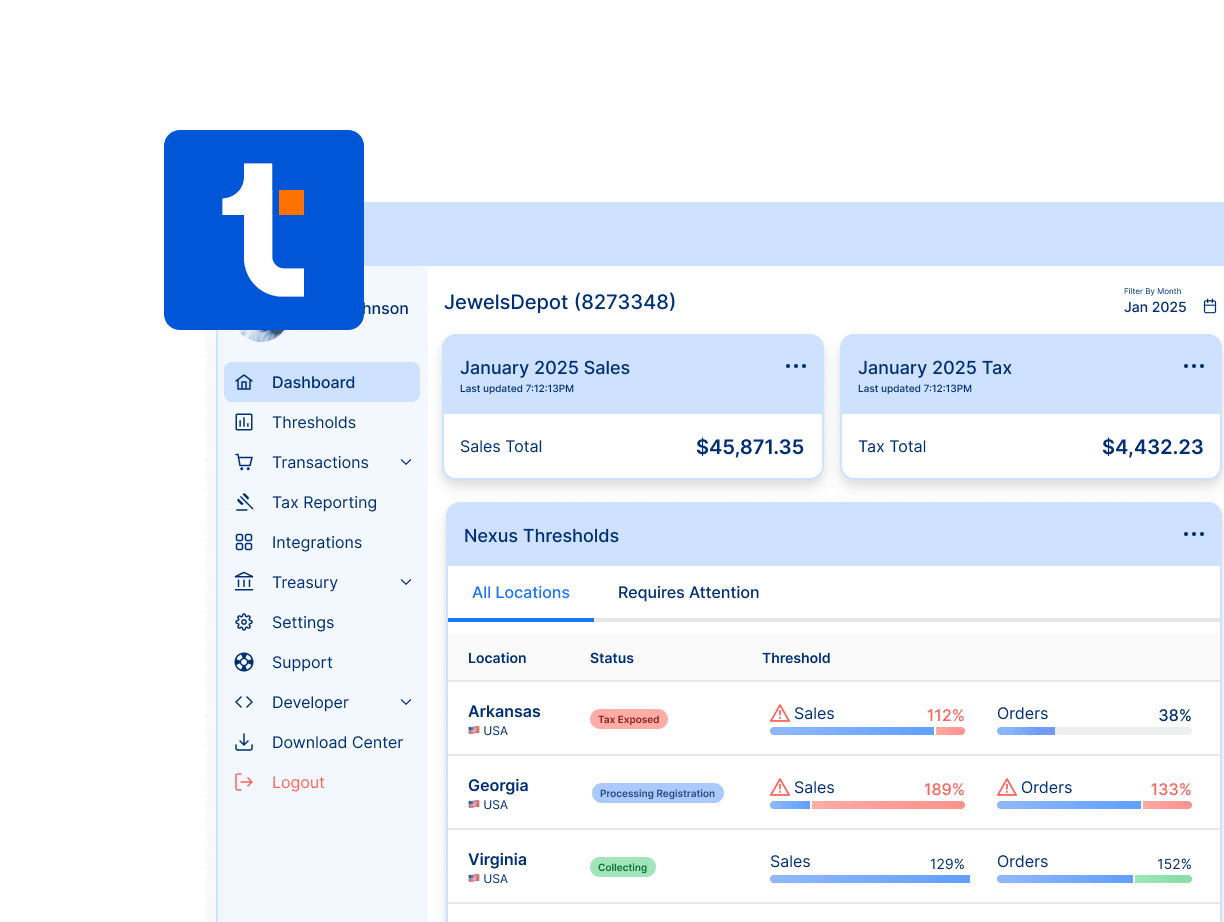
TaxCloud centralized all sales tax data into one dashboard, tracks economic nexus across platforms, and supports seamless integrations with Shopify, BigCommerce, WooCommerce, and others. Ultimately, this reduces manual work and eliminates the fragmented reporting that can lead to misfilings.
For businesses looking for a U.S.-centric filing partner that combines human support with automation, TaxCloud delivers predictable costs, responsive support, and complete multi-state coverage without enterprise-level complexity.
Avalara

Best for: Enterprise and global businesses with complex tax requirements and multi-jurisdictional operations.
Pricing: Custom, quote-based pricing depending on transaction volume, entity structure, and compliance scope.
Notable features:
- CSP-certified
- Wide platform and ERP integrations
- Automated filing workflows
- Extensive tax content database
- Managed services available
Avalara tends to serve businesses that need a powerful, highly integrated tax engine with nationwide filing capabilities. Like TaxCloud, Avalara is also a CSP, supporting SST filing and registration, though fees and service levels depend on the subscription tier. In non-SST states, Avalara automates return creation and remittance, making it a comprehensive tool for companies filing across dozens of states.
What makes Avalara stand out to larger organizations is its broad integration ecosystem. Avalara plugs into most major ERPs, ecommerce platforms, billing systems, and financial tools, allowing tax collection and filing to operate across complex workflows. Its tax content database is extensive, so businesses can stay updated on rate changes, compliance rules, and product taxability.
However, unlike other services, Avalara breaks much of its offering into modular, component products. Where TaxCloud is an all-in-one solution with pay-as-you-go pricing, Avalara offers functionality like tax calculations, returns, invoicing, and exemption certificate management as entirely separate products. This effectively forces companies to pay separately for solutions that would work better together, ultimately driving up costs.
Sovos

Best for: Large enterprises and global brands requiring strong compliance automation across multiple tax regions and jurisdictions.
Pricing: Custom pricing. Varies by product, plan, and transaction volume.
Notable features:
- CSP-certified
- Global compliance coverage
- Managed returns services
- Strong support for regulated industries
- Deep ERP integrations
Sovos is built for larger enterprises that need compliance coverage across multiple tax types (GST/HST, VAT, etc.), regions, and regulatory environments. While the platform supports U.S. sales tax filings, Sovos is best known for its global capabilities, including , e-invoicing, excise tax, and regulatory reporting. It’s a strong fit for brands with international operations or complex ERP workflows.
For sales tax, Sovos offers automated return preparation and filing in every U.S. state, along with payment remittance and liability tracking. As a CSP, Sovos supports SST states, though its greatest strengths lie in enterprise-level standardization and deployment. Sovos integrates with major ERP systems like SAP, Oracle, and Microsoft Dynamics, making it suitable for companies with larger transactional footprints and multi-system environments.
For brands that want a fully outsourced approach, Sovos offers managed services. In this scenario, Sovos essentially becomes a deployable tax department and takes over all filing and compliance-related issues on the user’s behalf. However, these solutions come with enterprise-level pricing and multi-year contracts, placing this service well out of reach for smaller organizations.
AccurateTax
Best for: Ecommerce retailers wanting an SST-certified option with automation.
Pricing: Per order. Filing services and exemption certificate management are considered add-ons to the base price.
Notable features:
- CSP-certified
- Filing automation across states
- Calculation and exemption handling
- Reporting tools for ecommerce platforms
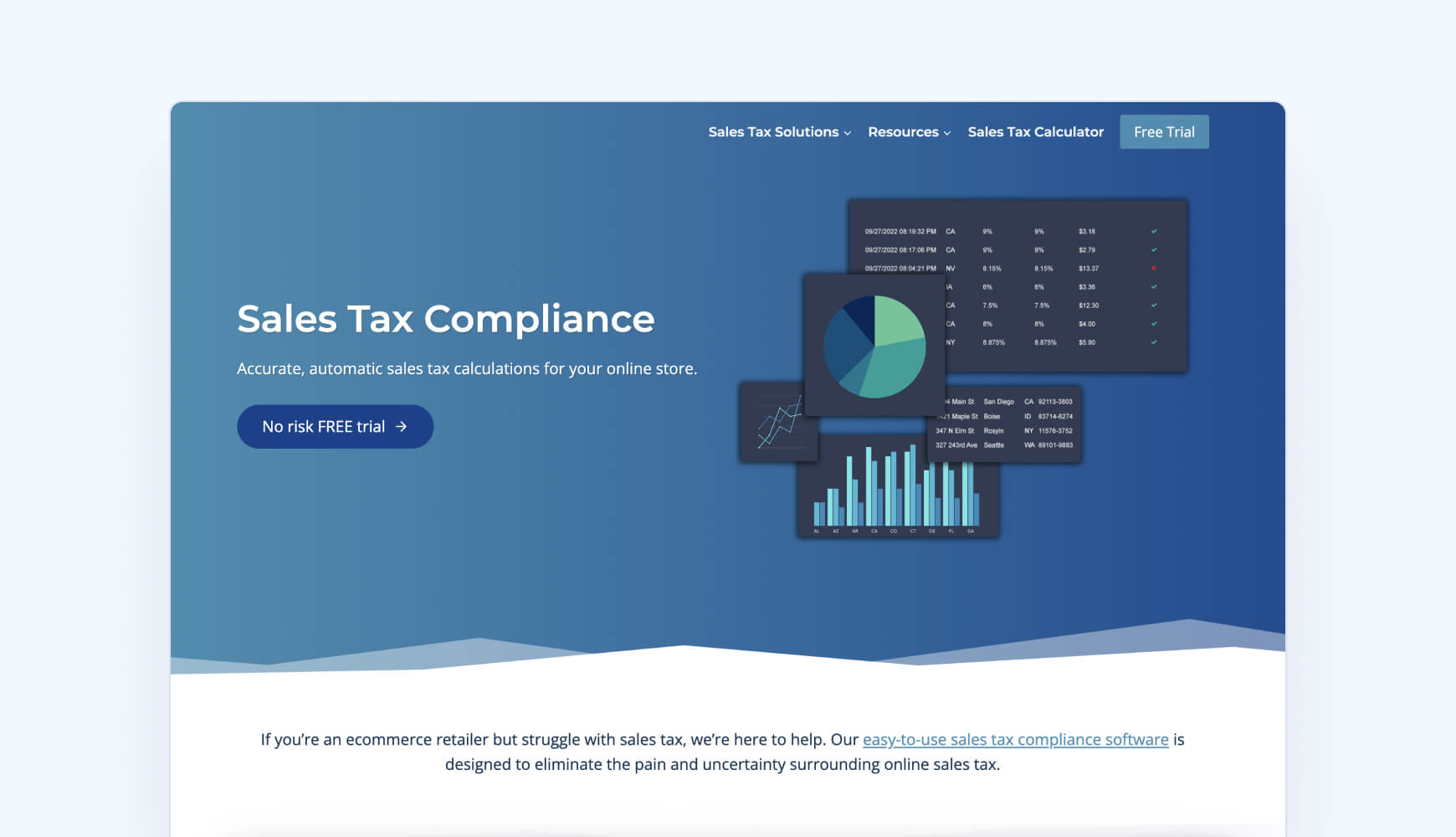
AccurateTax is a small but capable sales tax platform that provides automated calculation, reporting, and filing services for ecommerce brands. Similar to TaxCloud, it’s a CSP and supports both free filings and registrations in SST states while also providing non-SST filing options. It’s a good option for companies who want a straightforward, budget-conscious option with automated or managed workflows.
On the filing side, AccrateTax prepares and submits returns in support states, manages data imports from popular ecommerce platforms, and keeps track of filing schedules. Its tools help businesses consolidate transaction data, apply product taxability rules, and generate state-specific reports. As a smaller platform, support tends to be more hands-on, but response times can vary depending on plan and business hours.
Because AccurateTax is smaller, it doesn’t have the same breadth of integrations or advanced analytics seen in Avalara, Sovos, and other enterprise-focused platforms. However, it covers the core functionality that many ecommerce sellers need, including calculation, order capturing, nexus tracking, and multi-state filing. Overall, the platform will be a better fit for smaller or mid-sized businesses in need of SST coverage and reliable filing workflows.
Avior SutTax

Best for: Businesses seeking a newer SST-certified platform with modern tooling.
Pricing: Subscription plus per-return pricing.
Notable features:
- CSP-certified (new entrant)
- Filing automation
- Multi-state tax calculation
Avior is one of the newest CSPs in the SST program, offering automated sales tax calculation and filing for ecommerce brands. As a CSP, Avior supports free registrations and filings in SST states and provides automated filing workflows everywhere else. The platform is designed with a modern interface and a streamlined onboarding flow, making it an approachable option for smaller teams in search of a lightweight compliance tool.
Similar to TaxCloud, Avior automates return preparation, consolidates transaction data from connected storefronts, and submits filings through state-specific workflows. Its integration system is growing and currently supports most common platforms and marketplaces (including some harder-to-find options like Odoo). API-based integration options are also available.
At the same time, Avior is very small. Support and managed services are still a work in progress, so brands with extensive footprints or high-volume operations may find Avior less robust than more mature platforms. For early-stage brands and ecommerce sellers, Avior may be a viable and effective solution — but TaxCloud may ultimately be a better fit, even for businesses just starting out.
Exactor (Intuit)
Best for: QuickBooks users needing embedded tax calculation and filing.
Pricing: Bundled into Intuit ecosystem; fees vary by plan.
Notable features:
- CSP-certified
- Integrated into QuickBooks
- Automated filings
- Strong SMB market presence
- Paid SST support
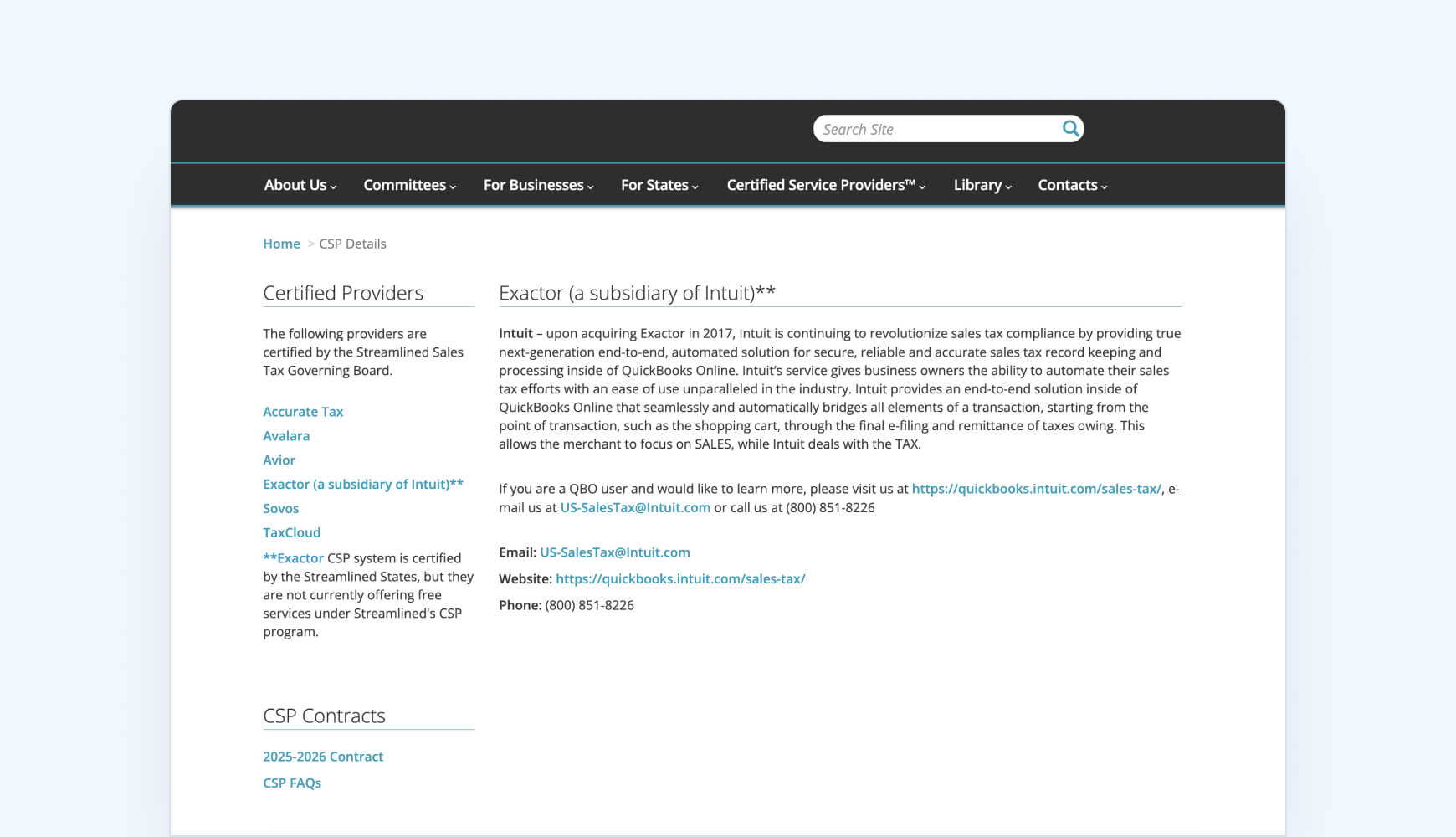
Exactor is Intuit’s built-in tax compliance solution, designed to handle calculations and automate filings for businesses using QuickBooks. Like other platforms in this section, Exactor is a CSP with the SST program, but its SST services aren’t free and may require specific plan levels. The platform is tightly integrated with QuickBooks, making it convenient for smaller businesses that already rely on Intuit tools for accounting, invoicing, and financial management.
Just like TaxCloud and others, Exactor automates return preparation and submission across states, consolidates transaction data from connected systems, and supports product taxability rules. The key differentiator is its connection to QuickBooks. For users in those systems, the interplay between QuickBooks Online and Exactor creates a streamlined workflow that keeps sales tax management inside a familiar environment. Filings in non-SST states are handled through automated workflows similar to other full-service tax tools, though functionality and configuration options may depend on which Intuit products are in use.
At the same time, Exactor is unique in that it’s part of a much larger ecosystem. Because of that, support, notice handling, and return corrections typically run through standard Intuit service channels. This can be convenient for smaller businesses but may feel more limiting to larger brands with complex filing needs. Overall, Exactor is a great fit for companies who are already deeply embedded with QuickBooks and want to expand platform functionality to include sales tax calculation and filing without using a dedicated integration.
National filing providers (non-SST program CSPs)
Not every filing provider participates in the SST program. Many well-known tax platforms still offer nationwide filings but without the benefits, cost savings, or streamlined processes that SST provides.
These non-SST program CSPs solutions range from enterprise tax engines to ecommerce-focused sales platforms with limited filing automation. Despite their lack of SST support, these platforms can still be a good fit depending on company size, tech stack, and filing volume.
That said, teams going with these providers should expect higher overall filing costs and more involved processes along the way.
Vertex

Best for: Larger and enterprise-level companies needing multi-channel tax automation.
Pricing: Custom enterprise pricing.
Notable features:
- Enterprise-grade tax engine
- Managed filing services
- Deep ERP integrations
- Strong support for complex jurisdictions
- Global tax capabilities
Vertex is an enterprise-grade tax engine built for companies operating complex financial systems and large transaction volumes.
Comparatively, this platform is more competitive with Avalara and Sovos than more SMB-focused options like TaxCloud or Numeral. As such, Vertex is less focused on ecommerce and is designed to integrate more deeply with ERP systems like NetSuite and Oracle. This makes it a strong fit for organizations that require highly structured tax automation across multiple business units and jurisdictions.
As a platform, Vertex offers automated return preparation and filing across the U.S., typically through managed services. Under this approach, Vertex handles data ingestion, return creation, filing, remittance, and notice management as a fully outsourced service. While this approach creates predictable workflows, it also tends to require enterprise contracts and longer onboarding times.
Outside of U.S. sales tax, Vertex specializes in global indirect tax, including VAT, GST, and industry-specific tax rules, making it an attractive option for multinational organizations. The platform even works well for companies with dedicated tax departments, as it can supplement current operations with additional automation and compliance tools, as well as managed support.
However, while Vertex works well with enterprise brands, much of its offering and related costs far exceed what smaller companies will need.
TaxJar (Stripe)

Best for: Small- to mid-sized brands that want simple, automated sales tax management and aren’t currently connected to Stripe.
Pricing: Varies based on order volume.
Notable features:
- AutoFile automation.
- Limited registration services.
- Strong Shopify/Stripe integrations.
- Basic reporting dashboard.
TaxJar, part of the Stripe ecosystem, is Stripe’s tax solution for brands who aren’t using Stripe as a payment processor. It’s a well-known tax tool designed primarily for ecommerce sellers using marketplaces like Shopify, BigCommerce, or WooCommerce. The platform provides automated tax calculation and reporting, along with AutoFile services that prepare and submit returns across supported states. For smaller sellers or those with straightforward sales channels, TaxJar provides a simple way to automate recurring tax duties.
AutoFile is TaxJar’s filing mechanism and works by automatically submitting returns based on the transaction data imported into the system. This is a hands-off approach and will appeal to businesses that want filings managed in the background. That said, AutoFile comes with several caveats and limited flexibility. For example, returns can’t be edited once queued, and filings depend entirely on the accuracy of imported data. In other words, AutoFile will submit your returns even if they’re inaccurate, and TaxJar doesn’t review filings before submission.
On the upside, integrations are one of TaxJar’s stronger points. The platform connects cleanly with most major ecommerce storefronts and marketplaces and supports batch imports for custom systems. TaxJar also offers limited registration services, which may be sufficient for early-state sellers filing in only a few states but can become expensive if additional registrations are required once the initial thresholds are reached.
While TaxJar is a great fit for smaller brands who need uncomplicated filing needs, it’s worth noting that there are plenty of alternatives out there that might be a better fit.
Stripe Tax

Best for: Brands already using Stripe for payments or subscriptions who need built-in tax calculations and nexus tracking.
Pricing: Starting at $90/month for Tax Complete. Pay-as-you-go options are also available.
Notable features:
- Automated tax calculation
- Limited filing availability
- Strong for SaaS and DTC billing
- No registration support
- Clean, developer-friendly API
Stripe Tax is the other side of the TaxJar equation and is mainly designed for brands already integrated with the Stripe platform for payment processing, subscriptions, or invoicing.
Because Stripe Tax is built directly into Stripe, it’s easy to enable from the dashboard, integrates immediately with any transactions coming through the Stripe platform, and natively supports tax calculations across thousands of jurisdictions. Overall, this flexibility makes it an appealing option for SaaS and DTC brands that want tax calculations embedded directly into their existing payment stack.
For compliance, Stripe Tax supports automated return preparation, but filing options are limited. By design, Stripe Tax users are meant to partner with one of Stripe Tax’s dedicated filing partners to manage this process. In some ways, this approach effectively shifts filing obligations to a third party, rather than keeping those processes inside your tax platform — as would be the case with a partner like TaxCloud.
In all, this makes Stripe Tax something of a mixed bag. The service is easy to implement for brands already using Stripe, but the need to outsource filing and compliance adds complexity by including third-party partners.
Numeral
Best for: Growing ecommerce and SaaS brands that need full-service tax compliance both in the U.S. and abroad.
Pricing: $75/filing or $150/registration. Custom solutions are also available.
Notable features:
- Automated filing
- Centralized reporting
- Multi-state nexus monitoring
- Modern UI/UX
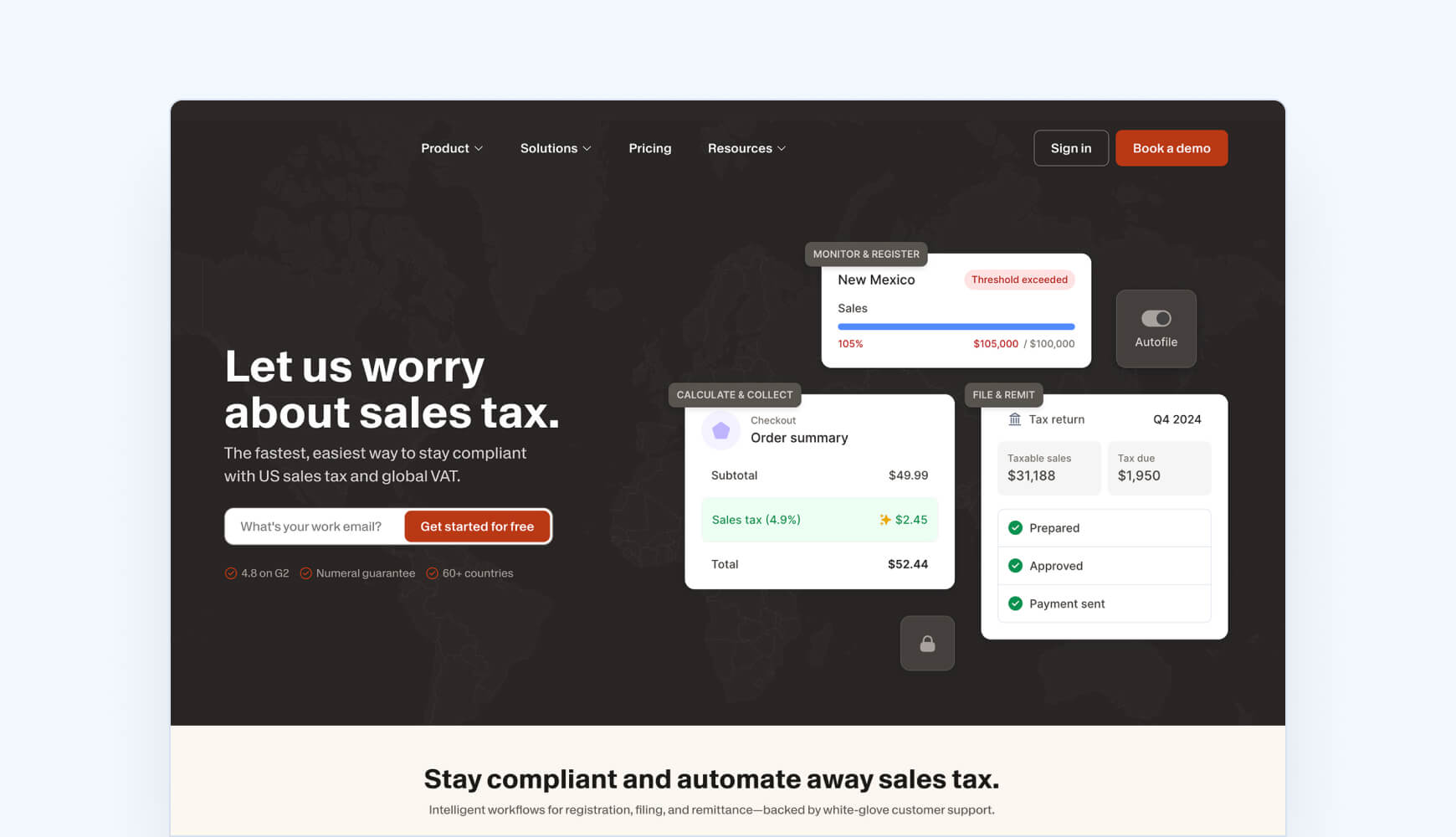
Numeral is a newer sales tax platform built for ecommerce brands looking for a clean-modern interface, straightforward multi-state filing options, and onboard AI functionality. The platform consolidates sales data across marketplaces and storefronts, prepares state-specific returns, and automates filing in supported jurisdictions while keeping a focus on simplicity and usability.
As a platform, Numeral offers nexus tracking, automated return preparation, and multi-state filing, along with dashboards meant to help sellers monitor thresholds and upcoming deadlines. Integrations cover major ecommerce channels, with additional data import options for brands with custom setups. Numeral also offers transparent pricing and guarantees that returns will be filed on time or they’ll pay the penalties and interest charges.
However, while Numeral is sleek and agile, it’s also a new startup. In September 2025, the company raised $35 million as part of a Series B funding round with clear intentions to push hard into the tax space with AI-powered tax automation. This is a major differentiator when compared to a competitor like TaxCloud, which places an emphasis on human-powered support and has a longstanding history in the tax space.
Even so, it’s a great option for modern ecommerce brands who want simple filing automation, a clean interface, and a quick setup without enterprise-level pricing.
Why growing brands choose TaxCloud for multi-State filings
Multi-state filing isn’t something that most brands want to handle in-house. It’s a time-consuming process with evolving rules and regulations that require constant admin and upkeep. That, combined with the looming threat of penalties, audits, and fines, greatly discourage manual and inexpert processes.
Unfortunately, none of those obstacles change the fact that taxes still need to be filed accurately and on time. For that, growing brands need a filing partner that can keep pace with their expansion.
TaxCloud was built for that reality. As a CSP in the SST program, TaxCloud offers free filing and registration in all SST member states, reducing compliance costs immediately. For non-SST states, TaxCloud’s volume-discounted filing model keeps costs predictable as your sales footprint increases.
Behind our platform is a dedicated, U.S.-based filing and support team. Last year, our team filed 85,000 returns on behalf of our customers — a total of $2.5m saved — with no issues while handling notices, frequency changes, jurisdictional updates, and state-specific quirks along the way.
Streamline your multi-state filings across the U.S.
Multi-state filing gets easier when your returns, deadlines, and notices run through one system. TaxCloud centralizes every filing, handles SST states at no cost, and gives you a U.S.-based team to keep returns accurate and on time. Get a walkthrough of the full filing workflow and see how it fits your stack.
Filing sales tax returns tools — FAQs
The Streamlined Sales Tax (SST) program is a multistate initiative meant to simplify tax compliance across all 24 member states. SST reduces administrative work by standardizing definitions, rules, and filing systems. However, only Certified Service Providers (CSPs) like TaxCloud can access the full benefits.
When you use a CSP like TaxCloud, your registrations and filings in SST states are free, and returns are filed through a single, consolidated process. For businesses with filing obligations across multiple states, SST can dramatically reduce both workload and cost.
This will ultimately depend on sales volume and the total number of states where you sell.
If you only sell in one or two states and rarely cross nexus thresholds, you might be able to file manually. However, as soon as you have to file in multiple states, manually filing quickly transforms into a more complicated process.
Exceeding nexus thresholds can happen in unexpected ways, especially for ecommerce brands expanding across digital channels like Shopify, Amazon, or Walmart. In those cases, it’s easy to cross transaction thresholds without knowing, especially if your sales are split across multiple channels, since channel-based tracking tools will only track sales on that platform rather than providing a global view.
Sales tax software adds an additional layer of oversight by consolidating sales from all channels and marketplaces into a unified dashboard, helping teams track nexus accurately, stay ahead of filing deadlines, and avoid penalties as the business grows.
When calculating sales tax, you’re determining how much to charge a customer based on product type, location, and tax rules.
Many online marketplaces have built-in tax engines and filing services that can accommodate this process. It’s also possible to plug in third party calculation engines like the one provided by TaxCloud to add taxes on platforms where that functionality isn’t supported.
Filing is a completely separate process. State-specific returns need to be prepared and submitted through each state portal. Taxes also need to be remitted, and the account needs to be managed. This might involve prepayment or responding to state notices.
While many sales tax platforms support tax calculations (the easy part), few offer the right combination of accuracy, automation, oversight, and transparent pricing that help to lower compliance risk and reduce administrative burdens.
Pricing varies widely across most providers. Some charge per return, per state, or per jurisdiction. Others use managed, third-party services.
Typically, costs range from around $20 – $50 per return for basic automation to thousands per month for custom, enterprise-focused solutions.
TaxCloud is one of the more cost-effective options. As a recognized CSP, TaxCloud can file returns for free in SST member states while non-SST filings use a volume-discounted model that lowers the cost per return as you grow.