Why mid-size Shopify brands are switching to SST filing


Shopify makes it easier than ever for growing brands to scale their business into a nationwide operation.
However, managing the sales tax obligations that accompany that growth is another matter entirely. As nexus expands into additional states, compliance requirements become more expensive and time-consuming to manage. Both filing frequency and the number of total filings increase, along with associated fees.
The Streamlined Sales Tax (SST) program offers a way for merchants to offset those costs. SST allows eligible remote sellers to file through a Certified Service Provider (CSP) like TaxCloud for free across 24 participating states.
In this article, we’ll cover how SST works for Shopify brands, when it makes sense for merchants to consider SST filings, and how to work with a CSP to maximize savings.
Key takeaways
- Sales tax obligations and costs increase rapidly as Shopify brands expand into additional states and exceed nexus thresholds.
- Eligible remote sellers can file for free in 24 SST states by working with a Certified Service Provider like TaxCloud.
- Shopify continues calculating tax at checkout while the merchant’s CPS manages filing and remittance behind the scenes.
Why sales tax filing becomes expensive for scaling Shopify brands
Shopify makes it easy for brands to sell across state lines, and tax filing partners built with Shopify in mind can help to alleviate those burdens. However, each new state that a brand sells into comes with its own sales tax obligations.
Once a merchant crosses a state’s economic nexus thresholds, they’ll need to comply with all jurisdictional requirements. Typically, that includes registering with the state, filing and remitting tax, and responding to any jurisdictional notices.
Over time, these requirements compound, creating additional expenses, complexities, and timesinks that ultimately cut into brand profitability.
Nexus growth creates additional overhead
Expanding into each new state increases the compliance obligations that a brand has to manage.
Once a Shopify merchant establishes nexus in a state, the business is responsible for complying with state regulations and requirements. When the organization is small and only needs to manage filings for one or two states, the process is manageable. However, even attempting to manage a handful of states can create an administrative workload that pulls key workers away from daily operations.
Because most states have different reporting requirements, deadlines, and rules, it’s easy for companies to find themselves overwhelmed with unanticipated compliance obligations. When that happens, companies run the risk of fines, penalties, and audits for failure to comply with regulatory requirements.
Filings costs and frequency scale with revenue
In addition to increasing the number of states where filings occur, brand growth usually increases the frequency and number of returns required for each state.
A Shopify brand that initially files quarterly in a small group of states will eventually transition to monthly filings in each state as revenue increases. That shift dramatically increases compliance costs in both time and effort, which scales proportionally in every jurisdiction.
Brands who are unprepared to deal with the uptick in filing frequency are likely to see taxes as a constant obstacle to success and are more likely to miss deadlines. Even when partnering with a dedicated tax compliance solution, the operational expenses required to automate and offload the administrative burden can sting the bottom line.
State filing requirements become more complex
Sales tax compliance becomes more difficult to manage as filing obligations spread across additional states.
Because each jurisdiction maintains its own requirements, maintaining compliance becomes a major challenge. Some states require local tax reporting while others handle exemptions, marketplace sales, or amended returns differently.
Additionally, that complexity increases over time. As the brand scales, teams need to coordinate filing across a much larger network. Without a centralized filing process, even minor differences between jurisdictions can create trouble that organizations are ill-equipped to handle.
The 24 SST states and what they mean for Shopify Sellers
The Streamlined Sales Tax (SST) program is a multi-state partnership designed to reduce the complexity of sales tax compliance for remote sellers.
Participating states work together under a shared framework that simplifies registration and filing requirements for eligible merchants. Instead, companies can work with Certified Service Providers (CSPs) like TaxCloud, who then manage filings on their behalf.
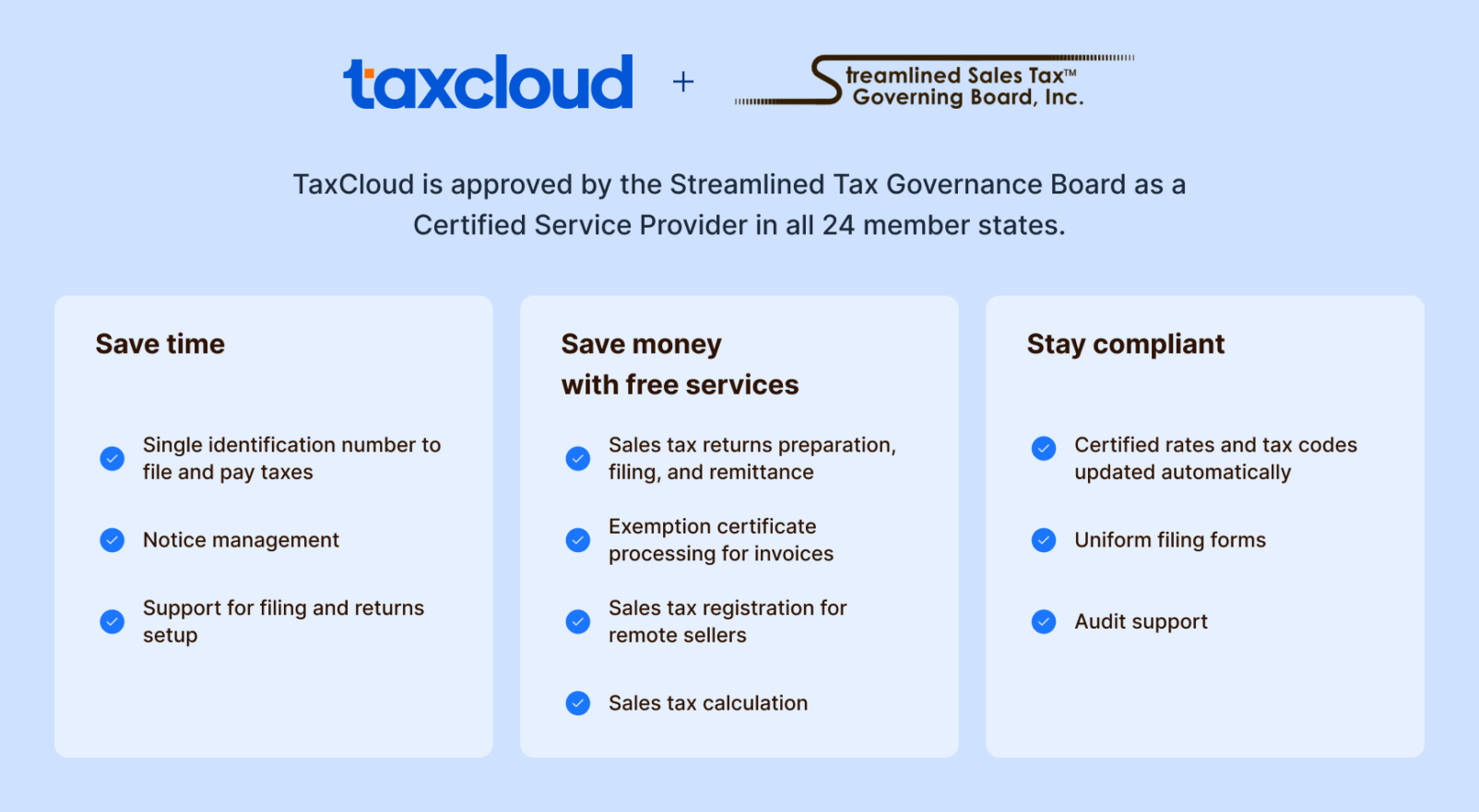
For Shopify brands filing across multiple states, SST introduces a different compliance structure and a few cost-saving opportunities that separate it from the traditional filing process.
Main benefits of SST for Shopify merchants
While SST carries many benefits for the states themselves — primarily in reducing the administrative overhead and simplifying the tax process for ease of use — the program also benefits remote sellers.
For Shopify merchants filing under multiple jurisdictions, the SST program streamlines ongoing filing operations and lowers the cost of maintaining compliance in participating states.
Here’s a closer look at the benefits that SST delivers to Shopify sellers who partner with a CSP:
- Free or reduced filing costs in participating states.
- Centralized filing and remittance workflows through a CSP.
- Simplified registrations across all SST member states.
- Lower administrative burdens related to multi-state compliance.
- Easier long-term management as nexus obligations expand.
These benefits and impacts become more noticeable as filing obligations increase and brands expand, but the streamlined filing mechanisms, savings, and ability to offload to a certified partner make SST a valuable option for merchants who want to reduce filing costs and compliance-related workloads.
Why SST filing is free for eligible remote sellers
One of the biggest differences between SST and traditional filing models is how the filing process is funded.
In the traditional model, the merchant has to pay the filing provider directly for each return submitted. These rates vary between providers. TaxCloud filing fees start at $39 per return and can drop as low as $20 per return with volume discounts. Other services may charge upwards of $75 per filing or more.
Under the SST program, participating states compensate the CSP for handling eligible filings on behalf of remote sellers. That means qualifying Shopify merchants can partner with a CSP to file and remit tax in SST states without paying separate filings fees in that jurisdiction.
Merchants may still be responsible for other charges, such as paying the CSP for calculating taxes, using integrations, or similar services, but the SST program prevents CSP from charging for filing services, as those are already covered by the program.
Where SST doesn’t apply
Although SST can significantly reduce filing costs for eligible remote sellers, there are situations where standard filing rules will still apply.
Physical presence within an SST state is one of the most common examples. If a Shopify merchant maintains operations such as warehouse inventory, employees, or office locations inside a participating SST state, that state may not qualify for SST filing.
However, note that any such limitation only applies to the affected state. A merchant with a physical presence in Ohio, for example, may still qualify for SST filing benefits in other participating states where no physical presence exists.
Real savings from real Shopify sellers
Sales tax filing costs can compound quickly once a Shopify brand begins operating across a large number of states.
The costs and complications associated with compliance have forced many ecommerce brands to reconsider how they manage filing and remittance operations as they scale. SST filing and CSP partnerships offer a way to reduce that burden for eligible sellers.
Here’s a closer look at two brands who found success in lowering costs by working with TaxCloud.
SLEEFS
A performance apparel brand for athletes, SLEEFS is a Shopify brand that found itself growing exponentially as it transitioned from a passion project to a full-blown ecommerce retailer.
Because they grew so quickly, the team had been managing filings manually in 37 states. They would export and upload the order data themselves, fill out the paperwork, and file with each state.
While SLEEFS initially turned to TaxCloud for help organizing and automating their tax compliance, the TaxCloud team also helped them save on filing costs in all 24 SST states. Once integrated with the program, TaxCloud was able to take over as their CSP and use the simplified filing system to remove that administrative workload off their plate.
For the remaining states, TaxCloud’s automated filing solutions import the data from Shopify, file with the appropriate states, and remit payments on time with minimal engagement from the SLEEFS team.
Rareform
As a brand, Rareform got an incredible boost due to the company’s appearance on the hit television show Shark Tank. The company managed to secure a deal, and the publicity made their sales skyrocket overnight. The sudden surge, while great for business, became a tax nightmare as nexus triggered in 30 states overnight.
At the time, Rareform was working with Avalara and moved to TaxCloud after seeing them listed as a CSP with the SST program. During the onboarding process, TaxCloud helped the company register with the SST program and took over as their CSP.
Through the SST program, TaxCloud was able to reduce Rareform’s filings by nearly 60%, down from nearly 300 to around 120 annual filings!. The team eliminated those filings fees entirely — a huge savings — and took over the administrative burdens associated with filing and compliance.
In turn, Rareform was able to take the money they saved and reinvest into their own growth, which allowed them to scale even faster.
When Shopify merchants should consider SST
SST becomes more valuable as Shopify businesses grow into larger, multi-state operations. Typically mid-sized businesses (avg. $5M in yearly revenue) stand to benefit the most.
A merchant filing in only a few states may still be able to manage compliance manually or absorb relatively small filing costs without major operational strain. That changes once filing obligations are spread across a much larger area with different rules and deadlines.
At that point, SST enrollment might be a good fit. Common signs that the program is worth exploring include any of the following:
- You’re filing in a growing number of states and multi-state compliance is becoming more difficult to manage.
- Filing frequency has shifted from quarterly to monthly, dramatically increasing the total number of annual returns that the business needs to file.
- Sales tax filing costs are becoming noticeable as filing fees stack across multiple states.
- Your team spends too much time managing returns manually, including reconciliation work, filing deadlines, and notice management.
- You sell remotely into multiple SST states and may qualify for free SST filing treatment in participating jurisdictions.
- You want a simpler way to manage multi-state compliance through a centralized filing workflow, rather than a state-by-state process.
- You’re interested in working with a tax partner who can help you organize, automate, and offset filing costs.
While all of these are strong indicators that SST is a viable solution, the last one is particularly important for the SST program.
Though it’s possible for companies to enroll in the SST program by themselves, the program is designed specifically for partnership with a CSP. Without one, the company will still be responsible for calculating, filing, and remitting sales tax to each of the member states. This approach is free, but it’s operationally similar to what a company would do without SST enrollment.
Outside of the SST program, tax compliance platforms charge to file on your behalf. However, CSPs take the administrative duty away from the merchant and also file via SST at no cost because the program is subsidized by the states, who pay the CSP directly.
How Shopify and TaxCloud work together for SST filing
Even though SST filing changes how sales tax returns are managed, it doesn’t require Shopify merchants to overhaul their ecommerce operations.
In fact, the way Shopify is set up to calculate tax internally simplifies the transition to CSP adoption and SST filings. Particularly when working with TaxCloud, Shopify merchants will still use Shopify Tax to handle calculations before passing that information over to TaxCloud for filing and remittance.
Here’s a closer look at how the process works.
Shopify still calculates tax at checkout via Shopify Tax
Shopify Tax is Shopify’s native tax engine and handles local sales tax calculations for most buyers and sellers. The engine calculates sales tax based on the buyer’s shipping address and uses its own product categorization to determine exemptions.
However, Shopify Tax doesn’t natively file or remit taxes for merchants. Instead, vendors need to either file by themselves or work with a tax compliance partner, which is likely to incur additional charges.
When trying to take advantage of SST savings, brands using Shopify Tax to handle tax calculations can continue to do so with no change in deployment. They’ll simply need to select a vendor certified to work with SST program and work with them to file via the SST program.
TaxCloud is a preferred choice in this scenario, as our team regularly saves an average of $30 to 70% on filing costs between SST and filing volume discounts. To work with TaxCloud and enroll in SST, merchants will need to install TaxCloud’s Shopify integration, which allows TaxCloud to pull sales data from Shopify.
Quick note: Even though TaxCloud offers a calculation engine, we don’t provide real-time sales tax calculations for Shopify. Our integration only pulls Shopify sales data into our platform so that our systems can file and remit tax on your behalf.
TaxCloud handles registration, reporting, full nexus, filing and remittance
While Shopify Tax focuses on calculating tax during checkout, TaxCloud handles the compliance side of the process after the transaction occurs.
Once connected through the Shopify integration, TaxCloud pulls transaction data from Shopify and uses that information to prepare and file sales tax returns on the merchant’s behalf. That includes SST filings where the merchant is eligible as well as direct filing workflows in non-SST jurisdictions.
TaxCloud also manages tax remittance workflows, so merchants can centralize all tax operations, rather than coordinating separate state-by-state filing processes. All the data flows to one place, and TaxCloud’s dashboards make it easy to see where nexus and compliance thresholds have been met.
In the event that merchants begin selling through multiple marketplaces or channels (Amazon, Walmart, etc.) TaxCloud’s marketplace orders consolidation can also help teams get a full view of their compliance obligations, regardless of where sales take place.
Planning for a blended filing model
While SST can reduce filing costs, it only does so in the 24 participating states. Merchants must still maintain compliance in direct (non-SST) states, which requires following a more traditional filing process.
Fortunately, TaxCloud is set up to support both models within the same platform.
Eligible SST filings can be managed through the SST program while non-SST state filings can move through TaxCloud’s standard filing services. This allows merchants to bring compliance under one roof rather than splitting responsibilities across multiple systems or providers.
Sellers partnering with TaxCloud also gain the back office infrastructure needed to handle taxes from multiple channels or across multiple states, regardless of how the business expands. When nexus thresholds are crossed — both in SST and non-SST states — TaxCloud can systematically handle those new obligations with no change in the workflow.
Automate SST filing with TaxCloud
SST can significantly reduce the filing costs for Shopify sellers, but the associated benefits extend beyond monetary savings.
As brands grow, centralized compliance management becomes more important. TaxCloud can help merchants manage filing, remittance, and SST enrollment via a single workflow build to support both SST and non-SST states.
TaxCloud helps Shopify merchants:
- File and remit sales tax through SST, where eligible.
- Reduce filing via the SST program.
- Maintain Shopify’s existing checkout workflows.
- Sync Shopify sales data to a consolidated dashboard.
- Centralize multi-state filing operations.
- Simplify compliance management as the business scales.
For merchants with a growing number of state filing obligations, leveraging SST is a proven way to create lasting operational and financial savings over time. But, to get the greatest benefit from the program, you’ll need a CSP who actively pursues those savings and can operate on your behalf.
That’s TaxCloud.
Want to know more?
Get in touch with one of our product specialists to see if your business qualifies for SST filing benefits.

Shopify SST — FAQ
The Streamlined Sales Tax program (SST) is a multi-state program designed to simplify sales tax compliance for remote sellers.
Participating states work with Certified Service Providers (CSPs) like TaxCloud to help eligible businesses manage registrations, filings, and remittance requirements across SST jurisdictions.
Companies who partner with a CSP to take advantage of the program can file for free in all 24 member states, drastically reducing costs associated with the filing process. Additionally, the CSP can act as a liaison between SST states and the brand, becoming the first point of contact in the event of an audit.
Yes. In participating states, eligible merchants don’t pay direct filing fees when working with a Certified Service Provider like TaxCloud. Eligibility varies depending on whether the merchant has partnered with a CSP and whether the brand has any physical presence in the state.
For more information, consult the SST website to determine how to qualify for free CSP services.
No.
While Shopify calculates sales tax at checkout, filing and remittance responsibilities remain with the merchant. However, merchants can partner with sales tax compliance platforms like TaxCloud to handle that aspect of the process.
Typically, a compliance partner will use an integration to access Shopify Tax’s calculations, then use that information to create the correct paperwork, file it, and remit the appropriate fees to state agencies.
Unfortunately, physical presence inside an SST state is likely to affect eligibility in that state. This holds true if the company has a storefront, holds inventory, or hires employees in that state.
However, the eligibility requirements have some flexibility. Consult the main SST website for more information.
Yes. TaxCloud supports both SST and non-SST filing workflows.
This enables Shopify merchants to manage multi-state compliance through a centralized platform even when filing in non-SST states. Teams will be able to use TaxCloud’s dashboards and nexus tracking tools to fully understand their tax obligations, regardless of how many sales channels they use.
For brands planning to expand outside of Shopify, the ability to centralize all tax data into a single dashboard is necessary to maintain compliance. With TaxCloud data is sorted and routed automatically, so you can monitor nexus thresholds, filing schedules, and more at a glance.