Stripe Tax alternatives: Find the best option for your ecommerce business

Written by

Head of DemandGen, TaxCloud

Updated
Stripe Tax is a popular choice for ecommerce brands using Stripe to process payments. The platform integrates with the entire Stripe ecosystem, allowing for simple, easy, and accurate tax calculation at checkout.
However, sales tax compliance doesn’t end when a transaction is complete. As companies expand into new states, add additional sales channels, or take on new filing obligations, they regularly reach the limits of what Stripe Tax can handle on its own.
That doesn’t necessarily mean replacing Stripe Tax. In fact, many teams continue to use it for payment-native tax collection on Stripe while integrating with a dedicated compliance platform to manage the rest of tax obligations.
In this guide, we’ll compare some of the leading Stripe partners and alternatives to help you determine which solution is the best fit for your business.
Why companies add a Stripe Tax compliance partner
By design, Stripe Tax only calculates sales tax collection on transactions captured through Stripe. Almost all other duties within the tax lifecycle — including filing and remittance — are handled by third party solutions.
Because of these limitations, companies end up adding a compliance partner to Stripe Tax to better accommodate their own tax workflows. The best solution will depend on what the business ultimately wants to accomplish.
| As your business grows, you might want to... | You’ll need a filing partner with these features... |
|---|---|
| File sales tax returns in multiple states | Automated filing & remittance |
| Transact payments outside of the Stripe ecosystem | Multiplatform tax calculations & reporting |
| Track nexus across all sales channels | Multichannel nexus tracking |
| Simplify state registrations | Registration assistance |
| Manage tax exempt customers and documentation | Exemption certificate management |
| Reduce or eliminate filing costs | Streamlined Sales Tax (SST) enrollment |
| Resolve prior-period tax exposure | Voluntary Disclosure Agreement (VDA) support |
| Establish a filing presence in new states | Virtual mailbox services |
| Expedite responses to government notices or audits | Ongoing compliance support |
As a reminder, sales tax compliance typically involves each of the following steps:
- Registration
- Tax calculation and collection
- Filing returns and remitting tax.
- Monitoring nexus and compliance obligations.
- Responding to audits and notices.
As these responsibilities become more complex, companies will need to decide whether to extend Stripe Tax with a compliance partner or ultimately replace it with a broader tax solution.
Stripe Tax: an overview

- Best for: Companies already using Stripe for payment processing.
- Starting price: 0.5% per transaction
- Core functionality: Sales tax calculation and collection
- Coverage: Global
- Compatibility: Stripe ecosystem
Stripe Tax is a tax calculation and collection tool built into Stripe’s payment ecosystem. This solution supports over 100 countries across more than 600 product types, making it a versatile choice for merchants who plan to scale into international markets.
As a standalone solution, Stripe Tax covers the transaction side of sales tax compliance well enough to meet the needs of many small and growing businesses. Companies selling exclusively through Stripe can engage Stripe Tax with a few clicks on the Stripe Dashboard and begin collecting accurate tax in minutes.
However, Stripe Tax offers no native solution for filing and remittance. Even within Stripe Tax’s subscription plans, these solutions are handed off to third-party partners. The platform simply isn’t designed to handle those requirements internally.
Because of these limitations, businesses with more complex compliance requirements — marketplace transactions, increased filing frequency, multi-channel payment processing, etc. — often need additional compliance services to close the loop on outstanding obligations.
What Stripe Tax does well
- Native Stripe integration. Stripe Tax can be enabled directly from the Stripe Dashboard without implementing a separate tax engine or integrating another platform.
- Instant, international tax calculations. In addition to U.S. sales tax, Stripe Tax supports VAT and GST in more than 100 countries and covers hundreds of product categories.
- Highly accurate calculations with minimal effort. Stripe Tax automatically calculates the appropriate tax with a high level of accuracy based on customer location and applicable tax rules with minimal merchant involvement.
When companies often add a compliance partner
- Sales are taking place across multiple platforms. Stripe Tax doesn’t have visibility on transactions that take place outside of the Stripe ecosystem. This creates compliance and reporting challenges that typically require another partner to resolve.
- Filing frequency increases. Many companies grow to the point where they exceed the filing credits allotted on the Tax Complete plan and seek lower rates with third-party partners.
- Specialized services are required. While Stripe Tax can assist with state registrations, some services are beyond the native scope of the platform, including exemption certificate management and voluntary disclosure agreements (VDAs).
| Feature | TaxCloud | Avalara | Vertex | Anrok | TaxJar | Numeral | TaxValet | Quaderno |
|---|---|---|---|---|---|---|---|---|
| Stripe Tax role | Partner | Replacement | Replacement | Replacement | Partner | Replacement | Partner | Replacement |
| Tax calculation | ✅ | ✅ | ✅ | ✅ | ✅ | ✅ | ✅ | ✅ |
| Return filing & remittance | ✅ | 💲 | 💲 | ✅ | ✅ | ✅ | ✅ | ✅ |
| State registrations | 💲 | 💲 | 💲 | ✅ | 💲 | 💲 | ✅ | 💲 |
| Multichannel support | ✅ | ✅ | ✅ | ✅ | ✅ | ✅ | ✅ | ✅ |
| Nexus tracking | ✅ | ✅ | ✅ | ✅ | ✅ | ✅ | ✅ | ✅ |
| Exemption certificate management | ✅ | 💲 | 💲 | Varies by plan | API only | Varies by plan |
💲 3rd party |
Limited |
| Voluntary Disclosure Agreements (VDAs) | ✅ | 💲 |
💲 3rd party |
💲 3rd party |
❌ | Varies by plan | 💲 | ❌ |
| Virtual mailbox services | ✅ | ❌ | ❌ | ❌ | ❌ | ✅ | ❌ | ❌ |
| Streamlined Sales Tax (SST) | ✅ | ⚠️ See review | ❌ | ❌ | ❌ | ❌ | ❌ | ❌ |
| Support Scoring (G2) | 8.5 | 6.8 | 7.7 | 8.7 | 8.9 | 9.1 | 9.6 | 8.9 |
Best Stripe Tax filing partners
Because Stripe is such a popular payment processor, there’s no shortage of platforms and partners to interact with it.
Some sales tax platforms are designed to work with and extend Stripe Tax with additional compliance services. Others offer their own calculation engine and can fully replace it. Almost every solution offers variations on pricing, scope, and scale.
Take a look below to see where each platform excels, what potential drawbacks you might encounter, and whether the service you choose will partner with or replace Stripe Tax.
TaxCloud

- Best for: Growing ecommerce & SaaS companies
- Starting price: $199/year; $39/filing
- Core functionality: End-to-end sales tax compliance
- Coverage: U.S. & Canada
- Compatibility: 12+ integrations + sales tax API
- Stripe Tax role: Partner
TaxCloud is an end-to-end solution that helps businesses manage all aspects of sales tax compliance.
Equipped with its own calculation engine, TaxCloud can integrate with a variety of sales channels to calculate tax, import data, and track nexus thresholds with its own systems. When it’s time to file and remit, TaxCloud compiles the data, completes the forms, and submits both paperwork and payments on your behalf.
In addition to other services, TaxCloud is one of only a few Certified Services Providers in the Streamlined Sales Tax (SST) program and actively works to enroll all qualifying customers. When enrolled, companies are able to file for free in up to 24 participating states, which can save thousands in annual filing costs.
Unlike many platforms on this list, TaxCloud is designed to work with Stripe Tax rather than replace it. In this scenario, TaxCloud’s engine won’t replace Stripe Tax’s own calculations. Companies can still use Stripe Tax to calculate and collect tax on Stripe while using TaxCloud to automate filings, manage exemption certificates, and handle other administrative duties.
For marketplaces and storefronts that don’t process transactions with Stripe, the TaxCloud engine can fill that gap by integrating directly with those sales channels. As sales are transacted, data flows into the TaxCloud dashboard, where the consolidated results are used to track nexus and maintain compliance. The Stripe integration performs the same way by enabling Stripe Tax’s sales data to pass to TaxCloud so that teams can get a holistic view of their tax obligations prior to filing.
Why choose TaxCloud
- Built for the complete compliance lifecycle. As an end-to-end platform, TaxCloud can handle everything from registrations to calculation, filing, remittance, and more without requiring enterprise software or complex, custom configurations.
- Reduced filing costs. TaxCloud’s filing costs reduce from $39/filing to as low as $19.99/filing with volume discounts. Plus, SST participating can eliminate filing costs completely in up to 24 states. All pricing is transparent.
- U.S.-based support specialists. The TaxCloud support team is based in the U.S. and is available via phone and email.
How TaxCloud complements Stripe Tax
- Continue using Stripe Tax for Stripe-based checkouts. TaxCloud doesn’t require companies to abandon or replace Stripe Tax. Instead, teams can continue calculating and collecting tax using established tools while TaxCloud manages return filing, remittance, and ongoing compliance needs.
- Expand beyond the Stripe ecosystem. As companies begin selling through additional storefronts, marketplaces, or payment processors, TaxCloud consolidates all data in one place to vastly improve nexus tracking and filing accuracy.
- Add services as compliance needs grow. TaxCloud offers capabilities such as SST enrollment, VDA assistance, audit support, virtual mailbox services, and exemption certificate management, so businesses can extend their compliance workflow without changing payment providers.
Customer perspectives
It would have cost us around $40,000 a year to go with a company that wasn’t an SST program participant. With TaxCloud being significantly less expensive than Avalara, we ended up seeing around 40 to 50% in savings.

TaxCloud was ‘set it and forget it’ for us. It just works, and that lets me sleep at night.

Switch to TaxCloud
TaxCloud provides sales tax calculation, nexus tracking, registration, and filing for SaaS and ecommerce businesses without enterprise-level costs.
Get fully automated sales tax compliance with transparent pricing and U.S.-based expert support included in every plan.
Avalara

- Best for: High-end mid-market & enterprise brands
- Starting price: Custom
- Core functionality: End-to-end tax automation
- Coverage: Global
- Compatibility: 1,400+ integrations
- Stripe Tax role: Replacement
Avalara is one of the largest and most established sales tax compliance platforms on the market, offering end-to-end compliance services that make it a common choice for larger organizations with complex compliance requirements.
This platform includes its own tax engine and effectively seeks to replace all other systems with its own. Upon integration with Stripe, Avalara will replace Stripe Tax, effectively changing how tax is calculated and where tax information is stored.
Similar to TaxCloud, Avalara is an SST provider and offers enrollment in the platform. However, users regularly report poor customer service, missed filings, double payments, and other problems that are difficult to resolve. Customers switching from Avalara to TaxCloud have also disclosed that Avalara was reluctant to enroll them in the SST program or omitted that opportunity altogether, ultimately costing tens of thousands in unnecessary fees.
Avalara is well-suited for teams that want to consolidate tax calculation and compliance into a single enterprise platform. However, companies that are satisfied with Stripe Tax’s capabilities may find that other compliance solutions offer a simpler and more cost-effective approach.
Why choose Avalara
- Built for complex environments. Avalara supports sales tax compliance at an enterprise scale. Custom configurations can connect ERPs, CRMs, and storefronts to create a unified solution far beyond what most compliance platforms can offer.
- Extensive integration ecosystem. With more than 1,400 integrations and additional API options, Avalara has the ability to connect with most business systems and services.
- Global tax coverage. Like Stripe Tax, Avalara supports VAT, GST, customs, and U.S. sales tax. The system can also accommodate other indirect tax requirements for businesses operating internationally and can provide support for those compliance scenarios.
Potential blockers
- Custom pricing makes costs hard to track. Avalara rarely publishes standardized pricing, and cost mechanisms can be difficult to predict. Some plans are flat-rate options while others are based on transaction volume, integration requirements, filing requirements, or additional services.
- SST participation may require closer review. Some former Avalara customers report that they weren’t fully enrolled in or advised on expanding their SST participation, resulting in higher filing costs.
- Enterprise-first platform. Smaller ecommerce companies may find Avalara’s features to be far more than what they actually need. The company has actively stripped away many of its SMB-targeted solutions over the years — such as the RSB program — to lean more heavily toward enterprise deployments.
Customer perspectives
Avalara filed some of our taxes correctly but missed several filings. They did nothing to help the situation. There was a bug with the shopify connector (their product) and we were stuck with the late fees. [However,] their communication is incredibly poor. I requested an update to our contract and they neglected to send it to me. I canceled our service and they continued to bill me.

I love that Avalara has experts to know all the state laws when it comes to sales tax. With the addition of economic nexus, our state collection requirements more than doubled and Avalara helped us to get compliant in all the states we needed to. [However,] customer support could use some work. I understand there are thousands, if not more, of clients probably constantly reaching out for help so do understand the delays that can be had, but some of the responses we get are just the canned, “out of the handbook” responses that do not really offer any help.
Vertex

- Best for: Enterprise
- Starting price: Custom
- Core functionality: Enterprise tax automation
- Coverage: Global
- Compatibility: 120+ partner integrations
- Stripe Tax role: Replacement
Vertex is an enterprise tax automation platform built for large organizations with sophisticated tax and accounting requirements. Like Avalara, Vertex offers end-to-end tax compliance across domestic and international markets. However, where Avalara is widely used by mid-market and enterprise companies, Vertex has historically focused on large enterprises with complex ERP environments and dedicated tax departments.
While Vertex offers several integrations, the vast majority are targeted toward specific industries, as well as ERPs and CRMs. For context, TaxCloud — a much smaller organization — offers 12+ integrations focused around ecommerce and SaaS while Vertex only offers two.
Specifically for Stripe, teams aligning with Vertex can only connect via API. Doing so will replace Stripe Tax with Vertex and allow payment information to flow into the Vertex ecosystem. Teams will need to configure and maintain this setup.
For organizations with mature finance and tax teams, Vertex’s flexibility with integrations and APIs can be a significant advantage. For smaller ecommerce brands, this solution runs into problems around implementation, long-term cost, and scalability. Similar to Avalara, Vertex’s enterprise-first infrastructure and pricing will be out of reach for smaller teams, but its built-in complexity is likely far more than small- and mid-market teams realistically need.
Why choose Vertex
- Built for enterprise organizations. Vertex is a great fit for organizations managing multiple legal entities, complex reporting requirements, or high transaction volumes at a global scale.
- Deep ERP connectivity. The platform integrates well with leading enterprise ERPs, including SAP, Oracle, Microsoft Dynamics, and similar tools. Vertex can then interlink these systems to financial and inventory hubs (just like Avalara) to create a compliance system that spans the entire organization.
- Highly configurable tax engine. Companies using Vertex can tailor tax determination, reporting, and workflows to align with industry-specific regulatory compliance, international regulations, and more.
Potential blockers
- Implementation requires technical resources. While Vertex has some integration options, the platform is largely designed around API connectivity and enterprise deployments rather than turnkey ecommerce connectors.
- High costs for smaller teams. Custom contracts and implementation projects may place Vertex outside the budget of many mid-sized ecommerce businesses.
- Limited value without dedicated teams. In large part, Vertex implementations involve finance, tax, and IT stakeholders working together. Companies without those in-house teams may lack the maturity to get actionable value from the deployment.
Customer perspectives
I love how Vertex calculates our sales tax for all of my company’s ecommerce orders. I appreciate that as jurisdictions change tax rules and rates, everything is automatically updated in our system. [However,] the custom reporting is sometimes hard to make it give me the data I want. It can be a little confusing as there are just so many categories and different ways to ‘group’ info that I’m not always sure what I need.
The taxability information available in the tool. I am able to look up a specific taxability category and see what states a product is taxable in as well as the specific state rules related to that product. When it comes to reporting, I find that some of the reports in Vertex are confusing and feel more like a data dump than a truly usable report. While using Vertex’s reporting features, I often had to manually manipulate the data quite a bit just to extract the information I needed.
Anrok

- Best for: SaaS
- Starting price: $100 per market(state)/month
- Core functionality: SaaS-focused tax compliance
- Coverage: Global
- Compatibility: 35+ integrations
- Stripe Tax role: Replacement
Anrok is a tax automation platform built specifically for SaaS and AI companies with recurring revenue models. Rather than serving the broader ecommerce market, Anrok focuses on subscription billing, digital products, and the confusing taxability rules that software companies encounter as they scale.
The platform is designed to automate the entire tax lifecycle in a single platform. SaaS companies can use it to manage recurring compliance obligations and shifting tax rules from one location, rather than spreading those duties across multiple solutions.
However, to make this shift, Anrok will replace Stripe Tax. Teams can continue to use Stripe as a payment system, but Anrok will calculate tax and pull that information into its own system, bypassing Stripe Tax’s built-in calculation engine.
Anrok’s SaaS-heavy specialization will be attractive for many tech companies, but businesses with more traditional ecommerce or retail operations won’t find these features applicable to their day-to-day compliance needs. Merchants in that situation will be better suited to other alternatives.
Why choose Anrok
- Purpose-built for SaaS companies. Anrok specializes in subscription billing, digital products, and usage-based pricing rather than traditional ecommerce transaction models.
- Easy integration with most billing & HR platforms. Native integrations with billing and HR platforms make compliance easier for smaller brands without in-house IT teams.
- Registrations are done at-cost. Unlike most other platforms, Anrok doesn’t charge additional fees for state registrations. Companies are still responsible for paying jurisdiction-imposed registration fees, but Anrok doesn’t charge for the service itself.
Potential blockers
- Narrow industry focus. In some ways, Anrok’s greatest strength is also a weakness. Although SaaS companies will thrive with the platform, it won’t be a great fit for merchants selling through more traditional systems.
- Limited public pricing. Aside from the Starter plan ($100 per market/month), all Anrok pricing is custom, making it difficult to know how much compliance will cost.
- Some global tax compliance gated by plan. While Anrok’s offers global coverage for all plans, some key countries (notably China) are locked behind premium access.
Customer perspectives
What I appreciate most is how seamlessly it synchronises with Stripe and how user-friendly the experience is. Uploading tax certificates is straightforward, thanks to its smooth integration with Stripe, and it even processes refunds automatically when a certificate is detected. This has made managing these tasks much simpler for me.
Anrok makes sales tax compliance simple and reliable. We use it to manage all our tax jurisdictions, and it automatically alerts us to new exposures so we stay compliant in every state.
TaxJar

- Best for: Non-Stripe U.S. sellers
- Starting price: $39/month
- Core functionality: End-to-end sales tax compliance
- Coverage: United States
- Compatibility: 40+ integrations
- Stripe Tax role: Partner (Stripe-owned)
TaxJar is in a strange place when compared to other platforms on this list because it’s owned by Stripe and is built specifically for U.S.-based small- and mid-sized companies selling outside of the Stripe ecosystem. Stripe merchants are directed to Stripe Tax while TaxJar handles all other forms of payment processing.
At the same time, TaxJar is the default partner for Stripe Tax. Because Stripe Tax is only a calculation engine, all filing and remittance is outsourced from Stripe Tax to third-party solutions. In the U.S., TaxJar is that solution, and the platform is responsible for those aspects of the compliance process.
Put another way: If you’re using the credits from the Tax Complete plan to file in the U.S., you’re already using TaxJar.
However, merchants who need to process payments outside of Stripe Tax will need to set up an entirely separate account with TaxJar and use the platform’s own calculation engine (not Stripe Tax!) in order to handle those payments. Because the platforms are two separate products, calculations from Stripe Tax and TaxJar aren’t natively combined into a single filing. This might be possible by reaching out to support, but it’s an extra headache that merchants will need to sort out before they can synchronize reporting.
Why choose TaxJar
- Direct filing relationship with Stripe Tax. As a direct partner and Stripe-owned company, TaxJar already receives transaction data from Stripe Tax. This service will already be familiar to merchants using Stripe Tax.
- Keeps Stripe Tax in place. Companies using Stripe Tax can utilize TaxJar to extend coverage across non-Stripe sales channels and continue to use Stripe/Stripe Tax as their primary payment solution.
- Broad integration options. TaxJar connects with most major ecommerce, marketplace, and accounting platforms, making it a practical solution for companies generating revenue through online channels.
Potential blockers
- Possible conflicts with Stripe Tax. Stripe Tax data and standalone TaxJar data aren’t automatically merged across separate accounts. Companies can work with TaxJar support to attempt consolidation, but separate filings may be required.
- Drastic price increase in late 2026. TaxJar’s 2026 pricing update adds a substantial increase (roughly 100% or more) in costs across all platform services, annual subscriptions, and Autofile fees.
- Filing options are limited. Subscription plans only include a set number of AutoFile credits, and businesses with additional state returns should expect to incur additional per-filing charges.
Customer perspectives
TaxJar is valuable because it helps us double-check our SAP tax setup by validating the ship-to address, confirming the correct city/county/state jurisdiction, and showing the tax rate breakdown. TaxJar works well overall, but it is not perfect every time. Sometimes we still need to manually review results when there is a missing rate, a rate mismatch, or an address that does not validate clearly.
It is a very simple platform, the interface is user friendly, and allows you to get things done fairly fast. [However,] not all businesses are subject to the same sales tax rules in every state. They don’t have options to exclude yourself from certain taxes like the B&O tax in WA when using their automatic filing system. Until recently you could not change if shipping was taxable or not based on your particular business situation.
Numeral
- Best for: Multichannel ecommerce and SaaS companies
- Starting price: $75 per filing
- Core functionality: Sales tax and VAT compliance
- Coverage: Global
- Compatibility: 30+ integrations
- Stripe Tax role: Replacement (mostly)
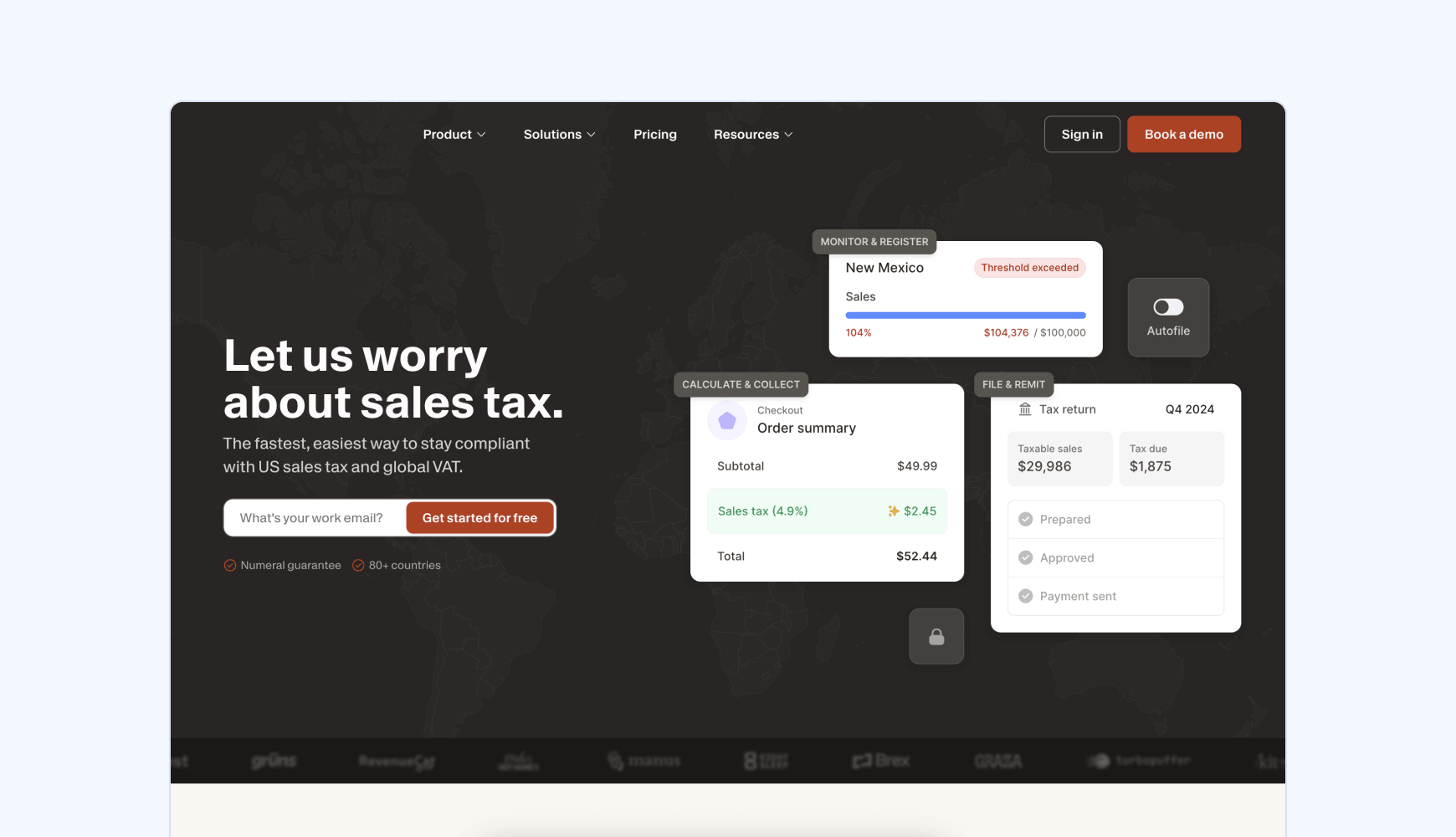
Numeral is an all-in-one compliance platform serving both ecommerce and SaaS businesses. Similar to TaxCloud, TaxJar, and others, this platform aims to automate most compliance obligations so that companies don’t have to worry about tax duties and can turn attention to other areas of the business. Numeral also offers global coverage on its custom plans, but includes filing and automation in its scope.
As a platform, Numeral aims for hands-off compliance and simplicity. Rather than offering convoluted pricing plans, transaction fees, or separate add-ons, Numeral provides a flat filing rate ($75) and registration rate ($150). Everything else is included by default. The drawback to this approach is that Numeral’s high per-filing costs are eventually eclipsed by other plans, so teams are trading simplicity for savings.
When it comes to Stripe Tax, Numeral can act as either a replacement or a partner, depending on the configuration. Teams using the standard integration will see Numeral replace Stripe Tax for all calculations. However, Numeral’s API can be configured to keep Stripe Tax in place while allowing Numeral to take over filings and compliance. However, Numeral warns that there are specific limitations around this configuration, and it’s clear that the preferred approach is to use the platform as a full replacement for Stripe Tax.
Why choose Numeral
- Hands-off compliance model. Numeral aims to integrate its compliance software with billing, finance, and other components of the tech stack to fully automate sales tax compliance.
- Flat-rate pricing solutions. Because Numeral charges a set rate for filing and registrations, pricing is clear and easy to understand.
- On-time filing guarantee. Numeral states that it will cover penalties and interests if sales tax returns aren’t filed on time.
Potential blockers
- Stripe Tax has defined limits. Numeral supports Stripe Tax transactions when used with its API, but there are limitations and guardrails around these configurations.
- Per-return costs will accumulate. At $75 per filing, companies registered in multiple states or who are required to file monthly may face considerably higher annual costs when compared to platforms offering similar value, prompting an eventual migration away from the platform.
- Advanced services require custom plans. VDAs, expert access, global filing, and API functionality are reserved for custom plans. Exemption management is also listed as an add-on with special limitations and configuration options.
Customer perspectives
I find the Stripe integration in Numeral to be great. It seamlessly calculates sales tax and files returns, which theoretically should make the process easy and simple. [However,] I find customer support unsatisfactory, as they do not adequately address the issues or assist promptly which coupled with the bugs makes for a very unsatisfying experience.
Their expertise with government departments was invaluable in helping me navigate the process of resetting access for past employees. Being able to connect to multiple Stripe accounts would be a dream and could add significant automation to our process.
TaxValet
- Best for: Businesses seeking fully outsourced compliance
- Starting price: $1,000 per month
- Core functionality: Managed sales tax compliance
- Coverage: United States
- Compatibility: 80+ integrations
- Stripe Tax role: Partner
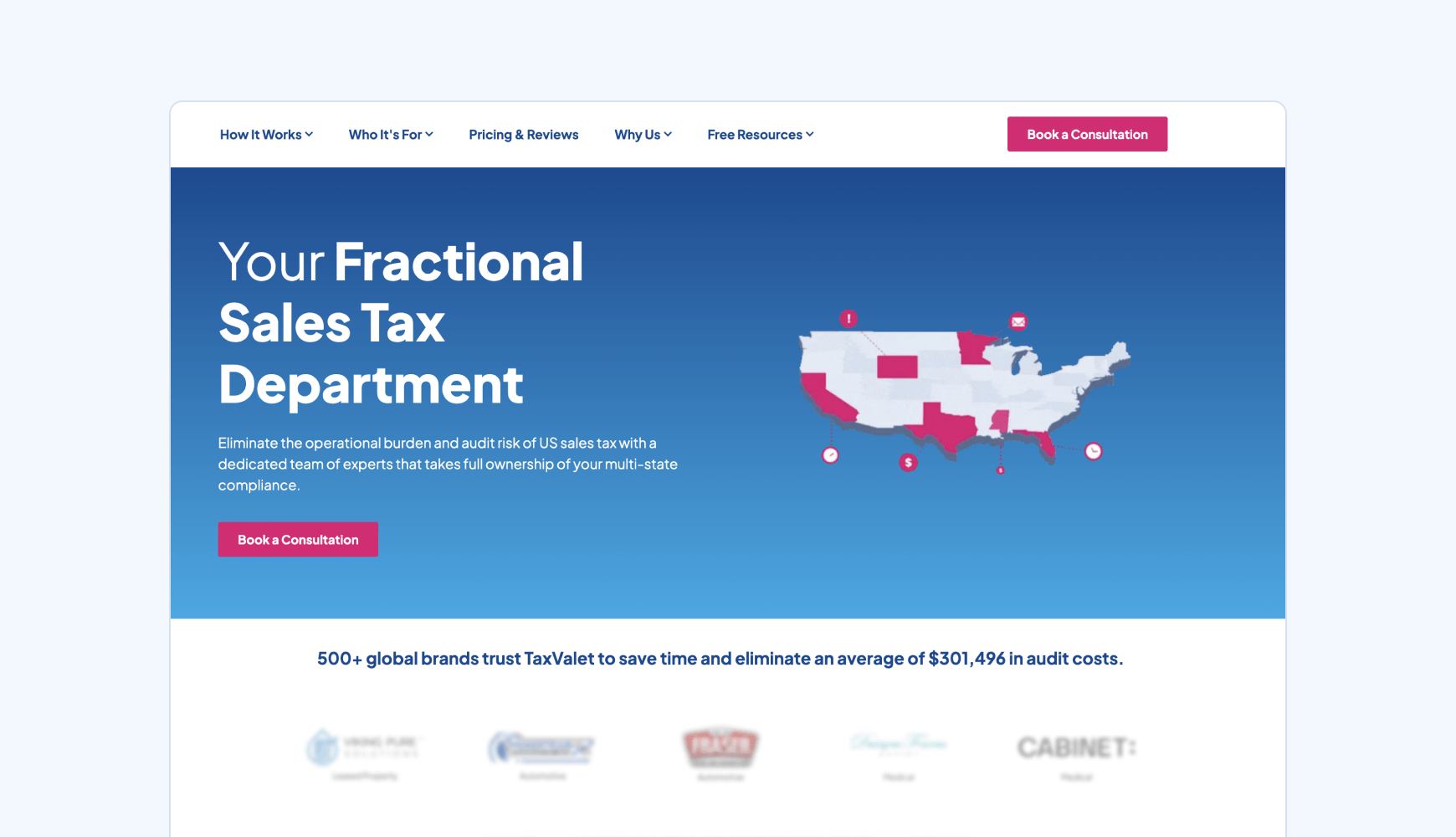
TaxValet is a managed sales tax provider designed for companies that would rather outsource compliance than operate or manage a tax software platform. The company positions itself as a fractional sales tax department, assigning customers a team that reviews their setup, manages recurring obligations, and corresponds with state tax agencies on behalf of the business.
This hands-on approach is at the core of TaxValet’s offering, and it’s why companies use them. For a premium cost, a business can hand over its tax duties to TaxValet and let them take care of the rest. Especially for brands where automation platforms feel too cumbersome or don’t fit the unique needs of the business, a managed service like TaxValet will make more sense.
While TaxValet’s integrations handle data importing, the company doesn’t offer its own calculation engine. Instead, it partners with solutions like Stripe Tax and doesn’t replace the existing engine. Stripe continues to calculate and collect tax, and TaxValet pulls that data into its own process to handle downstream filing and remittance (similar to TaxCloud). However, this also means that companies should plan to pay for tax calculations from another service in addition to working with TaxValet.
Why choose TaxValet
- Fully managed service model. TaxValet functions as an outsourced, fractional tax department and effectively removes compliance obligations from the companies that partner with it.
- Works with Stripe Tax. Companies using Stripe Tax can continue to leverage the platform for tax calculation and collection while TaxValet uses the transaction data for filing and remittance.
- Audit support included. TaxValet is one of the only solutions other than TaxCloud that offers any form of audit assistance. The company also provides (limited) protection for penalties or interest caused by its own errors.
Potential blockers
- High starting costs. Pricing begins at $1,000 per month, but TaxValet also charges an additional (one-time) $3,500 onboarding fee and $90 per filing for late returns due prior to onboarding.
- Tax calculation engines and product classifications not included. Because TaxValet doesn’t include its own calculation engines, teams should expect to pay for those services separately.
- Broad, third-party access requirements. TaxValet will need access to the company’s financial information in order to file and remit taxes, which isn’t required when using many automated filing solutions.
Customer perspectives
For me there has been nothing but upside to TaxValet. Not only was the onboarding process smoother, the people were more knowledgeable, and I’m actually paying slightly less than I was previously. I know the cost will go up as I start reaching nexus in additional states, but I genuinely believe the peace of mind is worth every penny.
TaxValet is incredibly helpful and truly takes the load off your shoulders when it comes to anything sales tax related. TaxValet’s only downside is their monthly minimums if you have a smaller entity.
Quaderno

- Best for: Cross-border online businesses
- Starting price: $29/month
- Core functionality: End-to-end tax calculation and compliance
- Coverage: Global
- Compatibility: 20+
- Stripe Tax role: Replacement
Quaderno is a global tax platform aimed largely at SaaS companies, digital content creators, course providers, and other businesses selling across international borders. The platform integrates with both traditional ecommerce marketplaces and teaching platforms, which is unique when compared to most compliance solutions.
Particularly for smaller teams, Quaderno provides the tools necessary to manage international invoicing and tax obligations without scaling to an enterprise solution like Vertex or Avalara. Plans are transaction-based, making the core software accessible to smaller businesses while registrations and filing services can be added as obligations expand.
Stripe merchants should primarily view Quaderno as a replacement for Stripe Tax. While Stripe will continue to process payments, Quaderno effectively replaces Stripe Tax for calculations and data collection. However, Quaderno’s default Stripe integration calculates tax after the transaction is complete, meaning that merchants will need to raise their base price to account for taxes. API solutions offer real-time calculations.
Why choose Quaderno
- Strong international focus. Quaderno calculates sales tax, VAT, and GST at a global scale, making it more relevant to cross-border sellers than U.S.-only alternatives.
- Emphasis toward education companies. Native integrations with Quaderno include connections to Kajabi, Thinkifi, Teachable, and others, which are unique to the platform.
- Subscription-based pricing. Companies can easily estimate software costs without contacting sales by using listed plans and estimated API volume.
Potential blockers
- Filing not included in basic subscription. Basic Quaderno plans include calculations, invoices, reports, and threshold monitoring, but registrations and returns are separate services.
- Tax calculated after a transaction is complete. Quaderno’s standard tax integrations are tax-inclusive, meaning that they pull the data and the engine makes its calculations after a sale is complete. Companies seeking real-time tax calculations will need to use the API or raise their unit price to account for post-sale tax deductions.
- Filing costs add up quickly. U.S. based filings are $100/month for each state, which can cause costs to skyrocket when compared with all-in-one solutions like TaxCloud (as low as $19.99/filing).
Customer perspectives
It’s easy to implement their API to determine the tax for different sales for us as a platform where many different cases are covert. In countries like the US where there are almost 3000 different tax codes, Quaderno is not precise enough because they only have less than 10. So I hope that they add more in the future.
Automatic tax calculations are very useful with checkout links. I ask Quaderno support if they support more than 1 Stripe account, they say yes. And then I find out that checkout URLs are only linked to one of those two. I can’t select a specific Stripe account for a specific checkout link. Now it’s €98 monthly instead of €49 monthly.
Which Stripe Tax partner is right for you?
The right partner for your Stripe Tax setup will depend on what you need beyond calculation and collection. Some companies only need returns filed in a few states while others require multi-channel reporting, international coverage, notice management, and more.
From the list above, it’s also worth noting that many alternatives are intended to fully replace Stripe Tax. Depending on your compliance needs and your setup, changing solutions may or may not be the right choice.
Small business: TaxJar or TaxCloud
For smaller, U.S.-based companies, TaxJar is a strong choice. As the default filing solution for Stripe Tax, it’s logical for users in this category to add a TaxJar account for non-Stripe transactions and then contact support to consolidate the filings.
However, TaxCloud is also a good option from the perspective of cost and future growth. TaxCloud features its own tax calculation engine and can step in to support marketplaces outside of the Stripe ecosystem (just like TaxJar).
Companies already using TaxJar who are seeking an alternative can use this guide to migrate to TaxCloud.
Mid-market: TaxCloud
TaxCloud is the strongest fit for growing companies that have moved beyond basic filing but still want to retain Stripe Tax for payment-side calculations.
Because TaxCloud can provide support in areas outside the scope of Stripe Tax — including non-Stripe transactions, VDAs, and filing — the two pair well together using TaxCloud’s native Stripe integration. Additionally, because Stripe Tax includes a set number of filing credits, it makes sense for global companies to focus those credits toward international filings while using TaxCloud for U.S. and Canadian filing and remittance.
Finally, TaxCloud offers free enrollment in the Streamlined Sales Tax program, which can completely eliminate filing costs in up to 24 states. This is something that only a handful of compliance solutions can offer, and it’s a great way to save thousands in filing costs while allowing TaxCloud to eliminate tax burdens from the company workload.
Enterprise: Avalara or Vertex
Depending on the needs of the organization, Avalara or Vertex will be the best fit for enterprise teams. Both providers can integrate sales from Stripe into their workflow, but each will replace Stripe Tax with a separate engine.
Both companies can support complex configurations, multi-entity operations, international sales, and high transaction volumes. For companies operating at this scale, it likely makes sense to move away from Stripe Tax as a calculation platform in favor of a custom, unified system tailored specifically to the needs of the business.
Bearing that in mind, companies switching to these platforms should be prepared for a large implementation, custom pricing, and a fundamental change in how tax is calculated and stored across the organization.
Complete your Stripe Tax workflow with TaxCloud
While Stripe Tax is a powerful platform, it’s limited to transactions collected by Stripe and doesn’t offer a native solution for filing and remittance.
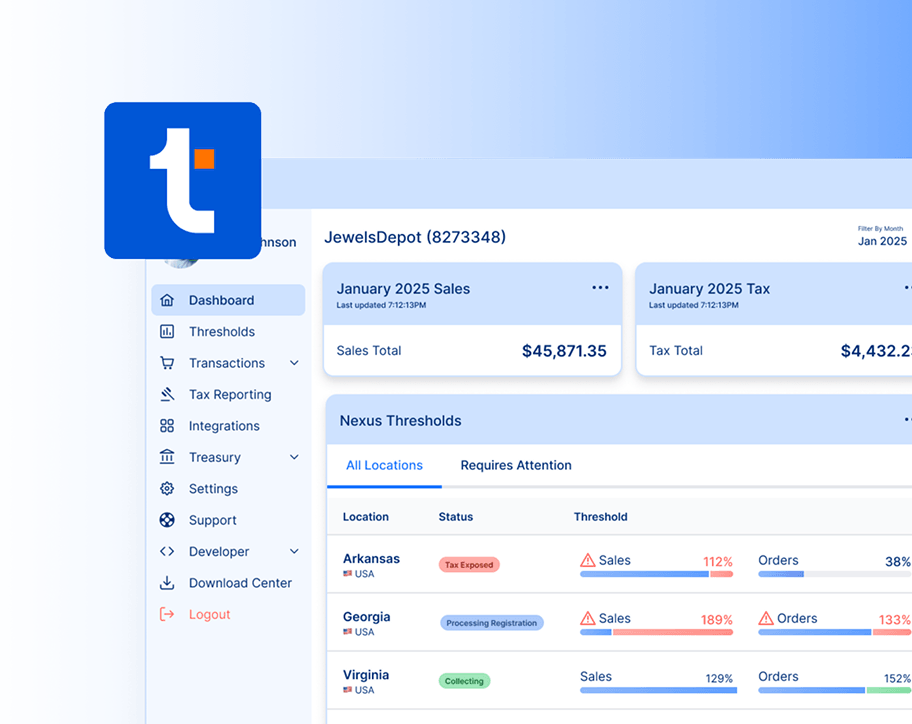
TaxCloud closes those gaps for growing businesses by acting as a central hub for all compliance needs. Data from all marketplaces, including Stripe Tax, can be consolidated inside TaxCloud for a full view of nexus obligations. TaxCloud’s own tax calculation engine offers support outside of Stripe payment processing. Filings and remittance are handled automatically and on time.
Talk to our team about handling the parts Stripe doesn't
Get a closer look at TaxCloud with a free 30-day trial or talk to a product expert for a live demo and personalized walkthrough.
How we evaluated these Stripe Tax partners
To evaluate these Stripe Tax alternatives and partners, our team pulled data from competitor websites, support documentation, and pricing pages, as well as review websites like G2, for a better understanding of what each solution offers.
We evaluated each service independently, considered their offering, and verified how each platform is designed to interact with both Stripe and Stripe Tax.
This research was conducted and verified manually and was correct to the best of our knowledge at publication. However, keep in mind that product offerings change. Be sure to verify platform details prior to making a purchase.
Stripe Tax alternatives — FAQs
Yes, but there are a few ways to handle this.
If you’re using the Tax Complete plan from Stripe Tax, filing and remittance will be outsourced to a pre-defined tax partner. In the U.S., that’s TaxJar while international filings are handled via Taxually.
Users on the Tax Basic plan will be responsible for filing on their own, either manually or through a third-party service.
Alternatively, teams can work with a compliance platform like TaxCloud to handle this process.
Yes.
Stripe Tax can continue calculating and collecting tax on transactions processed through Stripe while TaxCloud imports that transaction data for nexus monitoring, filing, remittance, and ongoing U.S. compliance.
TaxCloud can pull data from Stripe Tax via a native integration, combine it with other filing information, and automatically file a consolidated return on your behalf.
Not automatically, but Stripe Tax does support registrations (TaxCloud does, too!).
You’ll need to determine if you’ve exceeded the threshold and then reach out to the Stripe team for registration assistance.
Sometimes. Stripe Tax’s limitations are centered around payments and transactions more than the number of states or filings.
For companies with very straightforward obligations that process sales exclusively through the Stripe payment system, Stripe Tax will provide enough information for accurate filing and remittance.
However, additional support might be necessary when sales occur across multiple platforms or when additional documentation is required. For example, if a state requires specific exemption information or if auditors request specific information about previous tax periods, Stripe Tax wouldn’t have all of the information about sales transacted on an independent marketplace.
For that, you’ll need a solution like TaxCloud that consolidates all sales information into a single, unified system.
Yes, but only if the transaction itself is processed through a Stripe payment flow.
It’s possible for companies to import transactions from third-party platforms into Stripe Tax via CSV to improve nexus and reporting visibility, but those transactions aren’t included in Stripe’s location reports.
Plus, Amazon and other marketplaces may calculate, collect, and remit tax as marketplace facilitators, which eliminates the need for Stripe Tax to interact with the platform at all.
For Shopify, Stripe Tax can integrate in order to import transactions, monitor nexus, and use its partners to assist with filing and remittance. However, it doesn’t calculate tax because Shopify’s own engine, Shopify Tax, handles that workload.
Stripe Tax is embedded in Stripe’s payment ecosystem and primarily handles transaction-level tax calculation and collection. It’s part of Stripe, is integrated by default, and can be activated directly from the Stripe Dashboard.
TaxCloud is a third-party solution for U.S. sales tax that integrates natively with Stripe. Using the TaxCloud integration, teams can automatically import Stripe transactions, combine them with sales data from other channels, and use the consolidated data for nexus monitoring and accurate filing.
In this scenario, TaxCloud effectively becomes your downstream filing partner, meaning that taxes are collected by Stripe Tax and handed to TaxCloud to complete the remainder of the tax workflow.
Generally, adding a compliance partner makes sense when managing sales tax begins to require more time, systems, or expertise than your team can reasonably provide.
If your team is handling manual filings for several states, selling across multiple channels, receiving state notices, or managing tax exempt customers, it becomes easier to miss obligations and begin to incur penalties or accrue interest from incorrect payments.
A compliance partner also becomes valuable when you want to keep Stripe Tax for checkout calculations but need a system to handle other parts of the tax process, like consolidating transactions or automating the filing process.