Avalara is an SST Provider. So why are some sellers still paying so much?



Key takeaways
- SST can dramatically reduce filing costs for eligible ecommerce sellers operating across multiple states.
- Most SST savings are delivered through CSPs, including registration support, automated filing, and reduced filing costs in participating states.
- SST savings depend heavily on proactive management, and savings opportunities are missed when CSPs fail to properly manage the merchant’s account.
For eligible merchants, the Streamlined Sales Tax (SST) program can dramatically reduce the cost and administrative burden of multi-state compliance.
As a Certified Service Provider (CSP) in the SST program, Avalara can help merchants reduce filing costs by managing SST enrollment and filing returns on the merchant’s behalf. However, during onboarding sessions with former Avalara customers, the TaxCloud team began noticing missed SST enrollment opportunities, outdated coverage, and avoidable filing costs.
Some customers told us SST was never discussed. Others said they were enrolled initially, but coverage was never expanded as new states joined the SST program. Many assumed they were fully benefiting from SST already.
Those conversations revealed something important about how SST works operationally, how CSP incentives differ, and why some merchants continue paying more than expected.
We decided to dig a little deeper. Here’s what we found.
SST can save sellers serious money
Sales tax filing costs don’t stay small for very long. While most early-stage ecommerce brands don’t think much about sales tax, the monthly fees and compliance overhead becomes a serious operational expense as brands grow.
For eligible sellers, the SST program can dramatically reduce those costs. By working with a CSP, merchants can eliminate many of the costs associated with growth and simplify the filing process at the same time.
These savings are significant enough to range into the tens of thousands of dollars on an annual basis, which makes SST a major factor when choosing the right sales tax partner.
It would have cost us around $40,000 a year to go with a company that wasn’t a SST program participant.

Why many SST benefits depend on CSP enrollment
While it’s possible for sellers to participate in SST without a CSP, the biggest benefits usually flow through the CSP/seller relationship. That’s because the SST program was largely designed around CSP support.
In the SST model, participating states compensate CSPs directly for handling merchant filings, meaning that the state pays the CSP and the merchant can leverage those services at no cost.
That structure shifts most of the operational burden of SST on to the CSP. In a well-managed relationship, your CSP will handle the following:
- Enrollment
- Registrations
- Filing workflows
- Ongoing coverage management
- Compliance administration
- Audit inquiries
Merchants can handle filing on their own, but doing so is significantly more complex and resource intensive, especially for sellers operating across large nexus footprints.
In an ideal setup, the CSP actively manages the merchant’s SST participation behind the scenes. However, to get the most out of the program, the CSP must actively maintain the merchant’s relationship and cost-savings opportunities.
When the CSP fails to cultivate those opportunities, the system breaks down and the merchant ends up paying money for filing costs that could have been otherwise avoided.
In conversations with merchants transitioning from Avalara, the TaxCloud onboarding team has seen the result of a lapsed relationship several times. Merchants are regularly surprised to learn that their relationship with SST was mismanaged or overlooked, and that they could have saved more money if Avalara had fully leveraged the SST program on their behalf — if the program was ever mentioned in the first place.
Avalara never informed us about the Streamlined Sales Tax (SST) program, which could have saved us a significant amount of money.

How SST changes the incentives for CSPs
The economics of SST work differently than traditional sales tax filing services.
For example, the SST program sets ground rules that alter the monetary relationship between the CSP and the merchant. Because the state (not the merchant!) compensates the CSP, the program doesn’t allow CSPs to charge merchants for the service.
That creates a different incentive structure around SST participation, enrollment, and filing management.
While merchants want to maximize SST savings wherever possible, CSPs may instead focus on broader and more profitable tax filing services, standard compliance workflows, or non-SST operational processes in order to boost profits.
Even though the rules and restrictions set in place by SST give a pathway for cost-free merchant filings, how tax providers choose to interpret and engage with the program will vary.
All SST providers aren’t the same
Many merchants hear that providers are “SST-certified” and assume that the experience is largely the same across every CSP.
In practice, that’s far from the truth.
Even though the SST program standardizes rules around filing and compensation, it doesn’t guarantee how aggressively the provider will manage SST enrollment, filing coverage, or ongoing account reviews.
As a result, many CSPs engage with SST differently. Some, like TaxCloud, actively push to maximize SST participation. Others engage with it more selectively or treat SST as a one-and-done setup that doesn’t evolve as the program changes or the merchant expands.
These variations can impact merchant filing costs over time and are one of the key reasons why TaxCloud regularly discovers missed SST opportunities for migrating merchants who are already working with a CSP.
CSPs can participate in SST without prioritizing it
Participation in the SST program doesn’t require CSPs to structure their business around maximizing savings for merchants. Instead, that’s something that CSPs must actively pursue.
Some providers focus more heavily on broader filing services and compliance operations that generate more traditional revenue. In those environments, SST enrollment and ongoing coverage management can become a secondary consideration to a provider’s business model. Because SST filings are intermingled with other paid services, CSPs have the flexibility to choose how and when to engage with the program.
Remember: The SST program’s rules only apply when the provider is acting as a CSP on a merchant’s behalf in a participating state. If a merchant isn’t enrolled in a qualifying SST state, the provider can charge standard filing and compliance fees that SST enrollment would have covered.
Merchants often assume that their provider is proactively maximizing SST savings, but the truth is that some CSPs don’t actively pursue those benefits on the merchant’s behalf.
For best results, merchants either need to connect with a CSP dedicated to maximizing SST savings or must actively pay attention to changes in SST and push their CSP partner to take advantage as new opportunities materialize.
We paid around $25 to $30k for TaxCloud, compared to $100 to $150k with Avalara. The pricing difference is huge, and it’s a relief to move away from the endless negotiations just to get a decent price.

What we’ve seen during Avalara migrations
The TaxCloud team didn’t originally set out to investigate how CSPs operationalize SST opportunities. This pattern emerged gradually across dozens of onboarding conversations with Avalara customers.
Over time, the same SST-related issues kept appearing in our migration reviews and feedback, especially among growing ecommerce brands with larger nexus footprints.
Here’s what migrating users tell us:
- SST was never discussed. Some merchants told us that they were never informed that they might qualify for SST savings opportunities at all. In UntilGone’s case, the company later discovered that the SST program could have significantly reduced their filing costs.
- Qualifications were never reviewed. Some sellers later realized they might have qualified for SST participation, but eligibility discussions never happened during their onboarding or setup processes. (TaxCloud has this discussion during every new onboarding session.)
- Coverage wasn’t expanded over time. In several cases, merchants that were initially enrolled in the SST program, but that coverage wasn’t expanded as new states joined the program. While TaxCloud corrects these gaps during onboarding, those missed enrollment opportunities can cost a company thousands in unnecessary fees before the error is corrected.
- Merchant assumed SST enrollment was automatic. Several sellers told our team that they believed Avalara was already maintaining and expanding their SST coverage behind the scenes as their business grew. Unfortunately, this wasn’t the case.
- Costs kept increasing. As merchants expanded and their nexus footprint increased, filing costs rose. However, because these costs are often rolled into regular bills, they’re easy to overlook. Because Avalara modularizes its product offering, users assumed the charges were related to non-SST services such as tax calculation, exemption tools, or managed services.
None of these issues appear overnight. In most cases, merchants only discover them later, after filing obligations become more complex or a migration review forces a closer look at how SST coverage is actually applied and managed.
The natural complexity of tax compliance — even with the SST program to simplify filing — makes these issues difficult for ecommerce operators to spot. Combined with the belief that their CSP is fully leveraging SST, it’s easy for a merchant to assume those costs were a necessary part of tax compliance.
Why merchant/CSP partnerships matter for growing ecommerce brands
One of the biggest misconceptions around SST is that once enrollment is complete, the operational work is finished. While that might be true for slow-growth or static brands, it’s not the case for growing businesses.
Shifting priorities and ongoing enrollment opportunities make a merchant’s relationship with their CSP important for maximizing savings and lowering costs.
In this section, we’ll take a closer look at why proactive CSP management becomes more important over time.
Multi-state growth creates more opportunities for SST savings
As a company expands into additional states, filing obligations and compliance costs also expand. Most states have their own nexus threshold and filing requirements, all of which dictate when a brand needs to file and remit taxes.
In turn, enrollment opportunities continually materialize as brands grow and gain eligibility. SST savings opportunities can also change over time as enrollment eligibility and policy decisions evolve.
The changes and ongoing complexities around SST are one thing that makes an engaged CSP so valuable. When SST enrollment is actively managed, brands should see a reduction in filing costs and simplified multi-state compliance. Because the CSP can manage a merchant’s account on their behalf, much of this work is done on the CSP side.
However, when accounts aren’t proactively reviewed, merchants can end up paying entirely avoidable filing costs, taking on additional administrative work, and missing out on the opportunity to offload much of the compliance burden onto CSPs and experts best equipped to handle it.
Worse: Merchants who actively spot SST opportunities may have to nudge reluctant CSPs into taking advantage of those savings, creating additional and unnecessary work for the brand.
Filing costs and complexity increase faster than most operators expect
It’s easy for ecommerce operators to underestimate how quickly sales tax compliance can scale.
Because digital and online brands can see sales across an entire geographic region, what starts as a few monthly filings can quickly escalate into a mountain of paperwork and responsibilities. Merchants fully leveraging the SST program can offset both the costs and the paperwork that accompanies widespread growth.
In SST states, the CSP acts as a middleman between participating states and the merchant. The CSP files on the merchant’s behalf, typically using tax calculations created by their own tax engine.
For example, TaxCloud’s tax engine calculates tax across all jurisdictions. For SST filings, our system automatically generates the required documentation using the tax calculations created by our engine. Our team reviews those filings and then submits them via the SST portal. Afterward, tax is remitted from the merchant’s account to the appropriate state entity.
The CSP also becomes the first point of contact in the event of an audit in an SST state, since they’re authorized to act on the merchant’s behalf during the SST filing process. The CSP can then act as an intermediary by requesting documents from the merchant and offering them to the state.
While the SST program is designed to reduce the burden of tax compliance for merchants — including audits — the ability for the CSP to intercede on behalf of the brands makes the merchant/CSP relationship even more important.
Bad partnerships cost time, money, and additional administrative resources
One of the recurring themes that our team has seen during migrations from Avalara is how merchants believed that Avalara was actively seeking SST enrollment and savings opportunities on their behalf.
That trust means that internal teams didn’t spend as much time auditing SST coverage directly and instead turned their attention to other matters. They assumed enrollment was current, that new SST states were automatically included when they met the requirements, and that filing costs were being optimized behind the scenes.
This operational blindspot can cost a company tens of thousands in unnecessary filing costs, all because merchants make the assumption that the tax partner has the merchant’s best interests in mind.
Sadly, that isn’t always the case. Former Avalara customers reported that the company never engaged with them on that level. One customer even pointed out that Avalara concealed their CSP status from the brand and, when challenged, offered to work SST savings into their upcoming renewal.
When CSPs don’t actively pursue those savings, merchants think they’re saving money and don’t check to see if the SST program is being fully utilized. By the time they realize their mistake, brands may have spent years paying for filing costs that they assumed were unavoidable.
How TaxCloud approaches SST
One of the biggest differences merchants notice when onboarding with TaxCloud is how much attention is given to SST enrollment, coverage, and savings potential.
Rather than assuming enrollment is already current, our onboarding process includes a review of how SST is being managed and if new eligibility opportunities are available. This approach leads to conversations many merchants never had with previous providers.
SST enrollment is part of TaxCloud’s onboarding process
During onboarding, TaxCloud provides a comprehensive audit of SST eligibility and coverage. Our teams looks at the following for every new customer:
- Current enrollment status
- State coverage
- Nexus exposure
- Filing obligations
- Enrollment gaps
- Expansion opportunities
For merchants with disengaged CSPs, this audit may be the first time that SST coverage has been reviewed since their initial program enrollment. It’s common for our team to uncover missing SST states, outdated coverage, and filing obligations that can be reduced through program participation.
Once the audit is complete, our team actively assists merchants with SST registrations, enrollment transitions, and ongoing filing setup.
Proactive SST enrollment and expansion
Ecommerce businesses are constantly evolving, and both their tax obligations and SST savings opportunities evolve with them. Merchants expanding into additional states will see an increase in tax obligations that aligns with their nexus footprint.
The changing nature of the business is why TaxCloud continually reviews SST participation over time, rather than treating enrollment as a one-time activity. As the business grows, the TaxCloud team proactively evaluates whether additional savings opportunities exist and whether a brand is eligible for those savings.
For high-growth brands operating across multiple states, the ongoing review process can significantly reduce long-term filing costs.
Treats SST as a core customer outcome
Some CSPs treat the SST program as a secondary perk rather than a mandatory obligation.
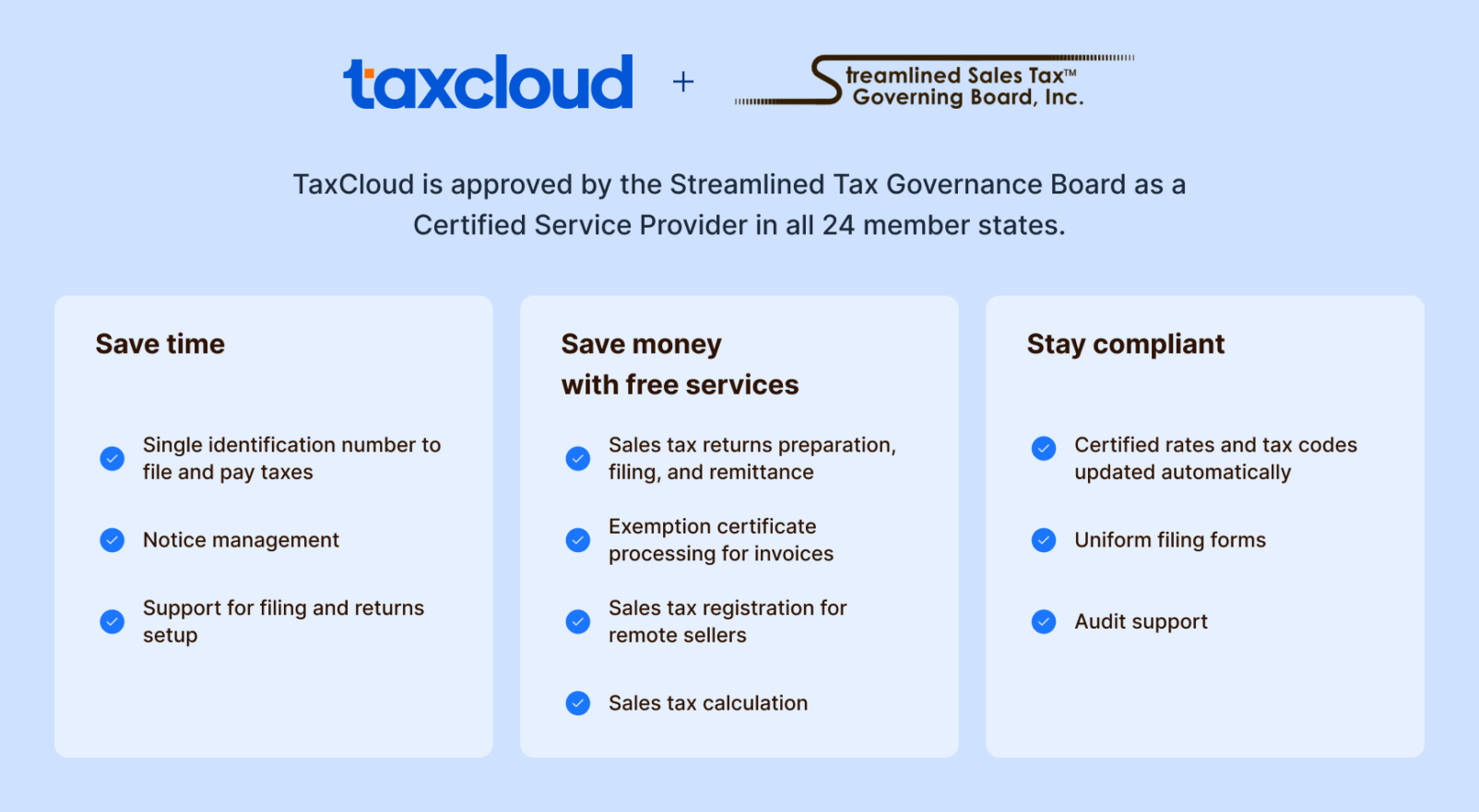
TaxCloud treats SST participation as a core function of the business. Enrollment is available across all paid plans, and our team is constantly searching for additional savings opportunities as brands continue to grow.
Our goal is to prevent merchants from drifting out of optimized SST coverage as they scale and grow, but that requires a close partnership and constant oversight.
TaxCloud helps sellers get more from SST
The SST program can dramatically reduce filing costs for eligible sellers, but only if enrollment, coverage, and ongoing participation are actively managed over time.
However, as many former Avalara customers discovered during onboarding with TaxCloud, how much merchants benefit depends on how their tax partner engages with the program.
TaxCloud approaches SST differently than other providers by actively working to stay abreast of program changes and working to capture savings for customers when those opportunities arise.
If you’re looking for a dedicated CSP who can help you make the most of your SST enrollment, get in touch with our team for a deeper conversation about SST enrollment and eligibility.
Already enrolled with SST but looking to migrate from Avalara? Take a closer look at our migration guide to see how the process works.
Already enrolled with SST but looking to migrate from Avalara?
Take a closer look at our migration guide to see how the process works.
Avalara SST — FAQ
Yes. Avalara participates in the SST program as a Certified Service Provider (CSP). That means Avalara can file SST returns on behalf of eligible merchants in participating SST states.
Note that CSP certification alone doesn’t guarantee that SST enrollment opportunities, coverage expansion, or filing savings will be proactively managed over time.
Yes.
For eligible merchants, SST can dramatically reduce or eliminate filing costs in participating states when working through a CSP. As ecommerce brands expand into more states, those savings can save companies thousands of dollars in annual filing costs.
However, because ecommerce brands expand rapidly across jurisdictions, it’s easy to miss these opportunities. CSPs need to actively check as nexus thresholds are crossed to ensure that coverage is expanded and that brands are able to take advantage of new savings as they become available.
Merchants with existing SST enrollment should ask their CSP the following questions:
- Which SST states am I currently enrolled in?
- Has my coverage been reviewed recently?
- Am I automatically enrolled when I meet the eligibility requirements in SST states?
- Are there additional states where I might qualify for SST savings?
- Which filing services are covered under SST, and which are billed separately?
It’s common for sellers to assume these reviews are happening behind the scenes when they are not, and that oversight can lead to missed opportunities.
No. Enrollment management depends heavily on the provider’s onboarding and account management processes.
Some CSPs, like TaxCloud, actively review enrollment and coverage expansion opportunities. Others may require merchants to initiative those discussions directly in order to see results.
Yes. During migrations to another CSP, merchants can review existing SST enrollment, remove Avalara as a managed provider, and assign their new partner to that role.
Keep in mind that only one CSP can be attached to an SST account at a time, so Avalara would need to be removed for the new provider to take over.
It’s usually best to have Avalara removed after they’ve filed the last set of returns before your migration. During removal, Avalara will also have the ability to close your account entirely, so be sure to provide clear instructions to the Avalara team regarding how this matter should be handled.
For additional guidance, take a look at the Avalara to TaxCloud migration guide. While this guide is specific to TaxCloud, it contains instructions and guidance for removing Avalara as your CSP without risking your account status.