When should an ecommerce business start using sales tax software?

Written by

VP of GTM

Published
Key takeaways
- Exposure risk, compliance workload, and operational complexity are often the biggest factors when determined whether sales tax software is necessary.
- New nexus obligations are a good signal to start evaluating software before additional states become difficult to manage.
- Manual processes can still work for businesses with limited nexus, few filings, and straightforward taxability.
- Growth often creates the tipping point as additional states, channels, and filing obligations make automation more valuable.
Sales tax is relatively easy to manage when an ecommerce business is small. A company selling through one channel with obligations in only one or two states may be able to monitor nexus, calculate tax, and manage filings without dedicated software.
However, that process becomes more difficult as the business grows. New sales channels, additional state registrations, more frequent filings, and changing taxability requirements can quickly turn sales tax into a recurring operational burden.
There isn’t a specific revenue threshold where every ecommerce business suddenly needs sales tax software. Instead, the right time to automate depends on how complicated the company’s sales tax obligations have become and whether the existing process can still keep up.
In this article, we’ll cover the most common signs that it’s time to start using sales tax software, when manual processes may still work, and how those needs change as an ecommerce business grows.
| Sales tax situation | Manual may still work | Start evaluating software | Time to automate |
|---|---|---|---|
| One sales channel; one/two states | ✅ | ❌ | ❌ |
| Approaching nexus in new states | ❌ | ✅ | ❌ |
| Multiple sales channels | ❌ | ✅ | ❌ |
| Tax-exempt & wholesale buyers | ❌ | ✅ | ❌ |
| Rapid growth into new markets | ❌ | ✅ | ❌ |
| Unclear nexus obligations | ❌ | ❌ | ✅ |
| Filing in several states | ❌ | ❌ | ✅ |
| Complex product taxability | ❌ | ❌ | ✅ |
| Recurring manual sales tax work | ❌ | ❌ | ✅ |
| Missed tax obligations* | ❌ | ❌ | ✅ |
*Software can help manage compliance going forward, but historical sales tax obligations may need to be addressed separately.
When should companies start using sales tax software?
There isn’t a specific point where every ecommerce business needs to adopt sales tax software. Instead, the decision usually comes down to how many obligations the company is managing and whether its existing processes can keep pace.
As nexus expands, sales channels multiply, and filing requirements increase, manual processes become harder to maintain. The following situations are common signs that it may be time to start evaluating a dedicated sales tax solution.
The business is economic nexus in another state
Economic nexus is one of the clearest signs that a business should start evaluating sales tax software.
As ecommerce sales expand across state lines, companies need to monitor how much revenue or transaction activity is taking place in each jurisdiction. Once a state’s nexus threshold is crossed, the business may need to register, begin collecting tax, and file returns according to the state’s requirements.
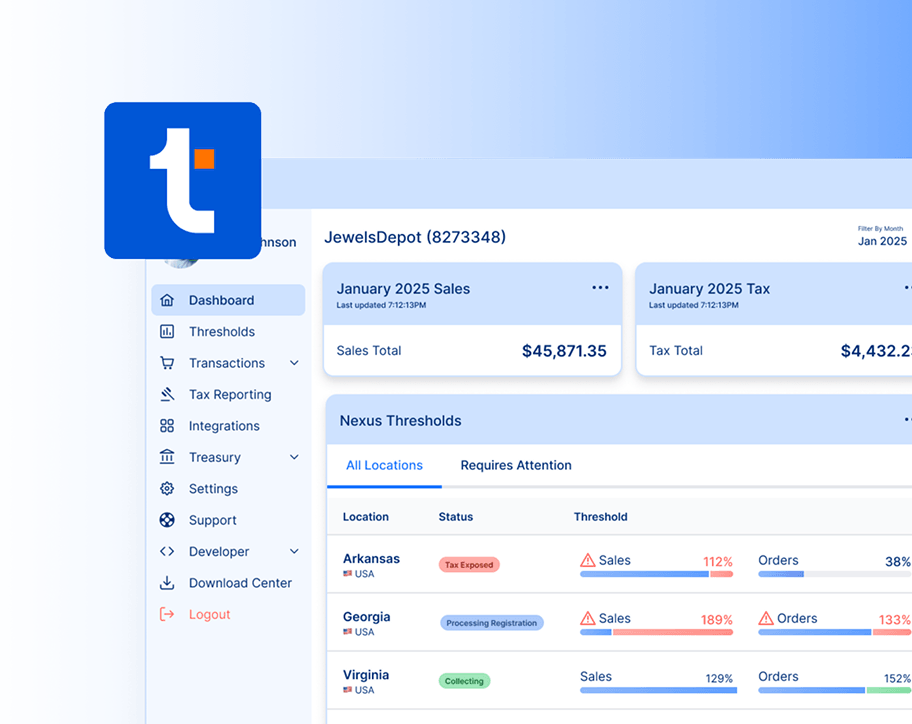
Tracking one or two states manually may be manageable, but the process becomes more difficult as additional jurisdictions come into play. Sales tax software can help teams monitor those thresholds continuously and prepare for new obligations before they become overdue.

Crossed nexus before you were ready?
TaxCloud can help businesses organize historical and ongoing sales data, identify where compliance gaps exist, and establish a more reliable process going forward.
For a closer look at the remediation process, see our guide to catching up on unfiled sales tax returns.
Transactions take place through multiple channels
Selling through more than one channel can make sales tax significantly harder to track. A business that starts with Shopify may eventually add Amazon, Walmart, wholesale orders, or another storefront.
Each channel creates its own transaction data, and the company still needs a complete view of sales activity when monitoring nexus and preparing returns. This can even be more convoluted than expected because some platforms are marketplace facilitators, while others aren’t.
When that happens, dedicated sales tax software can help consolidate transaction data across platforms and reduce the manual work required to reconcile sales before filing.
The business is registered and filing in several states
The amount of recurring sales tax work increases as a business registers in more states.
Each new jurisdiction can introduce another filing calendar, return format, remittance process, and set of reporting requirements. A handful of states may still be manageable internally, but the process becomes increasingly time-consuming as the filing footprint expands.
At that stage, sales tax software can help teams organize filings, automate repetitive tasks, and reduce the risk of missed deadlines.
Products or customers make taxability less straightforward
Products or customers that have different tax treatment in multiple jurisdictions can add complexity to the compliance process. A product’s taxability may vary between jurisdictions, while wholesale or tax-exempt customers can introduce separate documentation and reporting requirements.
The same can happen with product categories, not just the products themselves. For example, SaaS subscriptions might be taxable in one state but exempt in another because of how the laws are written. Bundled products, shipping charges, and other transaction details can add another layer of complexity.
When teams are regularly checking taxability rules or managing exceptions manually, dedicated software can help apply more consistent treatment across transactions and reduce the amount of manual review required.
Sales tax is becoming a recurring operational task
Manual sales tax processes tend to consume more time as filing obligations expand.
When teams regularly find themselves exporting transaction data, updating filing calendars, and logging into state portals, it’s a good time to consider automation. While none of these tasks are especially difficult on their own, they contribute to an administrative burden that takes time away from other critical tasks.
Dedicated software can help automate the repetitive parts of the process so that workers can spend more time running the business, rather than managing compliance.
Business is experiencing rapid growth
Rapid growth can cause sales tax obligations to expand much faster than the team expects.
A strong sales period or sudden increase in national demand can push the business across nexus thresholds in several states at once, creating new registration and filing requirements with little time to prepare. At that point, manual tracking can become difficult to maintain.
This exact scenario happened to Rareform. After appearing on Shark Tank, a surge in sales triggered nexus in 30 states nearly overnight and forced the company to urgently rethink how it managed compliance. While it’s safe to say that won’t happen to every company, growth spikes can happen anytime a product goes viral or a company breaks into a new market.
The sales tax software tipping point at each stage of ecommerce growth
While revenue isn’t a hard threshold for adopting sales tax software, it can be a useful indicator of how compliance needs change as a business grows.
Smaller sellers will be able to internally manage a limited tax footprint for a time. However, larger ecommerce companies are more likely to encounter additional nexus obligations, filing requirements, and operational complexity.
The following ranges offer a general framework for deciding when manual processes still make sense and when automation becomes the more practical option, but keep in mind that automation is viable — and can be beneficial — even at early growth stages.
For a deeper dive into managing your nexus obligations as your operation scales, check out this guide.
Early stage($0-$300k)
For businesses under roughly $300,000 in annual revenue, a manual sales tax process may still be practical if the company has a relatively small compliance footprint.
At this stage, the greater risk is failing to notice when compliance responsibilities change. Growth into new states or channels can create additional obligations before the business has established a process for managing them.
Teams should begin evaluating software when monitoring those changes starts requiring more oversight than the existing process can provide. At that stage, switching to a capable compliance platform becomes more efficient.
Growing ecommerce business ($300k – $1M)
Between roughly $300,000 and $1 million in revenue, ecommerce businesses are more likely to see sales tax become an ongoing operational responsibility.
At this stage, sales are spreading across more states, additional channels make tracking transaction data more difficult, and new nexus obligations begin appearing more frequently. Manual processes can still work, but they generally require more structure and attention than they did at an earlier stage.
This is often the point where businesses should seriously evaluate sales tax software, even if the current process hasn’t broken down yet.
Scaling economic business ($1M+)
Once ecommerce revenue moves beyond $1 million, dedicated sales tax software becomes almost impossible to avoid.
Businesses at this stage are more likely to have a broad nexus footprint that includes multiple filing obligations. Sales activity is usually spread across several jurisdictions and channels, many with a separate filing cadence and process.
Managing those responsibilities manually requires significant internal time and creates unnecessary opportunities for missed deadlines or incomplete reporting. At this stage, missing any deadline can incur substantial penalties, especially if the mistake isn’t caught early.
For scaling businesses, automation should generally become the default rather than something added only after the existing process fails.
What should tax software handle for an ecommerce business
Ecommerce businesses usually get the most value from sales tax software when it can centralize responsibilities that would otherwise be spread across platforms, spreadsheets, and state filing processes.
Here’s a breakdown of what to look for when searching for a compliance partner:
- Nexus tracking. Software should monitor sales activity across relevant states and help teams identify when new economic nexus obligations are developing.
- Tax calculation. The platform should apply appropriate sales tax rates and product taxability rules when tax needs to be collected.
- Multichannel reporting. Businesses selling through multiple storefronts or marketplaces should be able to bring transaction data together for more complete reporting and nexus visibility.
- Registration support. As new obligations arise, the software or provider should help businesses complete the registration process before collection begins.
- Filing and remittance. A full-service solution can prepare returns, submit them according to each state’s schedule, and remit the tax collected.
- Compliance records. Teams should also have access to the transaction and filing history needed for reconciliation, notices, and other ongoing compliance needs.
Businesses don’t necessarily need to automate every part of this process at once, but choosing a solution with these capabilities will help in the long run.
Especially as the company continues to grow, it makes sense to choose a platform that is both a fit for the size of the business and can offer scalability options for that stage of growth.
Looking for compliance partners?
TaxCloud is a great choice, but it’s not the only option out there. Check out our breakdown of the best ecommerce sales tax software.
How to move from manual sales tax to software
Once a business decides to automate sales tax, the transition begins by adapting the process that is already in place.
Existing obligations and historical records need to be accounted for before the company starts relying on a new platform. From there, teams can determine what to automate and choose a solution that supports both current requirements and future growth.
1. Review the company’s existing sales tax obligations
Before configuring new software, teams need to confirm where the business currently has sales tax obligations and which states already require registration or filing.
This creates a clean starting point for implementation and helps prevent existing responsibilities from being overlooked during the transition. If there are unresolved obligations, those issues can be addressed separately before the new workflow takes over.
2. Identify all channels where sales are transacted
Once the obligations are clear, teams should identify every platform or channel contributing to taxable sales.
When transactions are spread across multiple storefronts, marketplaces, or payment systems, those sources need to be accounted for in the new compliance workflow. If a sales channel is missed, the software will only reflect part of the company’s actual sales tax footprint.
3. Check for historical gaps before automating forward
Historical compliance issues should be identified before the new system comes online.
Teams will need to confirm whether any prior obligations were missed and determine what needs to be corrected separately. Once that work is understood, the business can move forward with a cleaner automated process.
Keep in mind that new software doesn’t automatically resolve past problems. In cases where sales tax was missed, backfiling or using solutions like voluntary disclosure agreements (VDAs) can bring an account back into compliance. However, these situations will be handled separately from your automation platform.
4. Decide which parts of sales tax compliance need to be automated
While it’s possible to automate everything, and will make sense to do so in many cases, it’s not always required. Typically, it makes the most sense to build automation goals around the parts of compliance that are hardest to manage internally.
Teams can start by identifying where manual work is creating the most strain and which responsibilities would benefit most from a dedicated system. That gives the business a clearer set of requirements when comparing software options.
Realistically, teams will need to choose a solution that fits with their automation plan.
For example, Stripe Tax offers tax calculations and can help with nexus tracking, but the platform offers plans that don’t automate filing. If the team wants to continue filing and remitting taxes manually, it makes sense to choose a plan that doesn’t include those features.
5. Choose software that fits where the business is heading
A sales tax platform should fit both the company’s current compliance needs and the direction the business is growing.
Software that works well for a small filing footprint may become limiting as new states or channels are added. Evaluating scalability during the selection process can help teams avoid replacing the system again a year or two later.
At the same time, it’s worth remembering that many platforms are tailored to a specific size or type of business.
- Anrok is known for its heavy focus on SaaS companies, but its ecommerce side is more limited.
- TaxCloud is a great fit for growing ecommerce brands but is focused on U.S. and Canadian tax compliance.
- Sovos and Avalara are pricy options primarily focused on multinational enterprise brands.
Take a close look before choosing your partner, especially if multi-year contracts mean the company will be locked in for several years. If the business outgrows what the provider can provide, or if teams are unhappy with the service, it can be a long wait to leave the platform.
Make the switch before sales tax becomes a growth problem
Waiting until sales tax becomes unmanageable can make the transition to software more difficult than it needs to be.
TaxCloud helps growing ecommerce businesses automate sales tax compliance before those responsibilities become a larger operational burden. As the company expands, teams can use the same platform to track nexus, manage filings, and support new obligations as they arise.
FAQs
Legally, no. However, revenue can be a useful indicator because larger ecommerce businesses often have more nexus and filing obligations.
The most common tipping point is compliance complexity. A smaller company selling through several channels or filing in multiple states may benefit more from compliance software than a larger business with a simpler tax footprint.
In most cases, a larger company has more compliance hurdles because of its larger customer base. That isn’t always the case, and highly profitable companies with a relatively small or static footprint may be able to operate without any kind of automation.
Not always.
It can make sense to start using sales tax software before economic nexus is reached, particularly when sales are approaching thresholds in several states. Setting up nexus tracking early gives the business time to identify new obligations and prepare for registration and collection instead of discovering a threshold after it has already been crossed.
Organizationally, setting up with automation early minimizes the risk of a missed filing and creates a strong foundation for future growth. Companies that bring a platform online before a period of growth will already have a solution in place as sales complexity increases.
Shopify Tax can calculate and collect sales tax at checkout, which may cover an important part of the process for Shopify merchants. However, merchants still need a process for handling responsibilities such as filing and remittance.
Businesses with growing multi-state obligations can continue using Shopify Tax for calculation while adding a compliance partner such as TaxCloud to manage downstream filing and other requirements.
Not always. Marketplace facilitator laws generally require qualifying marketplaces to collect and remit sales tax on facilitated transactions, which can significantly reduce the work sellers need to manage themselves.
However, marketplace sales can still affect a company’s overall nexus position, and registration or filing requirements may remain in some circumstances. Businesses that begin selling through their own storefront or other channels should reassess whether marketplace collection still covers their full sales tax footprint.
Not by itself. Implementing sales tax software can help establish a compliant process going forward, but historical obligations still need to be reviewed separately.
If a business crossed nexus before it began collecting tax, it may need to address prior registrations, backfile returns, or other remediation requirements before the account is fully current.