Avalara vs. Anrok (vs. TaxCloud): Which is best for SaaS?

Written by

VP of GTM

Published
For SaaS businesses, sales tax compliance can become overwhelming as the company scales. Because many SaaS products can be sold across jurisdictional borders, it’s easy for growing teams to find themselves caught up in unforeseen taxability rules and filing requirements.
And the tax landscape isn’t getting any simpler. California is set to begin taxing SaaS and prewritten software in 2027, which underscores how quickly taxability rules can change even in states where SaaS has historically been exempt.
Sales tax compliance platforms can offset many of these obligations, through automated tax calculation and collection at checkout or assistance with filing and remittance.
Avalara and Anrok regularly end up on the shortlist for SaaS companies looking to automate compliance. Both can be a strong fit for the right company, but they aren’t the only options. SaaS companies focused on U.S. and Canadian markets might do better with a solution like TaxCloud, which swaps international functionality for powerful integrations, U.S.-based support, and low-cost filing solutions.
In this article, we’ll take a closer look at how Avalara and Anrok compare across capabilities, integrations, pricing, and more.
Key takeaways
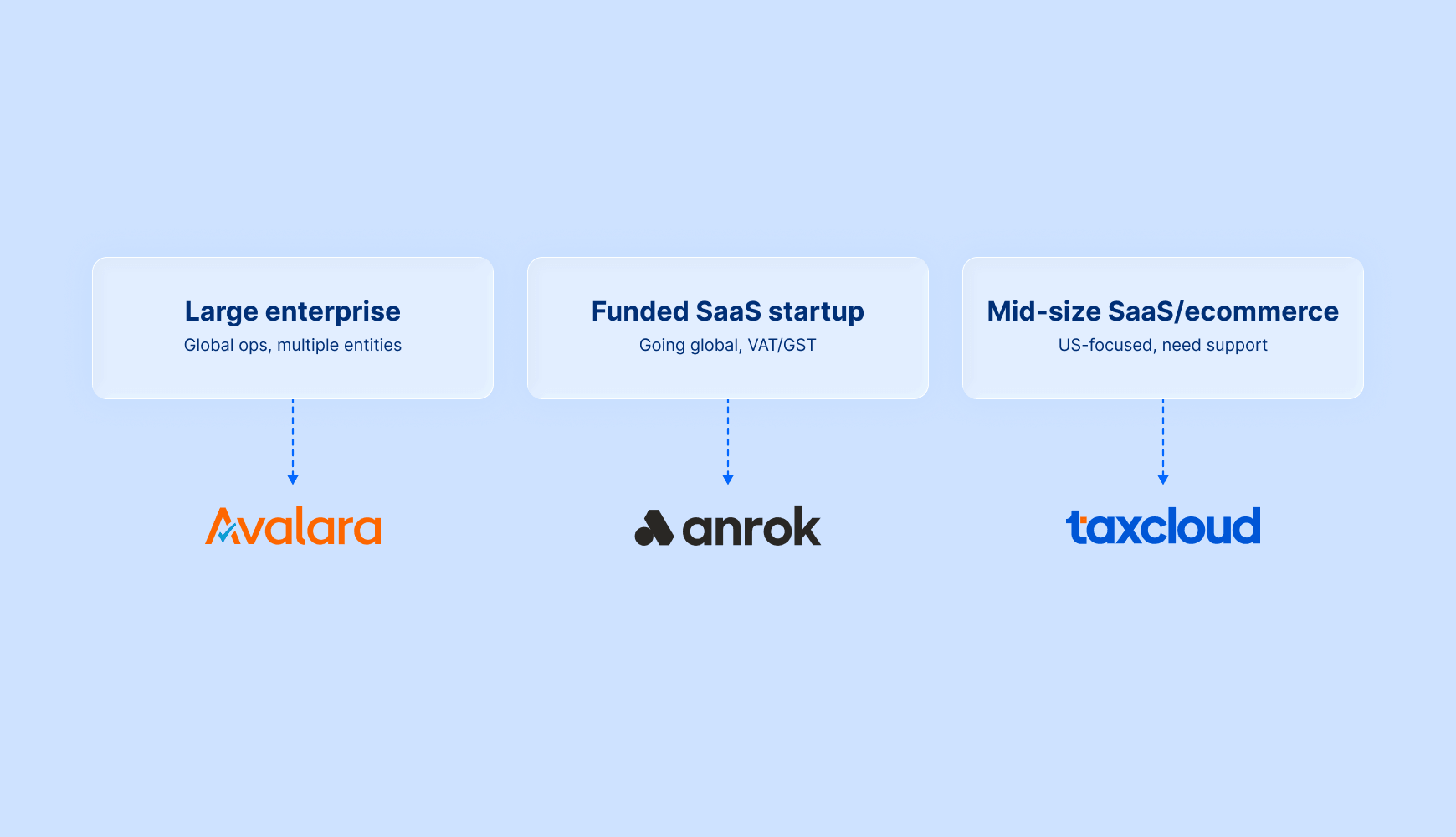
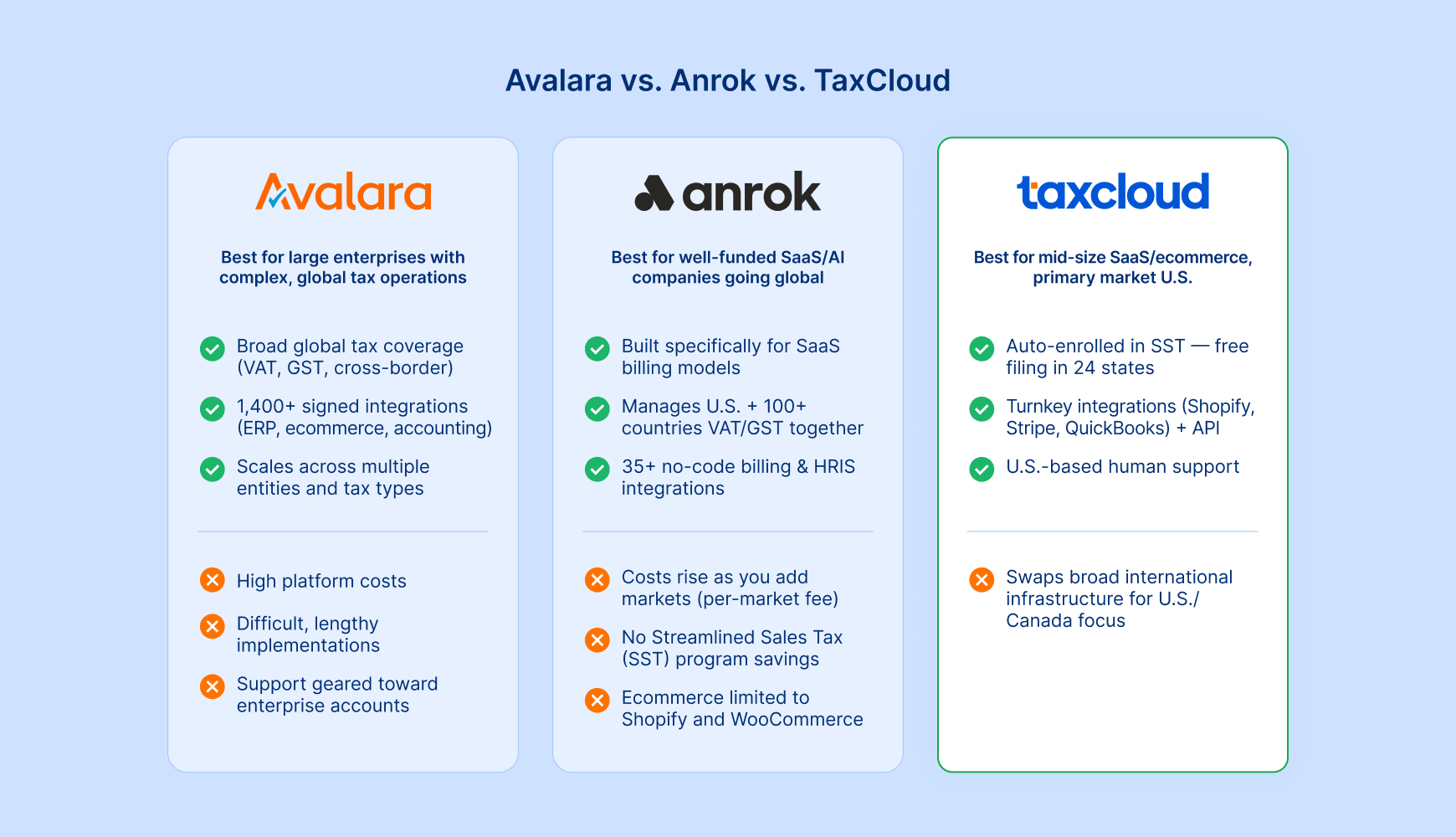
- Avalara is best for large enterprises that need broad global tax coverage, complex integrations, and support for multiple entities and tax types.
- Anrok is best for well-funded startups and SaaS businesses that need a modern platform for billing integrations alongside global VAT and GST capabilities.
- TaxCloud is best for mid-size SaaS and ecommerce companies with primary market U.S. that need a sales tax compliance partner, accessible human support, and at a reasonable cost.
Accuracy note: This comparison is based on publicly available information, product documentation, and independent user reviews.
Platform capabilities and pricing regularly change over time, so be sure to verify specific details directly with vendors if you’re switching to a different tax compliance solution.
| Capability | Avalara | Anrok |
|---|---|---|
| Real-time tax calculation | ✅ | ✅ |
| Product-level taxability handling | ✅ | ✅ |
| Economic nexus monitoring | ✅ | ✅ |
| Automated return filing | ✅ | ✅ |
| Exemption certificate management | ✅ | ✅ |
| Prebuilt ecommerce platform integrations | 💲 | Limited |
| ERP, CRM & POS integrations | 💲 | Limited |
| Public developer APIs | 💲 | ✅ |
| Self-service setup | Limited | ✅ |
| Self-service onboarding | ❌ | ❌ |
| Transparent entry-level pricing | Limited | Limited |
| SMB-friendly plans | Limited | ✅ |
| Global enterprise tax infrastructure | ✅ | Limited |
| Supports the Streamlined Sales Tax (SST) Project | ✅ | ❌ |
| Fast, reliable support from real experts | ❌ | Limited |
What is Avalara?
Avalara is one of the oldest sales tax compliance platforms on the market. Like most other solutions, Avalara is cloud-based and helps businesses automate sales tax calculation, monitor nexus thresholds, handle filing and remittance, and manage other tax workflows. Users can also deploy Avalara at a global level to comply with international tax requirements such as VAT or GST.
Compared with most other solutions, Avalara’s defining strength is its ability to scale. The platform provides a means for enterprise-level companies to stay compliant in every market. Through a mix of 1,400+ integrations and custom configurations, it’s possible to integrate Avalara with the rest of the company’s tech stack, including ERPs, billing tools, accounting software, POS systems, and online marketplaces.
The size and scale of the systems that Avalara provides makes it a great candidate for companies operating at a global level. Enterprise companies can keep both domestic and international sales tax in one place, making things easier to manage in the long run. However, that flexibility and convenience comes at premium costs that won’t make sense for small- and mid-sized teams that are more focused on deployments in limited markets.
While Avalara does offer a few plans tailored to smaller organizations, those solutions carry limited features and tend to be more expensive than competitor solutions focused entirely on mid-market customers.
The software does most of the work for you. I don’t have to keep up with thousands of rates or state laws. It also is a huge time saver with filing returns and keeping up with certificates. [But] it is difficult correcting errors in [Streamlined Sales Tax] states.

Key differentiators
- Broad global tax coverage. Avalara supports U.S. sales tax, VAT, cross border transactions, and other international compliance requirements, making it particularly useful for enterprise companies operating at a global level.
- Built to support complex operations. From automated calculation to international filing and remittance, Avalara can automate all aspects of tax compliance. The company also offers a blend of self service and managed services so that teams can offload complex tax obligations directly to dedicated support teams.
- Extensive integration ecosystem. Avalara offers more than 1,400 signed partner integrations across multiple categories (ERP, ecommerce, accounting, etc.). The platform also includes a variety of APIs that support custom implementations across complex technology stacks.
What is Anrok?
Anrok is a tax compliance platform built primarily for SaaS and digital-first businesses. By connecting with a company’s existing financial infrastructure, Anrok can monitor tax exposure, calculate tax as transactions occur, and automate the compliance work that follows.
Compared to broad, enterprise solutions like Avalara, Anrok distinguishes itself with a much narrower focus. The platform is a bad fit for traditional retail sales and is even somewhat limited for ecommerce solutions (although it can support them). Instead, Anrok focuses heavily on SaaS and includes the tools and features that teams using those models are most likely to need.
Anrok connects directly with billing and payment systems, supports both subscription and usage-based plans, and directly engages with taxability rules that apply to SaaS and digital services. That matters, because platforms that address those classifications poorly or fail to do so at all can create more costly compliance issues for SaaS customers.
Anrok also supports international VAT and GST, allowing software companies to manage domestic and global obligations inside a single platform. This is done through a combination of in-house automation and external, third-party partnerships. Companies providing SaaS products in areas with limited support will end up working with Anrok and a contracted partner in order to maintain compliance.
What I like best about Anrok is how seamlessly it integrates with our finance stack and automates the complexities of sales tax compliance, especially for SaaS. My main dislike with Anrok is the lack of a consistent point of contact. We often deal with different people depending on the issue, which can make it harder to maintain continuity and context.

Key differentiators
- Built specifically for SaaS. Anrok is designed to address the common compliance problems that SaaS companies face. The platform can calculate tax during invoice creation, monitor exposure as revenue grows, and account for SaaS-specific rules without forcing companies into a more generic ecommerce tax flow.
- Strong international capabilities. Digital companies working with Anrok can track exposure across 100+ countries and manage those obligations as they expand. Smaller companies aiming for global sales during early growth periods can use the capabilities to rapidly expand into new markets.
- Modern billing and finance integrations. Anrok connects with many of the billing systems that SaaS companies already use, allowing tax calculation and compliance data to move through existing billing workflows with less manual work.
Core tax compliance capabilities
For most SaaS teams, there isn’t a major capability gap between Avalara and Anrok when it comes to everyday sales tax compliance. The basic functions are largely the same. Both platforms can identify nexus exposure, calculate tax in real time, and automate the filing process.
Overall, the largest distinctions come down to a blend of scale, execution, and cost.
By design, Avalara’s tax ecosystem can manage compliance across a much broader selection of environments, jurisdictions, and scenarios. That gives businesses room to add new tax requirements as their operations become more complex. Integrations and supplemental filing products such as exemption certificate management can also be incorporated into a wider tax management workflow.
Anrok addresses the same problem, but through a SaaS-specific lens and without the same scale. The platform monitors U.S. jurisdictions and scales to international compliance, but most of those services are either automated or handled through AI. Turnkey integrations also aren’t as common, which restricts Anrok’s reach if a team doesn’t want to use custom API configurations.
Ultimately, these differences make Anrok a more niche solution but one that works very well for companies that don’t need the customization or complexity Avalara can provide.
Integrations and platform capability
In general, integrations allow users to connect their tax compliance platform to other software tools in their tech stack. That’s important for SaaS businesses because tax calculations need to fit into modern billing and accounting workflows.
With an integration, tax can be calculated accurately and folded into the existing systems and processes that the company already uses.
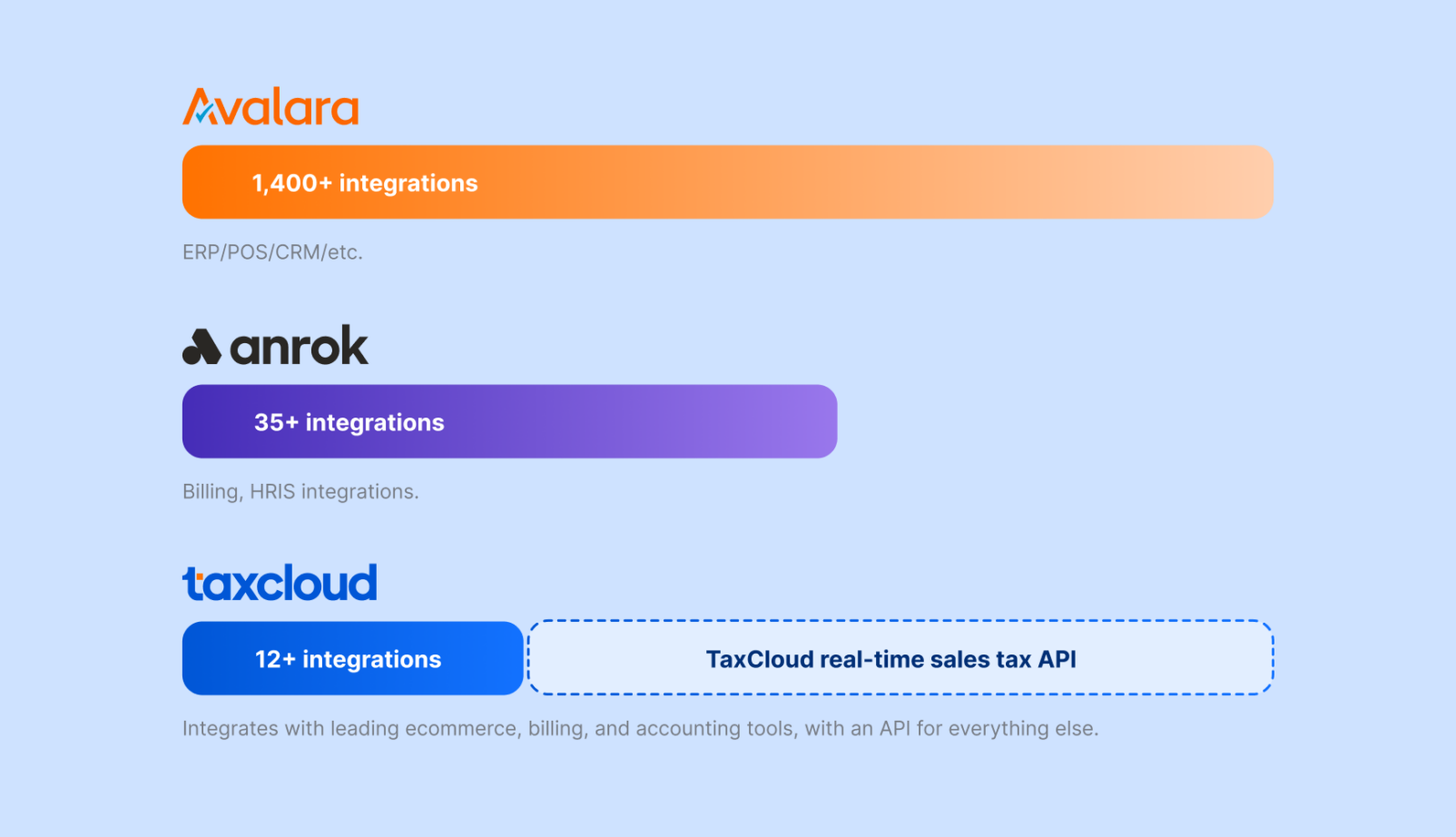
For example, TaxCloud offers 12+ integrations with the most popular marketplaces and billing platforms, not including TaxCloud API that can be used for connecting with any tool. If a digital company is selling through Shopify, processing payments through Stripe, and consolidating financial data in QuickBooks, TaxCloud’s integrations are more than sufficient to connect their entire tech stack. Having 1,000+ additional integrations won’t matter.
A higher number gives the best chance of finding a turnkey solution that matches the existing technology tools you use, but a developer with API access can also close that gap using API tools and custom configurations.
It may also be possible to use tax-based tools and APIs to connect compliance to parts of the workflow that might be otherwise unavailable.
Avalara integrations
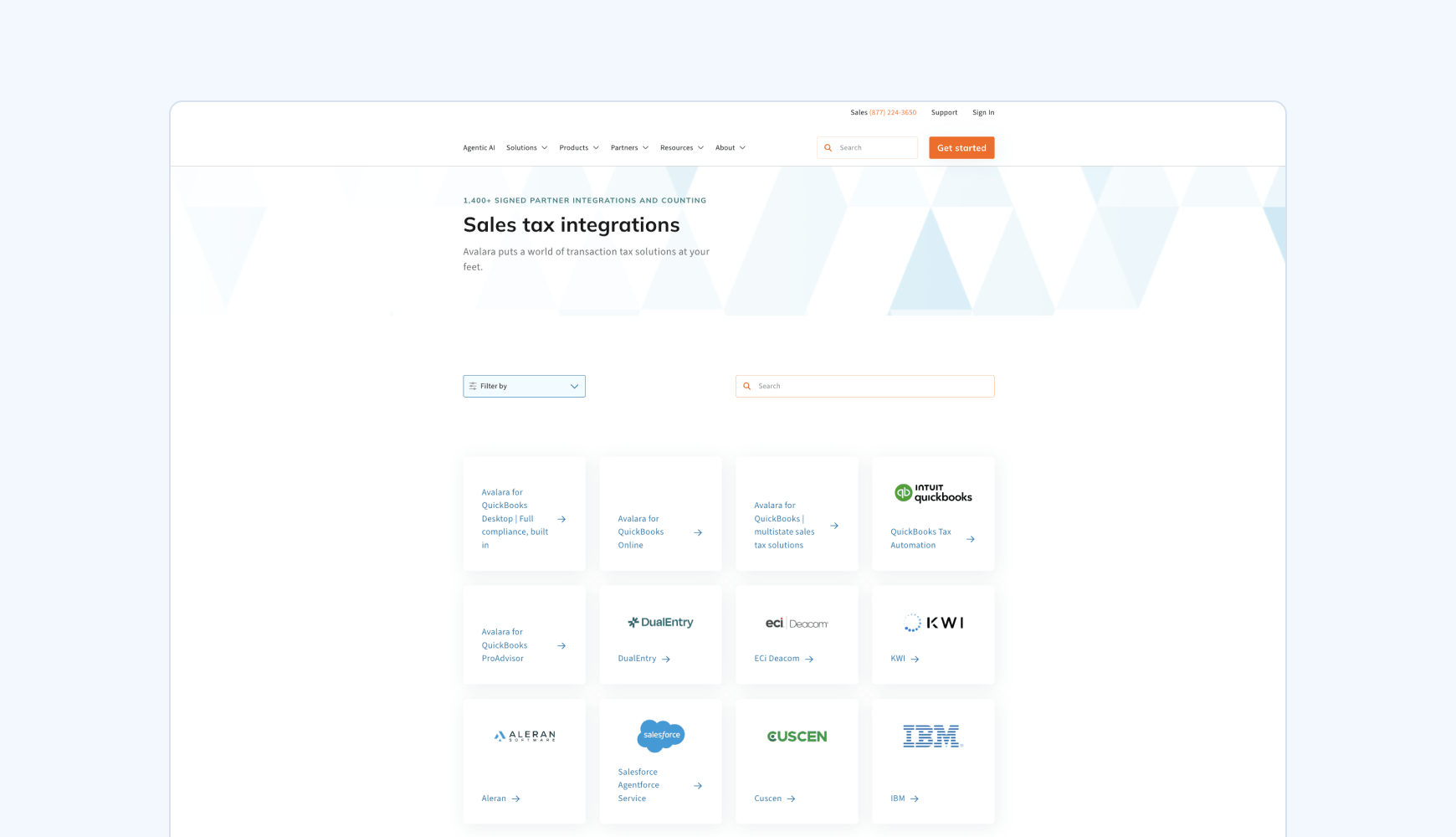
With 1,400+ integrations, Avalara supports more connectivity options than any other competitor.
Teams will find options for ERP and POS systems, subscription/recurring billing, online marketplaces, and much more. Some integrations are handled by Avalara’s own team, but others are partner integrations managed by third parties. All can further extend Avalara to add additional functionality or extend data intake for compliance purposes.
For enterprise teams using Avalara, these integrations are often critical to the success of the platform. If a company needs to connect tax compliance to various sales channels, accounting software, or needs to tie it to something like an inventory management system, Avalara’s integrations allow for that connectivity without the need for deep, custom setups.
[Avalara] doesn’t stand by their product and claim the issue with their sales tax not displaying in the sales tax field is a QuickBooks ‘display error’. They refuse to cancel our invoice even though the product does not work for the purpose of putting sales tax in the sales tax field.
However, that flexibility only goes so far, and there can be some hiccups. Every integration has programmed limits in terms of what information it can gather and how that data connects to the platform. While stacking integrations can allow for tremendous reach, there may also be limitations or gaps that can only be solved with API-based solutions.
Anrok integrations
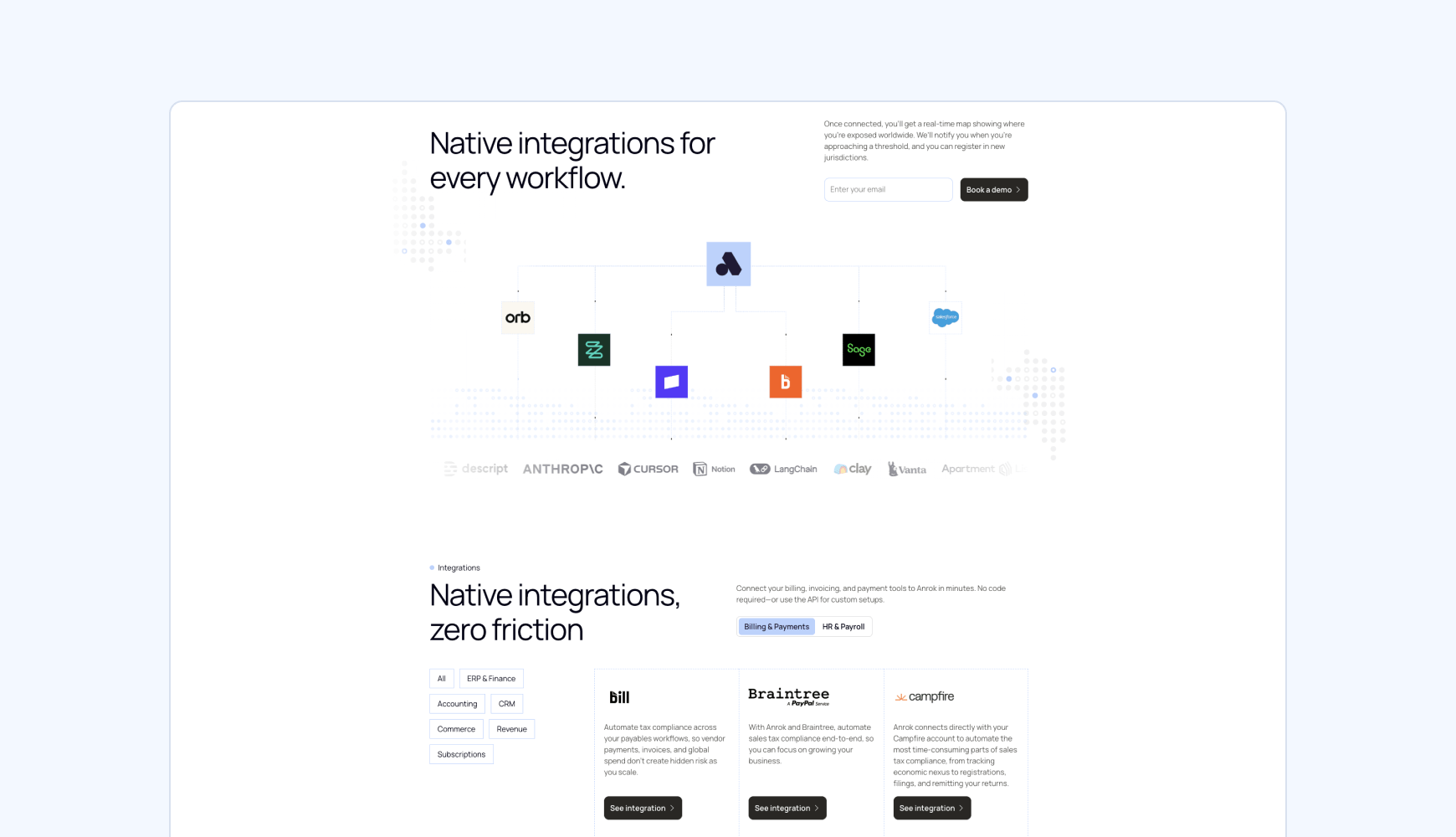
In large part, Anrok’s integration lineup connects to specific aspects of the revenue workflow. The platform sports 35+ native, no-code integration split between billing/payments, and HR/payroll. All are built primarily to import transactions, map products, and keep tax data synchronized without forcing finance teams to build a new process.
[Anrok is an] intuitive tool that syncs easily with Shopify and [is] super easy to onboard. It took less than half a day to set up and the implementation manager was very hands-on throughout the process.

For SaaS brands, the ability to connect tax compliance and calculation to payment flows is essential. Invoices can change due to renewals, credits, upgrades, or proration, and these changes may be initiated through a self-service workflow or product portal. By keeping tax calculations automatically aligned with those triggered changes, SaaS companies can adopt a set-it-and-forget-it setup and automate these transactions, rather than requiring a manual review.
Of course, teams still have additional flexibility when standard integrations aren’t enough. Anrok, like Avalara or TaxCloud, also offers API access. Teams using these tools can add the platform’s real-time tax calculation to custom or unsupported billing systems, but doing so will require developer support.
Compared to Avalara, Anrok doesn’t have the raw integration volume. However, much like TaxCloud, its connectors more closely match the needs and expectations seen in modern SaaS workflows.
Which is the better fit?
The best fit will depend on the systems that the company uses and whether or not the tech stack has already been configured.
For example, a company that already knows what they’re using for billing or finance data needs to find a workable solution that matches their existing configuration. SaaS companies using Chargebee for subscription invoicing can find compatible integrations with Avalara, and with smaller platforms like Anrok or TaxCloud. In that scenario, Avalara’s numerical advantage with integrations won’t matter.
On the other hand, brands that are still growing and expanding or who want to keep their options open for new infrastructure might benefit from the potential connectivity that Avalara’s library offers. Here, brands could further expand the tech stack (for a cost) to create a more comprehensive compliance solution.
Pricing and cost structure
While compliance platforms can help companies avoid penalties and audits, they also carry their own costs. To minimize loss from essential services, teams will always need to consider which subscription fees, costs for support services, and any add-ons that might be required to build a compatible solution.
With both Avalara and Anrok, every plan requires custom configuration. Users can’t simply sign up for service but must instead speak with a sales representative to get a custom-configured plan.
Here are a few elements to consider that can heavily impact final compliance costs:
- Monthly sales and transactions. With most plans, both Anrok and Avalara charge on a per-transaction basis when calculating tax. The more the products or services the company sells, the higher the cost. This is a common approach to tax calculation, and many platforms — including TaxCloud — use this approach. However, the per-transaction rate will vary between each provider.
- Number and location of tax filings. Most companies will consider the number of required tax filings when offering a quote. Avalara separates returns and filings into a separate module from tax calculations, but Anrok includes filings in the quoted price. While this is a standard practice, it offers less overall visibility into how costs are broken down, especially when compared to the transparent per-filing costs offered by solutions like TaxCloud.
- Integration count. Avalara is known for charging for the number of integrations or connectors included in a custom plan. The more integrations required to build a complete solution, the higher the cost. Anrok, like TaxCloud and many other compliance platforms, include most or all integrations with the cost of a plan. This offers a cost savings for companies that need multiple connectors.
- API usage. Teams planning to implement using custom API configurations will need to consider the amount of calls made to the API as well as the external costs of working with a third-party developer. While Anrok and TaxCloud grant full API access on their plans, Avalara offers multiple APIs with different endpoints, all of which may carry different pricing.
- Add-ons and additional modules. With Avalara, functionality like tax exemption management isn’t included with the basic tax calculation or filing systems. Teams needing these or additional features will incur an extra cost. Meanwhile, both Anrok and TaxCloud include exemption certificate management in all plans.
- Managed or outsourced services. In some cases, a tax platform may outsource services to a third-party vendor. Avalara offers access to a dedicated services team and partner services for an additional cost. Specific countries serviced by Anrok, including China, incur additional surcharges when users need filing support for those regions.
- Savings programs. Initiatives like the Streamlined Sales Tax Program, supported by Avalara and TaxCloud, offer a way to reduce filing costs in the U.S. Anrok doesn’t offer this service but may have programs that can help customers save when specific conditions are met.
A final word of consideration on pricing: Both Avalara and Anrok offer pricing bundles for smaller companies, usually with a specific caveat or limitation that may be worth considering. These plans typically carry usage caps and limited scalability before pushing teams into a full or custom plan.
Historically, Avalara’s plans targeted small- and medium-sized companies have dwindled in recent years. The platform has raised prices in pursuit of enterprise level customers, discontinued programs that were beneficial to smaller organizations, and more.
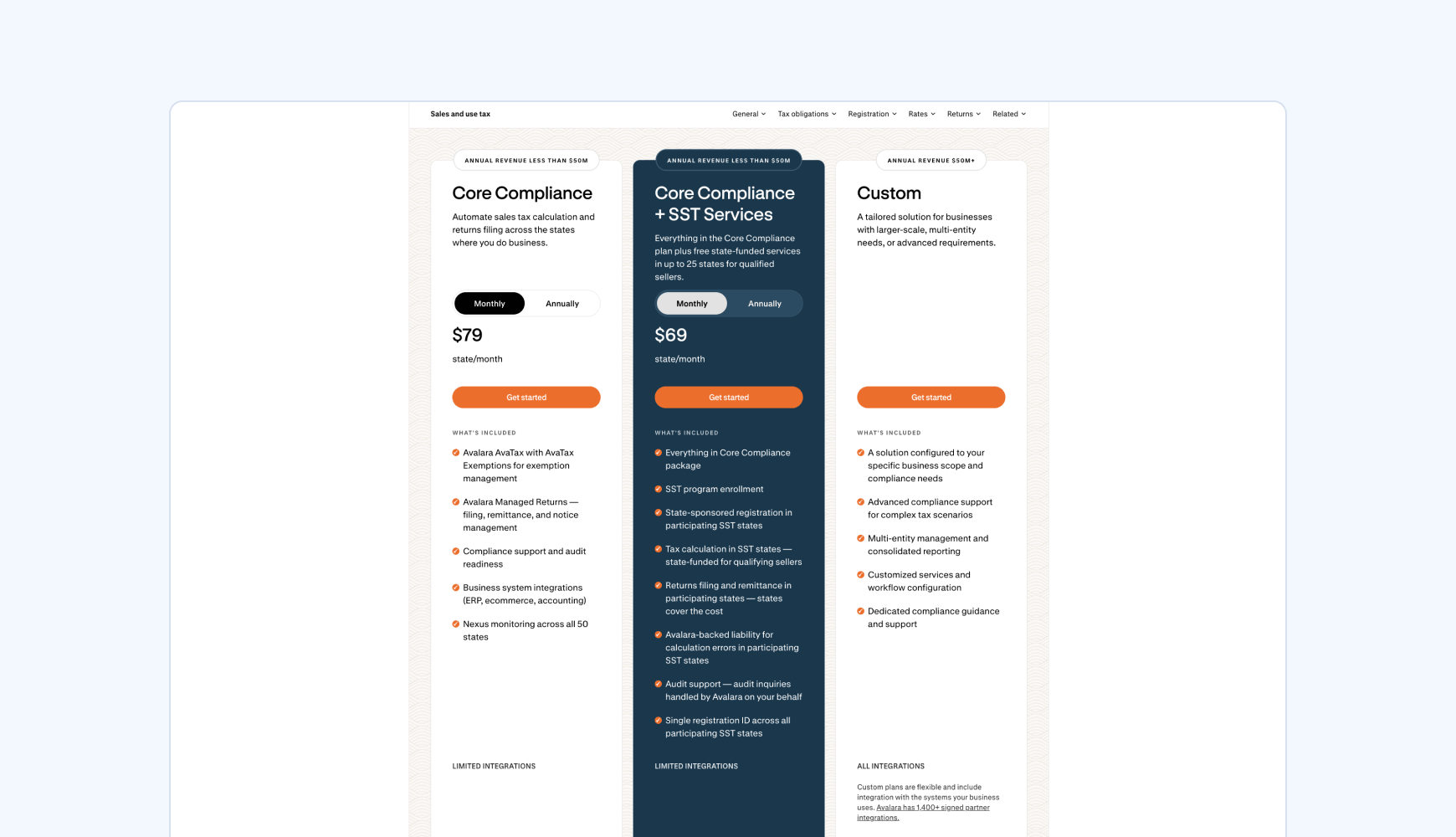
Anrok has become less transparent about their pricing, ultimately eliminating customer-facing, tier-based pricing in 2024 to replace it with custom-only options. More recently, the platform has begun offering a plan for startups, with strict limitations around scalability.
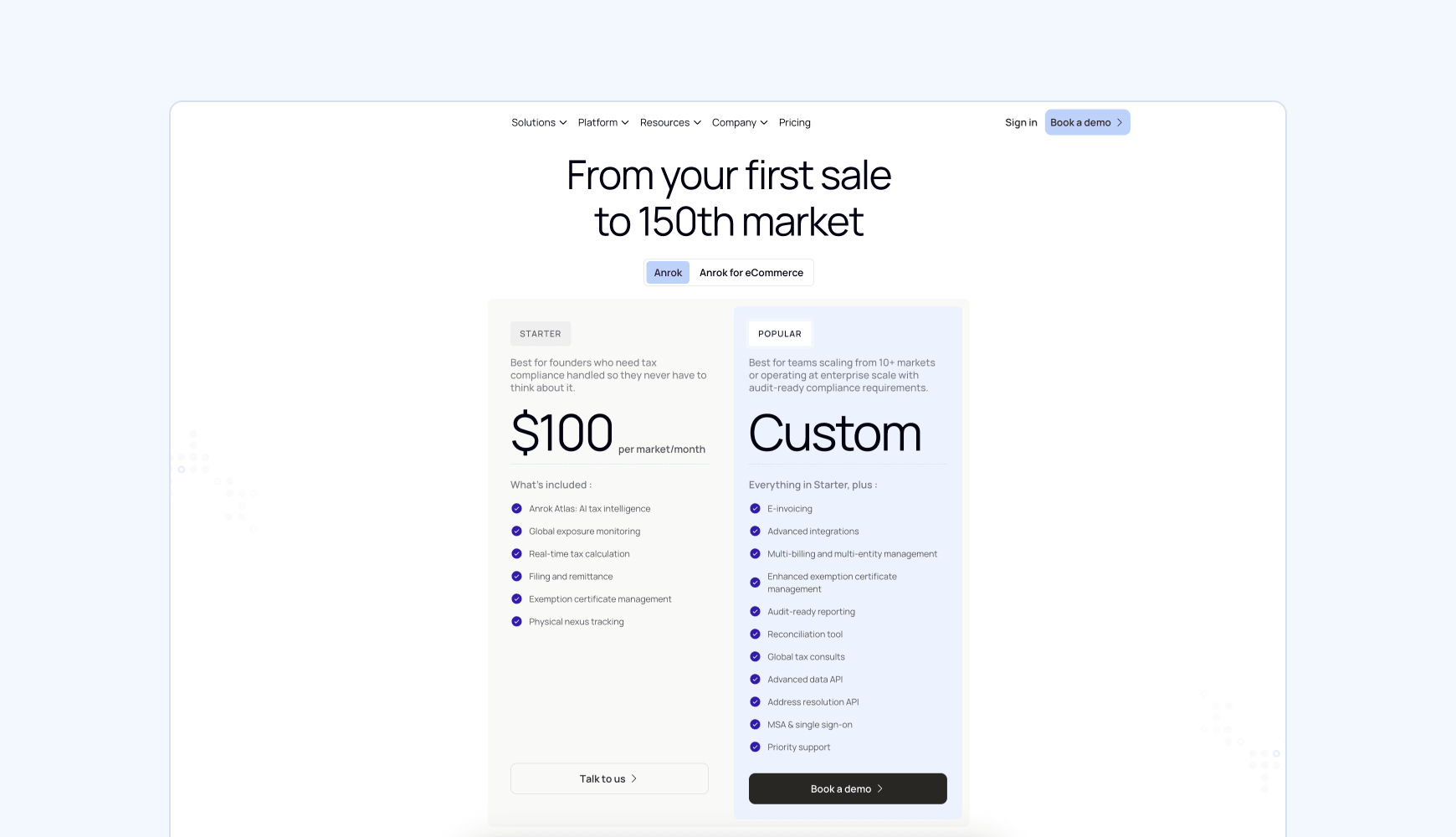
By comparison, TaxCloud’s pricing has always been open and transparent, so it’s easy to understand costs, features, and overall benefits.
Implementation and ease of use
Bringing a new compliance platform online will depend heavily on the company’s size, existing systems, and tax footprint. After the platform is connected, products still need to be mapped, and information like tax data, state registrations, and filing automation need to be configured. Once everything is set up, teams will need to conduct ongoing maintenance to keep things running smoothly.
With Avalara, companies will have the choice of Standard, Guided, or Managed implementation options. These are generally tied to support plans and come with added costs based around complexity and the level of requested support. However, even with added support, the most complex integrations can take months to fully configure and may even require assistance from third-party, Avalara-certified vendors.
Anrok’s onboarding is primarily built around connecting billing systems, adding past historical transaction data, and reviewing exposure before tax collection begins. Most integrations are no-code setups, and Anrok states that most configurations can be completed within one month, but the problem might not be seamless.
[Anrok’s] sales tax registration was/is a little bumpy. I understand that each state has different requirements, but I feel like communication could have been better through this process. We were supposed to be up and running by July 1. It is now November 3 and still are working on getting the last state registered.

For companies seeking a middle ground, TaxCloud offers white-glove, done-for-you onboarding support (webinar signup here). Our experts can help you migrate seamlessly from platforms like Avalara to TaxCloud without losing live calculation capabilities or historical compliance data.
Regardless of which solution you choose, keep in mind that implementations aren’t the only major lift to consider. No-code connections and integrations are easy to configure, but custom or convoluted setups may need regular maintenance as platforms update their policies or teams reconfigure their software setups.
Customer support and service models
Support can be critical in order for teams to stay compliant and on-time with filing and remittance. If sales tax isn’t calculated, an incorrect amount is applied at checkout, or if automatic filing and remittance fails, reporting can contain errors that lead to penalties and audits. Reliable support can close the gap when automation falls short and a real person needs to take ownership of the problem.
Avalara’s answer to potential problems is tiered support. The Standard support model includes a 24-hour response SLA during business hours. Higher plans can lower response times to as little as one hour and include varying levels of availability. Customers willing to pay for extra support may be able to get direct help. However, by default, Avalara’s Standard support model only includes a ticketing system.
[Avalara’s] support operations still require significant improvement. In some cases, it can take up to a month just to receive an initial response from their support team, which is highly unacceptable and impacts timely issue resolution.

By contrast, Anrok places a greater emphasis on customer assistance by offering AI support via chatbots, as well as priority support and assistance from a tax expert for every user on a Custom plan. The platform doesn’t offer post-sale support plans, meaning that customers don’t pay more for support and Anrok doesn’t offer a channel for customers to receive faster responses.
TaxCloud falls somewhere in the middle. Our support team is based entirely in the U.S. and doesn’t use AI tools. We usually respond within the same day and work with teams to quickly resolve any outstanding problems.
Final Verdict: Avalara Vs Anrok Vs Taxcloud
Before jumping into final verdicts, it’s worth pointing out that all three platforms mentioned here can handle serious tax compliance needs for SaaS and digital companies.
While there is a notable difference in the type of business that each solution is best-equipped to handle, it’s possible to configure all three systems to meet needs around subscriptions, recurring payments, real-time calculations, and more.
Because of the overlap in capabilities, the recommendations below are based upon a mix of business complexity, international usage, and U.S.-focused growth.
Avalara
Realistically, Avalara is the best fit for large enterprises with complex, globe-spanning tax operations. The platform’s complexity and scalability enables it to power deeply sophisticated compliance solutions that are only matched by platforms like Sovos or Vertex, two other enterprise-grade tax solutions.
However, the features that make Avalara so appealing to enterprise customers make it a bad fit for small or growing digital and SaaS companies. The high platform costs, difficult implementations, and cost-heavy support services often create operating costs that are difficult to justify.
Combined with a long history of difficult support problems, convoluted integration setups, and ongoing maintenance burdens, it’s difficult to recommend Avalara for brands who don’t have the in-house technical and accounting support to handle problems by themselves if and when they arise.
Anrok
For well-funded SaaS and AI companies that already have or plan to soon carry international tax obligations, Anrok is a great fit. The platform’s specialization for SaaS, as well as its modern billing integrations and ability to manage U.S. and global compliance together make for an appealing platform.
For U.S.-focused businesses, Anrok isn’t as appealing. Per-market pricing becomes more expensive as nexus obligations expand, and Anrok lacks the ability to help users save money through the SST program. That means, compared to solutions like Avalara and TaxCloud, Anrok customers will pay for filings that Anrok’s competitor can offer at no cost for qualifying companies.
Outside of SaaS, Anrok’s capabilities are more limited. While the platform offers a solution for ecommerce, this is restricted to two marketplaces — Woo and Shopify — which greatly limits sales channel expandability down the line. Even in that case, many of Anrok’s key integrations won’t be as useful, because ecommerce sales don’t often rely on recurring billing or e-invoicing.
TaxCloud
Compared to Anrok and Avalara, TaxCloud tends to be the strongest solution for growing companies who are moving from small to mid-size level and don’t really need global infrastructure at this stage. The platform blends automation, transparency, and support into an end-to-end compliance solution that streamlines calculation, filing, and remittance.
By default, TaxCloud automatically enrolls every eligible business in the SST program. Using this method, TaxCloud can file taxes in up to 24 member states at no cost to users. The SST program also allows TaxCloud to support a company by acting as its representative when dealing with audits and government inquiries. While Avalara can offer some functionality, multiple former Avalara customers have told us that Avalara failed to fully leverage SST savings on their behalf.
For both SaaS and ecommerce businesses, TaxCloud provides turnkey access to popular billing and marketplace integrations, as well as customization options via API. The system can be configured to calculate tax when users select a subscription plan or buy a product, and that transaction data is automatically imported to TaxCloud’s tracking and filing solutions.
These features, among others, make TaxCloud a great choice for users seeking a balanced option between the enterprise scalability that Avalara provides and the more narrow focus seen with Anrok.
Other compliance solutions
Although we’ve primarily focused on Avalara and Anrok in this comparison, keep in mind that other compliance solutions may be a better fit for your particular use case.
- For enterprise teams, Avalara alternatives like Sovos or Vertex offer similar extendability.
- Solutions like TaxCloud or Stripe Tax are great alternatives for Anrok and can even work together to create a complete solution when billing through the Stripe platform.
Remember: before making a final decision, it’s worth taking the time to consider the company’s growth strategy, as well as what capability and functionality will be needed as part of future compliance.
Simplify tax compliance with TaxCloud
There are several great tax solutions out there for growing companies, but selecting an option with unnecessary functionality can easily come with high costs. For example, companies operating solely in the U.S. may not need to pay for broad, international tax infrastructure if they’re only expanding to other states.
Especially for companies focused in the U.S. and Canada, TaxCloud offers the right balance of cost and complexity. In addition to providing an end-to-end tax solution, TaxCloud’s partnership with the SST program makes savings viable as a business continues to thrive. That’s especially true for SaaS companies, where statewide expansion can happen quickly as word about the service spreads.
Want to learn more?
Get in touch with one of our product specialists for a personalized demo to learn how TaxCloud can help your team stay compliant while keeping your tax footprint low.
Avalara vs Anrok vs TaxCloud — FAQs
Avalara is a larger tax platform than Anrok. While Avalara supports smaller sellers with limited or bundled plans, it’s a better fit used by enterprise companies with complex, global tax requirements. The vast integration library that Avalara supports allows for greater connectivity across the company tech stack.
Anrok is more narrowly focused on SaaS and digital-first companies. Its product and integrations are built to accommodate recurring workflows and subscription-based services. Anrok can also support ecommerce businesses, although its ability to do so is more limited in scope than TaxCloud and other competitors.
It can. Avalara’s packaged plans sometimes include a limited set of common integrations, but access to its full catalog of 1,400+ integrations is only available through the Custom plans. Integration is a factor in plan configuration, and will add costs.
Similarly, Standard support is included for every plan, but Priority and Enterprise plans are paid upgrades.
Yes. Anrok calculates and adds sales tax in real time as an invoice is created through supported integrations like QuickBooks or Chargebee. The API also allows custom billing systems to request tax calculation when an invoice is created or updated.
Anrok is generally a better fit for the subscription billing that SaaS companies generally use. The platform’s integrations are specifically built to handle recurring invoices and changes like upgrades, credits, and prorations.
Avalara can support subscription businesses, but it’s built for a much broader range of industries and technology environments.
An SST Certified Service Provider like TaxCloud has been certified by the Streamlined Sales Tax Governing Board to perform most sales tax administration on the seller’s behalf.
For qualifying sellers, participating states compensate the CSP for covered services (calculation, filing, remittance, etc.), which allows SST providers to offer free filing to qualifying businesses.
A non-SST provider doesn’t have access to that arrangement and is therefore unable to offer the same saving or unified filing options.