7 signs your ecommerce brand has outgrown manual sales tax
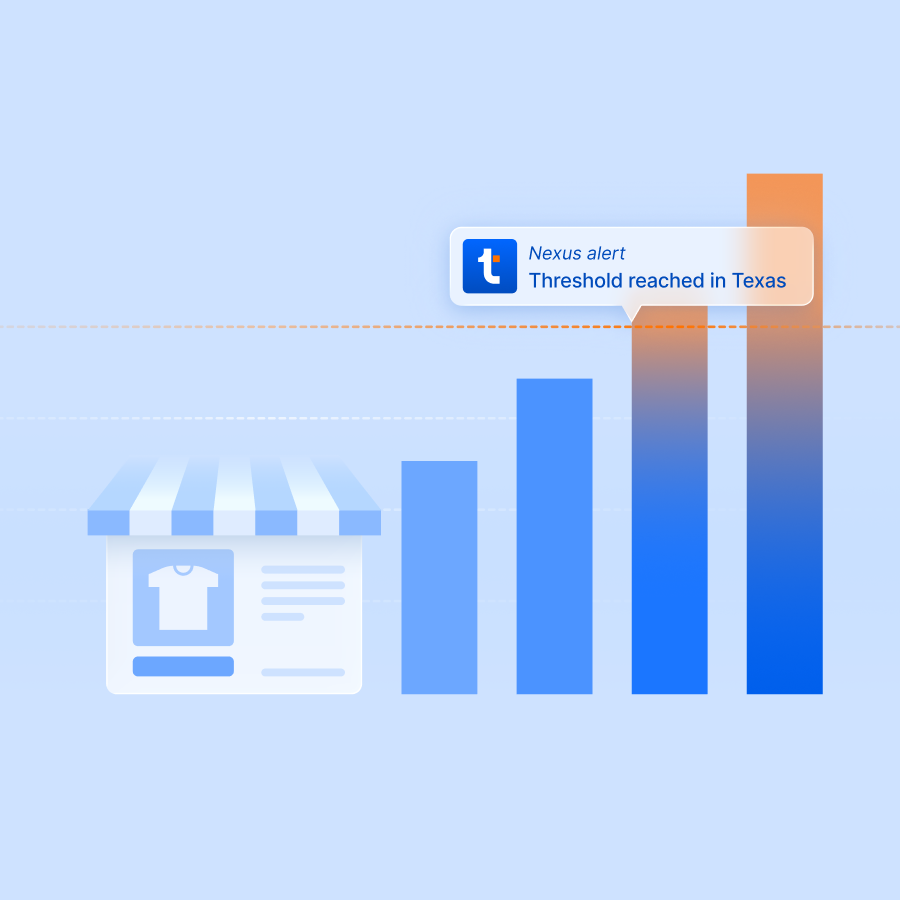


By the time manual sales tax breaks, it’s not a small fix. You’re facing back taxes, penalties, and interest, and that money comes out of your own pocket to replace tax you never charged customers in the first place.
The challenges of manual sales tax filing are real for sellers of every size. USAMM was doing millions in revenue and still tracking sales tax for 50 states in a spreadsheet, a week of work every month, with no real confidence the numbers were right.
If you’re managing sales tax in-house and part of you already suspects you’ve outgrown it, you probably have. Ecommerce sellers who switch to TaxCloud almost always describe the same breaking points. Here are seven of them, and what each one costs you.
Manual nexus tracking: The first thing that breaks
Tracking economic nexus manually is easy when you’re a small seller. As your sales footprint scales, it’s the first thing that fails.
Sign 1: You discover you have nexus in a new state after the fact
If you update your nexus spreadsheet periodically — once a month, once a quarter — you’re always looking backward.
You can cross a threshold in January and not see it until April, with three months of sales tax liability building while you think you’re fine.
By the time you catch it, the tax bill is yours to pay. But you can’t collect that tax from past customers now. So it comes out of your own margin, penalties included.
Sign 2: You can’t see your true nexus exposure across all your channels
Amazon and Etsy track and collect tax on your sales automatically, so it’s easy to assume you’re fully compliant.
But marketplaces only remit tax on their own channels, while most states count all your sales toward nexus regardless of where they happen. Without one view across every channel, you can’t see where that leaves you.
Marketplace volume can quietly push you over a state’s economic nexus threshold. You could be on the hook for collecting sales tax on your Shopify or WooCommerce store and you won’t even know it.
Manual sales tax calculation: Where the errors compound
Small tax errors multiply fast as your business grows. Tax processes that worked for one or two states often buckle at five or six, compounding your liability.
Sign 3: You’re relying on your bookkeeper to figure out sales tax
You hand off sales spreadsheets to your bookkeeper and tell them to figure out the tax math. But bookkeepers are experts at reconciling financial data, not navigating multi-state tax laws.
They don’t know how to determine where you have nexus, what tax classifications apply to specific products, or how to handle exemption certificates. If your bookkeeper makes the wrong call, it’s your business that bears the consequences.
Relying on your bookkeeper for tax compliance doesn’t reduce your audit risk. It amplifies it.
Sign 4: You don’t know how much you owe in back taxes
You crossed an economic nexus threshold months ago, and the liability has been building ever since. But if you’re tracking manually, you have no way to see how much you’ve racked up.
The state can. They have your sales data, and they expect to be paid in full. Every day you wait to remit, they stack more interest and penalties on top of what you already owe.
Manual filing: Where the consequences land
Manual filing exposes the cracks in your process that have been growing quietly under the surface. This is where penalties pile up and states come knocking.
Sign 5: You’re managing filing deadlines in a spreadsheet
You have a spreadsheet with every state’s filing portal and deadline, so you think you can manage filing across multiple states.
The trap is that as your volume grows, states can switch your filing frequency from quarterly to monthly without warning. Your spreadsheet won’t alert you to the change.
By the time you’re ready to file your quarterly return, you’re already 60 days delinquent on your monthly filing. Penalties and interest have been growing and now you have an unexpected tax bill to pay.
Sign 6: You assume your tax calculation software is also filing returns
You installed a tax calculator in your online shop and your platform collects tax from customers. It seems reasonable to assume that money is being remitted to states.
But sales tax calculation and sales tax filing are two completely separate functions. Months or even years could go by before you discover your business has been collecting taxes without remitting them.
Your business is responsible for paying all of the back taxes plus interest. You also need to convince state tax agents that you made a simple error rather than committed tax evasion.
Sign 7: You received a notice from a state revenue department
You thought you were doing everything right. Until one day a sales tax audit notice appears from a state revenue department and you have no idea why.
Now you’re not just playing catch-up — you’re playing defense.
Your business has to spend time and money reviewing records and dealing with tax agents. That’s in addition to paying the back taxes and penalties that have been piling up without your
What changes when you automate sales tax compliance with TaxCloud
If your sales data is scattered across channels and spreadsheets, you can’t see where you actually stand. You find out you’ve crossed a line only after it’s cost your business.
The fix isn’t more discipline with the spreadsheet. It’s pulling everything into one place with ecommerce sales tax software that watches your thresholds, does the math, and files for you. It reduces your administrative burden and surfaces problems while you can still act on them, not after a state does.
Here’s what ecommerce sales tax compliance looks like when you automate with TaxCloud:
| Managing manually | Automated with TaxCloud | |
|---|---|---|
| Knowing you've crossed nexus | Found out after the fact, often months late | Alerted in real time as you approach each threshold |
| Visibility across channels | Sales scattered across marketplaces and your store | Every channel in one per-state view |
| Tax calculation | Bookkeeper guessing at multi-state rules | Catalog mapped to each jurisdiction's rules automatically |
| Back-tax exposure | No idea how much has built up | Historical exposure surfaced and sized |
| Filing deadlines | Tracked in a spreadsheet that can't warn you | Filed on each state's schedule, frequency changes handled |
| Free filing in SST states | No. Register and file (for a fee) with each state yourself. | Yes. TaxCloud is an SST Program certified service provider; eligible remote sellers pay $0 per return in up to 24 SST states. |
| When a state notice arrives | You face it alone | US-based experts who can handle the state directly |
If you’re new to ecommerce sales tax automation software, a few of these are worth spelling out:
- One clear view of where you actually stand. For the first time, all your sales and tax obligations live in one place, across every channel and state. No more piecing it together from spreadsheets and hoping you didn’t miss something.
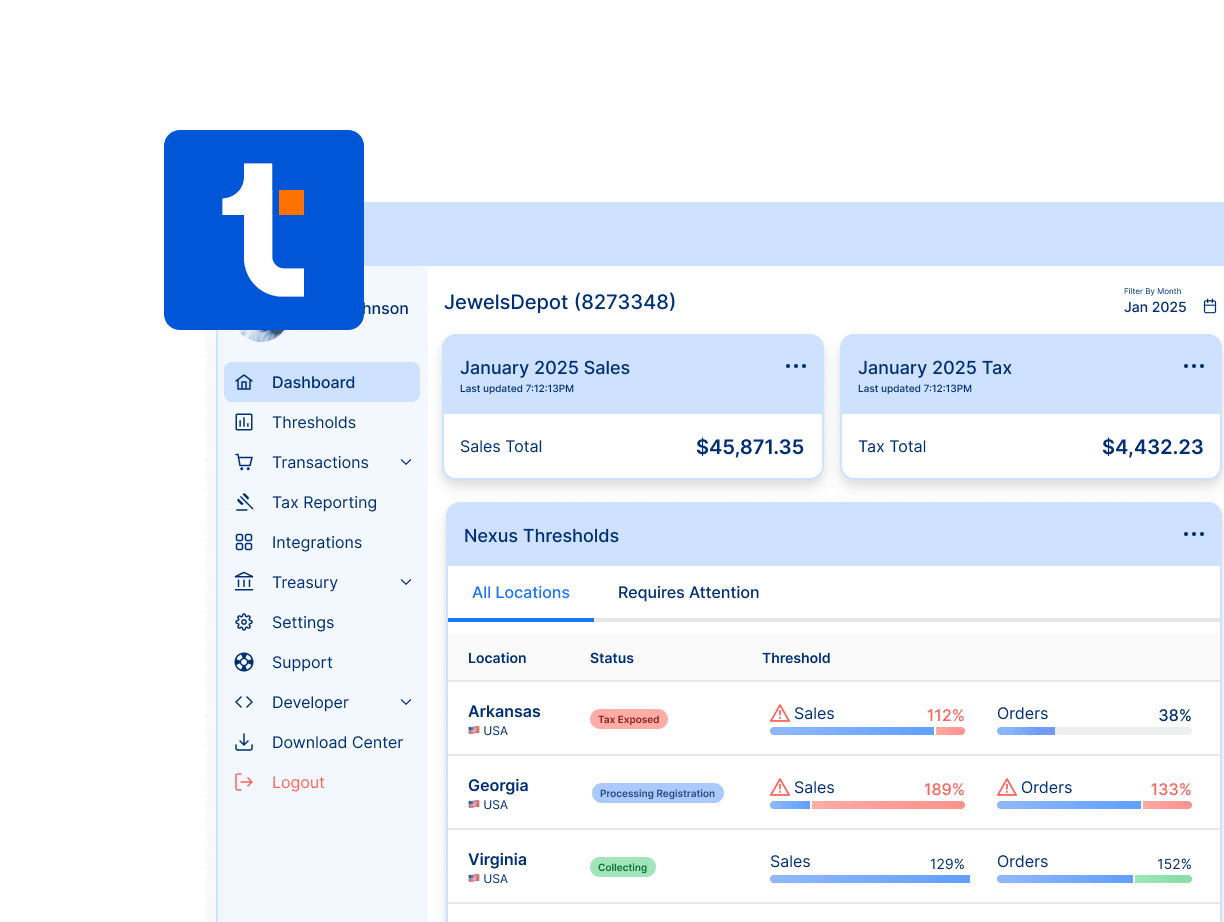
- Nexus tracked across every channel, in real time. TaxCloud pulls sales from all your channels into one view and alerts you as you approach a threshold in a new state. When you cross nexus, you’ll know it right away.
- Sales tax rates calculated right, exposure you can actually see. TaxCloud maps your catalog to each jurisdiction’s rules and shows your historical exposure, so you’re never guessing about your compliance risk or hoping your bookkeeper got it right.
- Filing handled for you. TaxCloud files tax returns with each state on schedule, so there’s no spreadsheet of deadlines, no filing errors, and no quarterly-to-monthly surprise waiting to catch you.
- SST program benefits (free filing in up to 24 SST member states). As a Certified Service Provider under the Streamlined Sales Tax (SST) program, TaxCloud files for $0 per return for eligible remote sellers in the 24 SST states. If you choose to file manually in an SST member state, you won’t have access to the SST program benefits; you’ll have to pay filing fees to each state. So the more states you’re in, the more you’re overpaying by doing it yourself.
- Real support when a state notice arrives. If a notice does appear, you’re not facing it alone with a spreadsheet. TaxCloud’s US-based team knows sales tax and your account, and in SST states where you have no physical presence, they can handle the state’s audit directly.
- Guided migration and onboarding, not a rebuild from zero. TaxCloud connects to your existing platforms and imports your historical orders, so moving off manual doesn’t mean starting over or losing the sales history you need to size past exposure. Most sellers are up and running in hours, not weeks.
The real reason most sellers delay switching to automated compliance is a quiet fear that turning on sales tax compliance software for ecommerce notifies a state and surfaces all your past sales tax mistakes. It doesn’t.
States already have your sales data. What you’ve been missing is a clear view of it. With TaxCloud, you get a sales tax compliance partner that takes care of all of your obligations and tells you where you stand before you get a notice.

Rareform found four years of SST savings hiding in plain sight
Rareform’s VP of Finance dug into the Streamlined Sales Tax program herself and realized their previous provider had never surfaced the savings TaxCloud passes through as a Certified Service Provider. Four years of overpaying, uncovered on her own.
Rareform moved to TaxCloud and stopped paying to file in states where filing should have been free. Read the story.
Stop being your own sales tax department
Automate your sales tax compliance with TaxCloud and stop worrying about whether you’re compliant everywhere you sell.
Manual sales tax — FAQs
It depends on how much exposure you have. If it’s only a few unfiled returns over less than a year, the usual path is to register, file the back returns, and request penalty abatement.
If the exposure spans multiple years, a Voluntary Disclosure Agreement (VDA) is often the better route, it caps how far back the state can look and can waive penalties, but only if you act before the state contacts you. A VDA is best handled with a tax specialist, and the first step either way is a nexus study to confirm what you actually owe.
You have to file taxes in any state where you have nexus, whether that’s economic nexus, physical nexus, or another type of nexus. Physical nexus may apply if you have any employees in another state. It can also apply if you house inventory in another state, even if that inventory is managed by a third-party logistics provider.
In most states, marketplace sales do count towards economic nexus. However, around 20 states exclude marketplace sales from economic nexus. In those states, only direct sales through your ecommerce store count towards nexus.
It depends on that state’s economic nexus laws and how you sell. Some states don’t require you to register if you only make sales through marketplaces. Other states still require registration if your marketplace sales cross nexus. If you sell through both marketplaces and your own ecommerce store, you must register once you cross nexus.
Yes. Even if you haven’t registered with a state, you can still owe taxes there. Whether you owe depends on whether you ever crossed a nexus threshold in that state. If you did and didn’t register, you likely owe back taxes.
You must pay back taxes out of pocket. If you didn’t collect sales tax from customers at the time of purchase, you can’t go back and ask for additional payment later. If you owe a state back taxes, your business is directly liable for that money.