SaaS sales tax by state: Is SaaS taxable in 2026?
Written by

Director of Growth, TaxCloud

Published

Updated
SaaS taxability is one of the most confusing areas of U.S. sales tax law. There’s no federal rulebook, and taxability rules differ by state. This guide gives you the full picture: where SaaS is taxed, where it’s exempt, and how nexus, customer type, and local rules shape your obligations.
TL;DR: Is SaaS taxable?
In some states, but not all.
- 24 states and D.C. tax SaaS in some form as of October 2026.
- Five states (Alaska, Delaware, Montana, New Hampshire, and Oregon) have no statewide sales tax, though some Alaska localities tax SaaS.
- California and Colorado will start taxing SaaS statewide on January 1, 2027.
And even in taxable states, you only need to collect sales tax where your SaaS business has physical nexus or economic nexus.
A monthly SaaS subscription can be taxed completely differently depending on where the customer is located. Automating sales tax with a tool like TaxCloud helps you keep up with the rules in every state you sell into.
Where is SaaS taxable in the U.S.? SaaS sales tax by state
This table shows which states require businesses to charge sales tax on software as a service (SaaS) as of October 2026.
Sources: State Departments of Revenue; TaxCloud internal database. Table updated October 2026. Verify rules with each state’s Department of Revenue.
For a deeper dive, check out our SaaS sales tax state guides:
Don't let sales tax slow you down
TaxCloud automates SaaS sales tax compliance so your team can focus on revenue, not returns.
Why is SaaS sales tax so complicated in the U.S.?
U.S. sales tax laws were written for physical goods, not cloud software. With no federal rule, each state decides for itself whether and how to tax it.
“SaaS sales tax is uniquely weird,” says Joe Stanton, CEO at TaxCloud. “Software breaks the basic assumption sales tax was built on: that a sale happens somewhere.”
Whether you need to collect sales tax on a SaaS sale comes down to five questions:
- Does your customer’s state tax SaaS? Check the table above. In a few places, like Chicago and Denver, local governments tax SaaS even when the state doesn’t.
- Do you have nexus there? You have nexus in a state if you have a physical presence there or you pass its economic nexus threshold, which is based on your sales or number of transactions in the state.
- Is your customer a business or a consumer? A few states treat B2B and B2C software sales differently. Ohio only taxes SaaS bought for business use, while Iowa exempts SaaS bought for business use.
- Does your customer download anything? Some states that don’t tax SaaS still tax software that gets installed, like a desktop app.
- What else is included in the price? When support or implementation is billed together with the subscription, some states tax the whole charge. Others tax only the SaaS if the services are listed separately.

SaaS taxability is a moving target
Every state sets its own taxability rules, and the SaaS rules keep changing. Louisiana and Maryland changed how they tax SaaS in 2025, and California and Colorado will begin taxing SaaS statewide on January 1, 2027.
Sales tax automation platforms like TaxCloud automatically monitor rule changes and nexus thresholds, so your SaaS company stays compliant as you grow.
How to calculate and collect SaaS sales tax in the U.S.
Once you have nexus in a state, the work comes down to three steps.
1. Register for a permit
Get a sales tax permit in each state where you have nexus. Some states require you to register even if SaaS isn’t taxable there, while others let you skip it if nothing you sell is taxable.
2. Start collecting tax
Charge tax on taxable sales to customers in that state. Each state sets its own start date after you cross the threshold, anywhere from your next sale to a few months later. Rates vary by state, county, and sometimes city, so you need to know where each customer is.
3. File returns on the state’s schedule
When you register, the state assigns a filing schedule, usually based on how much tax you collect. Each return reports what you collected, and you pay that amount to the state through its own portal. Late or missed returns can bring penalties and interest.
Doing this by hand gets harder with every state you add. That’s where sales tax automation comes in.
How to automate SaaS sales tax compliance
Sales tax automation means using software to do the sales tax work you’d otherwise do by hand, from calculating tax on each sale to filing returns. For SaaS companies, that usually covers:
- Connecting your billing system to track sales by customer location
- Monitoring nexus thresholds so you know when to register in a new state
- Calculating tax at checkout using current rates and exemptions
- Filing and paying returns on each state’s schedule
- Keeping records in one place in case of an audit
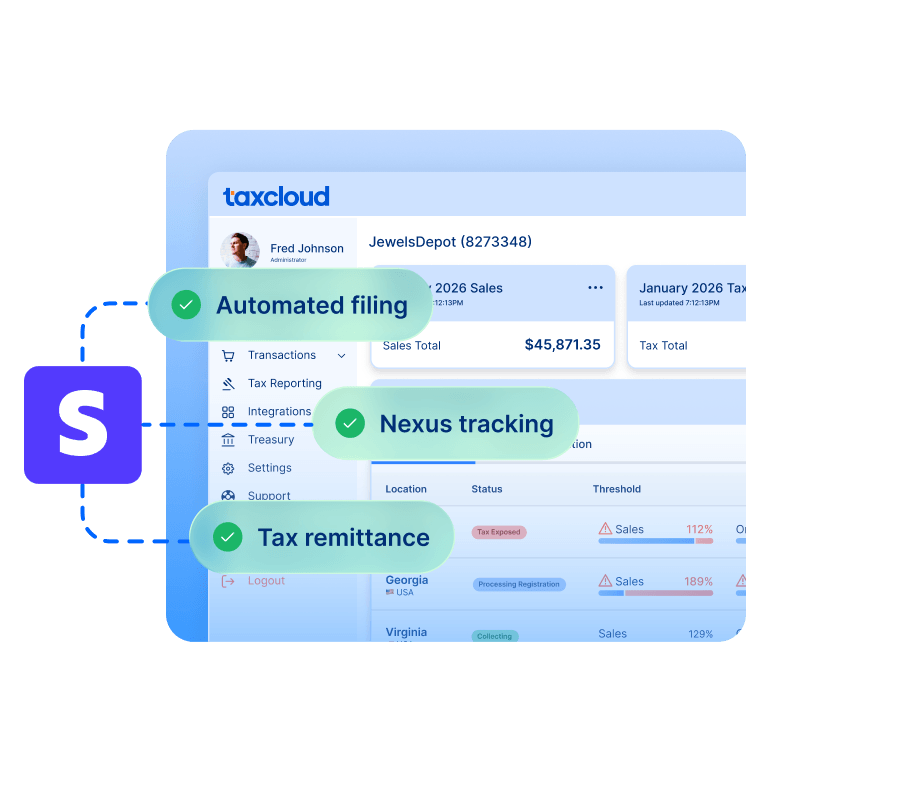
For a fast-growing SaaS company, that’s a lot to handle in-house. TaxCloud connects to Stripe and Chargebee, monitors nexus in all 50 states, and handles registration, filing, and audit support.
Stripe Tax handles calculations. TaxCloud handles the rest.
TaxCloud for Stripe works with your existing Stripe setup for complete compliance: nexus tracking, registrations, filing, and remittance on your behalf.
How does the SST program work for SaaS sales tax?
The Streamlined Sales Tax (SST) program is an agreement among 24 states to simplify and standardize their sales tax rules. As a Certified Service Provider (CSP) for the program, TaxCloud offers free sales tax filing and registration in those states for eligible remote sellers.
Eligibility is set state by state. One condition is that you don’t have a fixed place of business in the state for more than 30 days, so check the SST rules if you have an office there.
What if you owe back tax on SaaS sales?
If you think you’ve owed sales tax in a state without collecting it, talk to a tax professional before you act. This section is general information, not legal advice.
Many SaaS companies find out they have nexus after the fact, often because of a remote employee or faster growth than they expected. Many states offer a voluntary disclosure agreement (VDA), which lets a business come forward on its own and pay what it owes. A VDA can limit how far back the state looks and reduce penalties, as long as you come forward before the state contacts you. Terms vary by state.
TaxCloud doesn’t provide legal representation, but it can help you pull together historical sales data for your advisor. Once you’re registered, automated nexus tracking and filing help you catch new obligations as they come up.
Keeping up with SaaS sales tax
For each state, SaaS sales tax comes down to two questions: does the state tax SaaS, and do you have nexus there? Both answers can change as your business grows and as states update their rules. California and Colorado, for example, start taxing SaaS statewide in January 2027.
Sales tax shouldn’t get in the way of growing your SaaS business. TaxCloud takes sales tax filing, nexus tracking, and audit support off your plate, with free filing and registration in SST states for eligible sellers.
Ready to stop worrying about sales tax?
Join thousands of growing businesses that trust TaxCloud with their sales tax compliance.
U.S. SaaS sales tax FAQs
Only in states that tax SaaS and where you have nexus. Nexus comes from a physical presence or from passing a state’s economic threshold, which is $100,000 in annual sales in most states and $500,000 in California, Texas, and New York (New York also requires more than 100 sales). If you have nexus in a state that taxes SaaS, you need to register, collect tax, and file returns there.
As of October 2026, 24 states and Washington, D.C. tax SaaS in some form.
Of those, 21 states and D.C. tax it statewide: Arizona, Connecticut, Hawaii, Iowa, Kentucky, Louisiana, Maryland, Massachusetts, New Mexico, New York, Ohio, Pennsylvania, Rhode Island, South Carolina, South Dakota, Tennessee, Texas, Utah, Vermont, Washington and West Virginia.
In Alaska, Colorado and Illinois, only local governments tax it.
California and Colorado begin taxing SaaS statewide on January 1, 2027.
Usually not. States that tax SaaS generally tax it whether the buyer is a business or a consumer.
A few states draw a line, though. Ohio taxes SaaS only when a business buys it, while Iowa exempts SaaS sold to a business for its own use. Connecticut taxes both, but charges business buyers 1% instead of 6.35%.
It depends on the state. Many states define digital products as things you download and keep, like e-books or music, and treat SaaS separately.
Georgia, for example, taxes digital products (it calls them digital goods) but expressly exempts SaaS. Other states group the two together: Louisiana has taxed digital products and SaaS alike since January 2025.
Not in most states. States generally tax prewritten software, meaning software built to sell to many customers, which is what SaaS is. Software built for one specific buyer is usually exempt.
Vermont, for example, taxes all prewritten software but exempts custom software. California and Colorado’s new laws, effective January 1, 2027, both specifically exempt custom software too.
Disclaimer: Tax laws are constantly changing. This information is for general purposes only and is not legal or tax advice. Businesses selling SaaS should consult a tax professional or use sales tax automation software to ensure compliance in all relevant jurisdictions.