Streamlined Sales Tax (SST) Explained: States, benefits, and how it works
Written by

Director of Filing, TaxCloud

Updated
Key takeaways
- Streamlined Sales Tax (SST) simplifies multi-state compliance by standardizing how 24 participating states handle sales tax registration, calculation, and filing.
- Eligible businesses can use SST to reduce or eliminate filing costs because SST states often subsidize the services provided by Certified Service Providers (CSPs).
- Businesses can manage SST themselves or use a CSP like TaxCloud to centralize compliance and take advantage of program discounts.
Streamlined Sales Tax (SST) is a multi-state program that simplifies sales tax compliance for companies selling across state lines.
Typically, each state has its own rules, rates, and filing requirements. SST standardizes those requirements across 24 participating states, reducing complexity and making compliance easier to manage.
SST is particularly valuable for ecommerce and remote sellers that have triggered economic nexus in multiple states. Rather than handling separate registrations, rates, and filings for each state, companies can centralize that process through the SST program.
While companies can manage SST themselves, many choose to work with a Certified Service Provider (CSP) like TaxCloud to automate SST registrations, calculations, and filings.
This walkthrough explains more about the SST, who can qualify for the program, and whether managing it yourself or using a CSP makes more sense.
States participating in the Streamlined Sales Tax (SST) Program
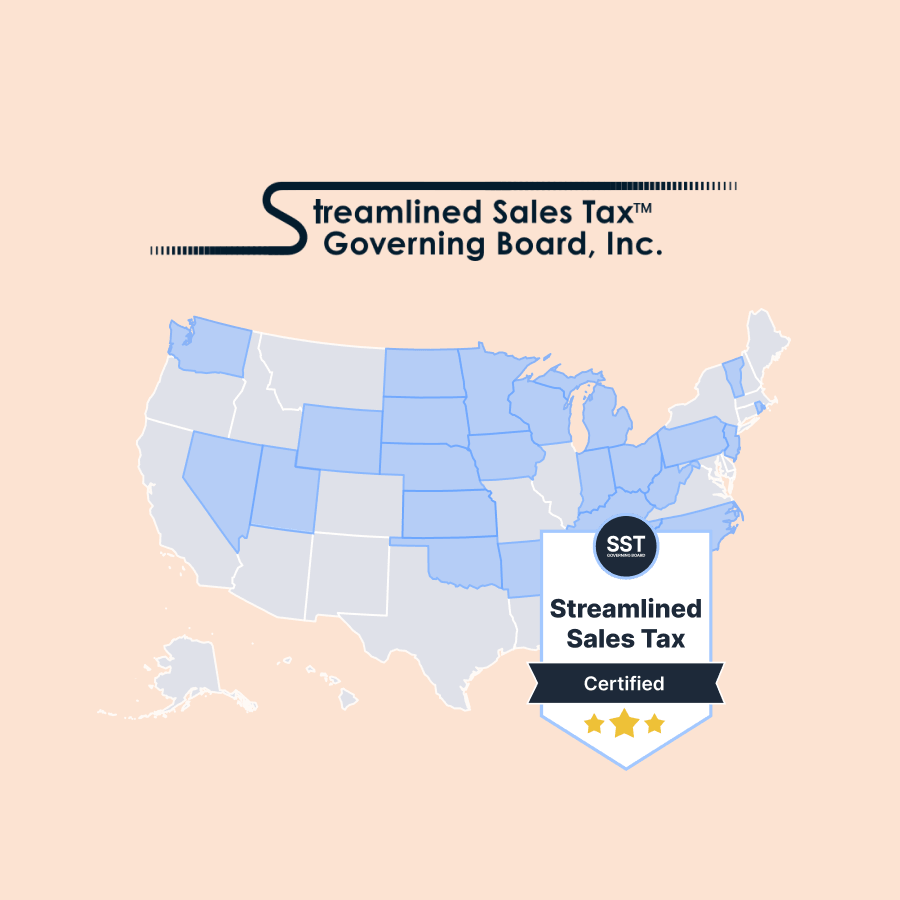
Currently (in 2026), 23 states have fully adopted the SST program, with 1 additional state (Tennessee) participating as an associate member. These states have agreed to standardize key parts of their sales tax systems to simplify compliance for companies selling across state lines.
Here’s a list of all SST member states and their nexus thresholds:
| Participating states | Nexus threshold |
|---|---|
| Arkansas | $100,000 or 200 transactions |
| Georgia | $100,000 or 200 transactions |
| Indiana | $100,000 |
| Iowa | $100,000 |
| Kansas | $100,000 |
| Kentucky | $100,000 or 200 transactions |
| Michigan | $100,000 or 200 transactions |
| Minnesota | $100,000 or 200 transactions |
| Nebraska | $100,000 or 200 transactions |
| Nevada | $100,000 or 200 transactions |
| New Jersey | $100,000 or 200 transactions |
| North Carolina | $100,000 |
| North Dakota | $100,000 |
| Ohio | $100,000 or 200 transactions |
| Oklahoma | $100,000 |
| Rhode Island | $100,000 or 200 transactions |
| South Dakota | $100,000 |
| Utah | $100,000 |
| Vermont | $100,000 or 200 transactions |
| Washington | $100,000 |
| West Virginia | $100,000 or 200 transactions |
| Wisconsin | $100,000 |
| Wyoming | $100,000 |
For manual filers, the main benefit of SST is that filing is standardized. Users can submit their filings through the SST portal and then remit payments to the appropriate state agencies.
However, most businesses use a tax automation platform like TaxCloud, Avalara, and others to automate their tax calculation and track nexus obligations. These platforms can automatically generate the appropriate documentation based on monthly or quarterly sales and file on behalf of your organization, but they charge filing fees to do so.
For these users, the SST program provides a few other benefits:
- Qualified tax platforms can act as Certified Service Providers (CSPs) and file on behalf of the company using their tax services.
- When filing on behalf of a company, a CSP can’t charge for filing via SST but can charge for other services, like general accounting services, tax calculation services, etc.
- In the event of an audit, states will generally contact the CPS for any audits or questions related to tax payments and returns.
However, keep in mind that working with a CSP isn’t free. Companies will still need a service plan and must pay for services like tax calculation or preparation and filing in non-SST member states. Even so, organizations filing across multiple SST states can see substantial savings by participating in the program.
Example: Assume that a business is filing monthly in all 23 SST member states listed above and that the tax platform they use charges $50 per monthly filing.
12 (months) x $50 (filing fee) = $600/year per state.
By leveraging the SST program, that business could save a substantial amount of money — up to $13,800 /year, using the example numbers — in filing costs across 23 states.
Naturally, as your sales footprint increases across SST-member states, the program becomes more valuable as a centralized compliance solution.

How the SST Program works
The SST program is designed to simplify how businesses register, calculate, and file sales tax across all member states, but these benefits are only applicable to companies who engage with it.
For most businesses, getting started follows a clear set of steps:
- Confirm where you have economic nexus. Start by identifying which SST-member states require you to collect sales tax based on your sales volume or transaction count.
- Register through the SST system. Rather than registering in each state individually, you can complete a single registration that applies across all participating SST states.
- Receive your SSTID. This is a unified ID that a business receives once registration is complete. You’ll use it to register, file, and pay sales tax for all states participating in the SST program.
- Apply standardized tax rules and rates. Use SST-provided systems and guidelines to apply consistent tax rates and product taxability rules across all SST states.
- File and remit tax. Submit filings and payments using the state’s schedule and the SST framework.
- Maintain ongoing compliance. Monitor nexus thresholds, keep records, and stay up to date with filing deadlines to remain compliant over time.
Services included in the SST Program
By design, the SST program attempts to standardize several key aspects of sales tax compliance. Companies using the program will find it easier to manage obligations across all member states by conforming to the same set of requirements.
Here’s a closer look at where SST standardization takes place:
- Sales tax calculation. Applies consistent tax rates and rules across SST states, including product taxability and sourcing.
- Multi-state registration. Provides a centralized system to register in all participating SST states at once.
- Sales tax filing & remittance. Supports standardized return preparation and submission processes across all member states.
- Nexus tracking and compliance monitoring. Helps businesses stay aligned with economic nexus thresholds and filing requirements.
- Exemption certificate management. Support the handling and validation of exemption certificates (where applicable).
- Audit support and recordkeeping. Establishes consistent data and reporting structures to help businesses respond to state audits.
Note that, in many cases, SST sets a framework but leaves businesses to fill in the gaps.
For example, while the program’s Streamlined Sales and Use Tax Agreements (regularly updated here) ensure that tax rates and rules are consistent across all participating states, there is no centralized tax calculation engine. Businesses would instead need to handle the calculations themselves based on the framework rules, then remit the correct taxes at the appropriate time.
While it’s possible to handle these processes manually, tax compliance is still a time-consuming process. Even though the SST program helps to standardize filing requirements, participating companies are still responsible for monitoring nexus, filing according to state requirements, and remitting the appropriate payments.
About Certified Service Providers (CSPs)
A Certified Service Provider (CSP) is an SST-approved partner that manages sales tax compliance for companies operating across m multiple states. These providers are certified by SST member states and must meet strict requirements for accuracy and ongoing performance.
CSPs are responsible for executing key compliance functions, including tax calculation, return preparation, filing, and remittance. This allows businesses to offload the operational burden of managing sales tax by themselves.
Keep in mind that this approach comes with some cost.
Example: While TaxCloud offers free filing and remittance via the SST program, customers still need to pay for tax calculation services. Without accurate calculations and a full understanding of a company’s nexus obligations, TaxCloud would be unable to perform its duties as a CSP.
In most cases, brands working with SST choose to partner with a tax calculation service to handle tax filings for both SST and non-SST states. Where possible, the CSP files using the SST program — ideally saving time and lowering costs — and then handles the non-SST states on a case-by-case basis.
Because the SST program holds strict requirements for inclusion as a CSP, there are only a handful of compliance platforms to choose from. If you’re searching for a provider, your choices are listed below.
TaxCloud: Best for mid-market brands
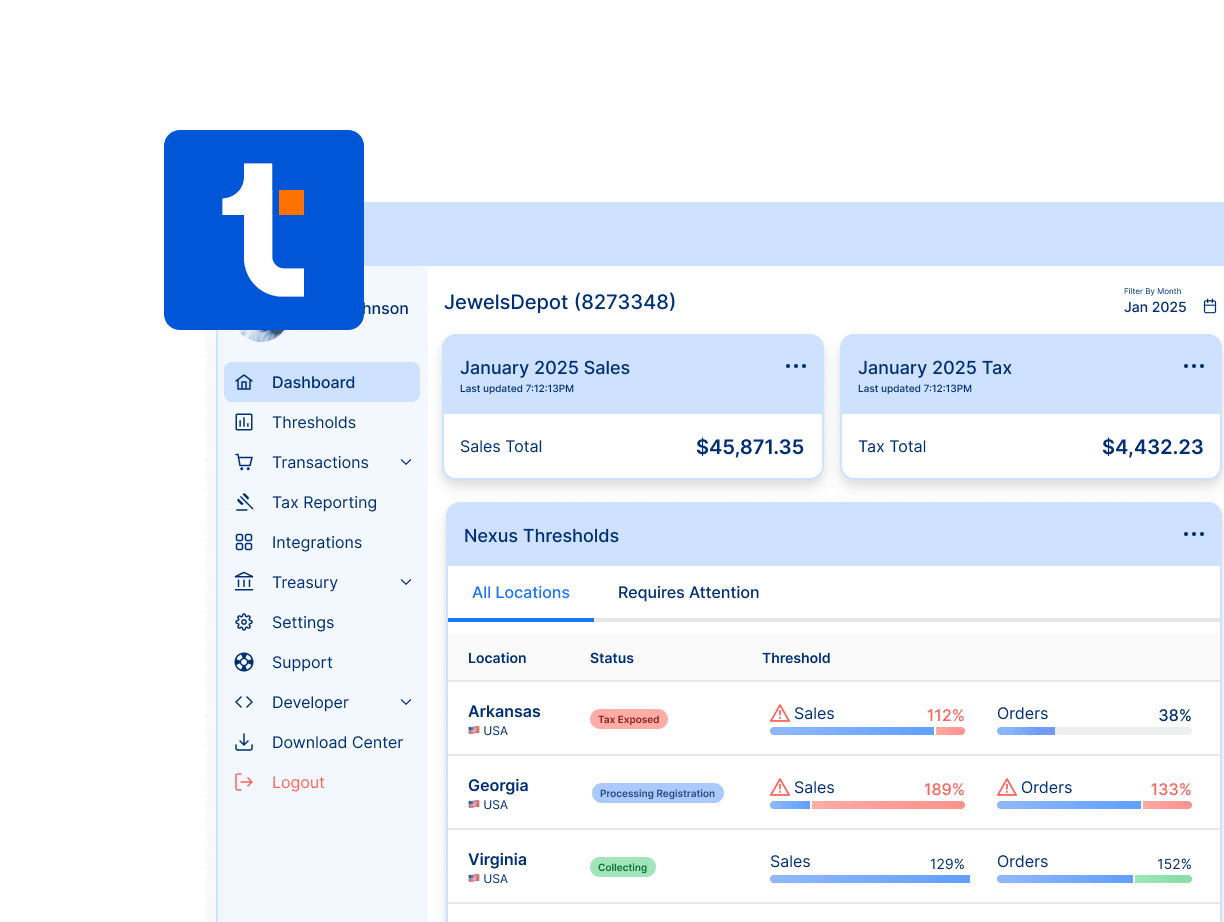
TaxCloud is built specifically for growing mid-market brands that want to simplify sales tax compliance through automation. This is a different approach than what you’ll see in other SST providers, like Avalara and Sovos, where the primary goal of the tax engine is as an automated component to in-house finance and tax teams.
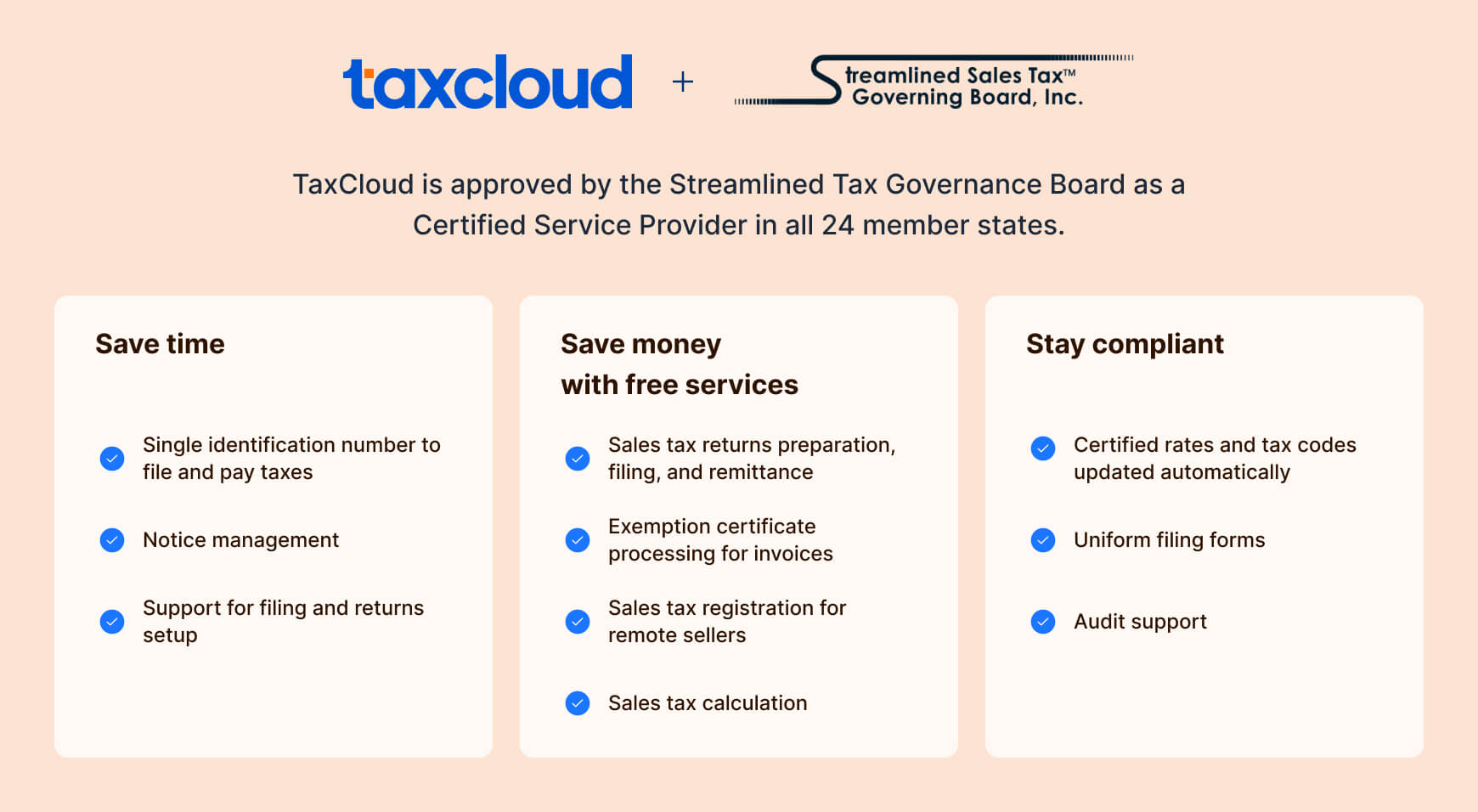
As a CSP, TaxCloud handles SST filings and remittance for eligible businesses while also supporting non-SST states through the same tax engine and automated filing system. Put another way: All tax obligations are calculated through the same engine and go through the same preparation process. However, as your CSP, TaxCloud will then file eligible returns through the SST program using the data accumulated by its tax engine.
TaxCloud’s transparency and clear pricing is an important differentiator when comparing SST providers. Where most platforms bundle their services into opaque pricing tiers or custom-built configurations, TaxCloud offers SST options for all paid users and makes it clear what you’ll pay for the service before you commit. For teams who want SST value without enterprise costs or complexity, TaxCloud is the best choice.
Key benefits:
- SST access for all paid plans.
- Transparent pricing with no hidden fees.
- Filing starts at $39 per return, dropping to $20/return.
- Strong ecommerce integrations (Shopify, BigCommerce, etc.)
- Guided onboarding and responsive, human-powered support.

Read Cable Bullet’s full story.
Avalara: Best for enterprise complexity
One of the most widely recognized names in sales tax compliance, Avalara is typically used by enterprise organizations to handle complex, multi-jurisdictional tax requirements. The platform offers a comprehensive suite of tax tools that can be deeply integrated with various ERP, CRM, and POS systems.
However, the level of capability that Avalara offers comes with deeper complexity and higher costs. As a platform, Avalara is designed for organizations with dedicated tax and finance teams, and pricing increases significantly as transaction volume and future usage grow. These packages are custom-built by sales reps, meaning that it’s not possible to engage with Avalara with standardized packaging. Everything is tailored to your personal use case and planned expenditures.
Companies that need to deploy to global markets or deploy tax systems in conjunction with specific industry and compliance regulations may be a strong fit. On the other hand, smaller brands have seen Avalara’s SMB-friendly programs discontinued in recent years and will pay enterprise-level pricing for integrations, transactions, and filings when working through Avalara.
Key benefits:
- Comprehensive compliance platform with global tax capabilities.
- Wide range of integrations (ERP, CRM, POS, etc.).
- Advanced reporting and tax engine customization features.
- Scales well for high volume, enterprise operations.
- High costs for mid-market and smaller brands.
A quick note about Avalara and SST: Based on what former Avalara users have told the TaxCloud team, SST enrollment wasn’t actively championed in the Avalara ecosystem.
One possible reason might be that SST changes the filing model. Rather than paying per-state filing fees, brands can reduce those costs significantly by enrolling in the SST program. Because of that, SST may not align with Avalara’s business model, even though it’s highly beneficial for businesses filing in multiple states.

Read UntilGone’s full story.
Sovos: Best for large compliance teams
Similar to Avalara, Sovos is designed for enterprise organizations that require a high level of control, customization, and compliance oversight. The platform supports a wide range of tax and regulatory requirements, making it a common choice for large enterprises operating at an international or global scale.
If Avalara excels at connectivity, Sovos’s strength lies in the platform’s ability to integrate well with in-house compliance teams. This solution handles regulatory compliance exceptionally well, and can offer advanced reporting, configurable workflows, and compliance support for in-house tax experts.
As an enterprise solution, Sovos sits at the higher end of the market. SST services are available to users, but Sovos is clearly priced toward enterprise brands and will be out of reach for small organizations.
Key benefits:
- Strong compliance for large, multi-national organizations.
- Advanced reporting and audit support capabilities.
- Flexible configuration for complex tax scenarios.
- Built for teams and dedicated tax and finance resources.
Other providers
In addition to the major platforms above, a few other compliance solutions also offer SST support. These platforms tend to focus more on specific use cases or simpler implementations, depending on the needs of the business.
- AccurateTax provides flexible, integration-friendly sales tax solutions built on its TaxTools platform. It supports real-time tax calculations, reporting, filing, and is regularly used by brands that need more customizable, API-driven setups.
- Avior is one of the newer CSP options and offers an end-to-end compliance solution that includes calculation, registration, filing, and nexus tracking. This platform is designed to be straightforward and accessible, but it lacks integrations with popular e-commerce solutions like Shopify and BigCommerce.
- Extractor was acquired by Intuit in 2017 and functions primarily as an end-to-end automation solution for QuickBooks Online (QBO). At this time, Extractor doesn’t offer free solutions, and QBO no longer mentions it as a tax partner or a core SST provider, making the future of this platform unclear.
Example: Cost savings with SST
Savings from the SST program primarily come from reduced filing costs when a business is operating across multiple states. The more states you file in, the more meaningful the savings becomes.
Below, you’ll find a breakdown to show how it works. For this example, let’s assume the following:
- You sell into 12 states.
- 8 are SST states.
- 4 are non-SST states.
- State filings requirements are monthly.
Filing costs average $39 per return.
| Scenario | States filed (x) | Monthly filing cost (x * $39) | Annual filing cost (x * $39 * 12) |
|---|---|---|---|
| Without SST | 12 states | $468 | $5,616 |
| With SST | 4 states (non-SST only) | $156 | $1,872 |
| Estimated savings | — | $312 | $3,744 |
While this is a simplified example and excludes things like volume discounts, it illustrates the point well. When using the SST program, companies simply don’t pay the filing costs in SST states.
In this example, a company filing with SST is able to save thousands in annual filing fees because they only need to pay those costs in the four non-SST states. Since filing with SST is subsidized by the state or eliminated entirely, the company in this example effectively lowers their compliance costs by 66%.
While your mileage will vary depending on your specific tax situation, participating in SST with a dedicated CSP like those covered above is a proven way to lower filing and compliance costs.
However, keep in mind that the SST program doesn’t handle everything. Companies will still need to calculate sales tax, track nexus obligations, and handle compliance in non-SST states. That’s why companies work best with compliance solutions that can handle filing options across all 50 states, regardless of SST status.
How to get started with SST
Getting started with SST is a relatively straightforward process, but the right approach depends on how much time and complexity you’re willing to manage internally.
Most brands must choose between handling compliance themselves or working with a CSP to handle the process.
Option 1: Self-register and file by yourself
Businesses can register for SST directly through the Streamlined Sales Tax Registration System, which allows companies to apply across all participating states at once.
After registration, companies will still be responsible for the following:
- Nexus tracking and determination.
- Calculating the correct tax rates.
- Preparing and filing returns in each state.
- Remitting payments and tracking deadlines.
While this approach can work for smaller businesses with limited state exposure, it requires ongoing effort and a strong understanding of sales tax rules. As the company’s footprint grows, managing compliance can quickly become a time-consuming and error-prone process that takes key personnel away from other important business functions.
Option 2: Work with a Certified CSP provider
Many businesses choose to work with a tax solution to simplify and automate their calculation and filing obligations. By choosing to work with a CSP, companies can maintain compliance while further lowering costs.
This approach allows brands to do the following:
- Automate multi-state filings.
- Reduce the risk of errors or missed deadlines.
- Scale compliance as the business grows.
- Keep sales tax compliance away from the core of the business.
When working with a CSP, the provider engages with the SST program on your behalf.
For companies who are new to the program, the CSP can even handle the registration process and set themselves up to manage the account. This approach is especially useful for ecommerce and remote sellers operating across multiple states.
Automate SST and direct (non-SST) filings with TaxCloud
Managing sales tax across multiple states becomes significantly easier when SST is paired with automation. Rather than handling registrations, calculations, and filings manually, companies can centralize the entire process in a single system.
TaxCloud is a Certified Service Provider that helps businesses take full advantage of the SST program while also managing compliance in non-SST states. By combining calculation, filing, and reporting into a single platform, TaxCloud creates an all-in-one system that can effectively calculate taxes and report obligations across all 50 states.
SST access with TaxCloud is included in both Starter and Premium plans, meaning that eligible businesses can benefit from subsidized filing whenever it’s available. With transparent pricing, flexible integrations, and guided onboarding, TaxCloud is the perfect fit for growing brands who need automation and compliance without enterprise-level costs.
Want to learn more?
Book a demo with our product team to see firsthand how TaxCloud can help you save big with SST.
FAQ
The Streamlined Sales Tax (SST) program helps businesses simplify sales tax compliance across multiple states.
The program standardizes how participating states handle registration, tax calculation, and filings, making it easier for companies to manage sales tax without dealing with completely different systems across each state.
In practice, this effectively reduces what companies must do in order to stay compliant. Rather than registering in every state, companies can complete one registration profile on the SST website (for free!), which is then passed along to every member state.
While companies will still need to handle their own tax calculations, filings, and remittance, SST aims to simplify the process around one set of unified standards.
SST can be free for certain aspects of sales tax compliance, but not everything is covered and some additional conditions may apply. In many SST states, filing and remittance are subsidized when working with a Certified Service Provider (CSP), but businesses will still need to pay for tax calculation and other compliance-related services.
Remote sellers can also qualify for free CSP services if they meet specific conditions, primarily having to do with the presence of physical nexus in a given state. CSPs can charge for services where SST participants don’t qualify for free services and for services in non-member states.
Reasons vary, but the SST program is voluntary and requires states to standardize parts of their tax systems. Some states choose not to adopt these changes due to differences in tax structure, policy priorities, or administrative control.
No, although most businesses choose to work with one.
You can register and file on your own through the SST system, but a CSP greatly simplifies the process by automating tax collecting, filing, and remittance. Handling these tasks manually can become a huge time-sink for the business.
Due to the complexity of sales tax compliance and the time it takes to manually calculate and file, most companies use automated compliance services to improve accuracy and efficiency. Platforms on the CSP shortlist, like TaxCloud or Avalara, can handle taxes in both SST and non-SST states, making them a great choice for brands who want to automate and save by taking advantage of SST membership.
Yes. CSPs handle SST filings differently by automating the process and integrating it with tax calculation systems.
Essentially, CSPs use their own tax automation tools to calculate and manage filings on your behalf. These tools work for both SST and non-SST states, allowing them to handle tax calculation regardless of SST status in a single platform.
The main difference is that, when it’s time to file, the CSP will submit filings through the SST portal before their platform remits the appropriate payments to each state. In non-SST states, filings and payments are remitted directly to state authorities, rather than through the SST portal.
TaxCloud uses the SST program to provide eligible businesses with subsidized filing and remittance across participating states. The platform combines SST support with tax calculation and compliance tools, so businesses can manage both SST and non-ST states in a single platform.
In this model, businesses will still need to pay for the number of transactions that the TaxCloud engine calculates, but filings in SST states are free.
Yes. While CSPs can’t charge for filing on your behalf via the SST program, working with one typically requires a platform subscription.
Typically, CSPs handle duties beyond SST filings, including tax calculations and direct (non-SST) state filings. In order to file on your behalf, the CSP will need accurate tax calculations for a given filing period, and most platforms will charge based on the number of transactions or sales your organization generates.
As your CSP, your platform will also act as your representative with the SST governing body and manage registration, filings, and ongoing compliance on your behalf. Brands using SST often operate in multiple states, which means they also have filing obligations outside of SST.
Working with a CSP like TaxCloud gives a business the ability to handle tax filings across all 50 states, so the same set of tools used for SST filings can help you stay compliant for states outside of the program.