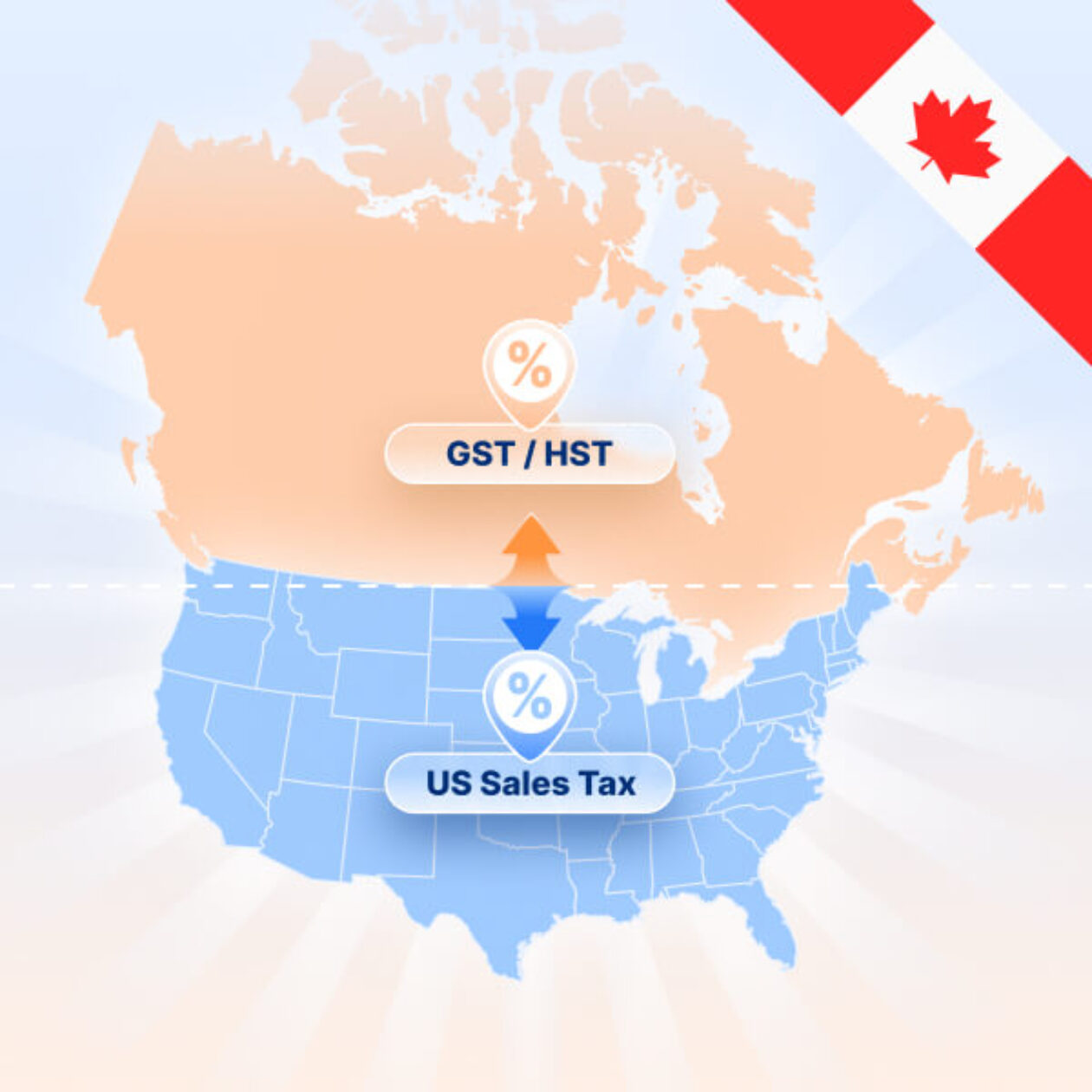
U.S. vs Canada sales tax: What cross-border sellers need to know
Selling cross-border without understanding sales tax is a recipe for penalties. U.S. and Canadian systems look similar on the surface, but the details diverge in ways that cost sellers money. Miss a threshold, file in the wrong place, or charge the wrong rate, and you can face fines of 10–30% of tax due, lost input tax credits, or delayed shipments at customs.
If you’re new to cross-border selling, this guide explains how the U.S. and Canadian tax systems differ, where sellers get tripped up, and what you need to fix before expanding.
U.S. vs Canada sales tax: Key differences at a glance
Cross-border compliance isn’t about memorizing acronyms. It’s about recognizing two fundamentally different systems. The U.S. is fragmented across 50 states and thousands of localities. Canada looks centralized, but provinces like BC and Quebec create their own hurdles.
This table shows how the two systems compare at a glance. We’ll unpack these in further detail below.
| Question sellers ask | United States | Canada |
| Who governs sales tax? | Each state sets its own rules; some cities/counties add their own. | GST and HST are administered federally by the CRA.
GST is set at 5%, and provinces that use HST have agreed to combine their provincial sales tax with GST into one harmonized tax (13–15%). Other provinces run their own PST or QST on top of the 5% GST. |
| What are the rates? | 13,000+ state/local combos, 4–10% typical, can exceed 10%; rates change often. | GST 5%; HST 13–15% in ON, NS, NB, PE, NL; PST 6–8% in BC, SK, MB; QST 9.975%. |
| When do I have to register? | Register when you trigger nexus in a state.
Economic nexus is often $100K in sales or 200 transactions. Physical nexus, like inventory, employees, or offices, also requires registration from the first sale. State nexus rules vary by state. |
If you qualify under the simplified digital economy rules (many U.S. based online sellers do): register when your to Canadian destination-based sales exceed CAD $30K.
If the CRA considers you to be carrying on business in Canada: register when your worldwide taxable sales exceed $30k CAD over four consecutive quarters. PST/QST require separate accounts. |
| Where are sales considered taxable? | Usually destination-based (customer’s location), but some states use origin-based rules (seller’s location). | Always destination-based (customer’s location). There are no origin-based rules. |
| How often do you have to file? | Varies by state—monthly, quarterly, or annually. Some states require partial-year filings if you register mid-year. | Depends on your GST/HST revenue. Smaller sellers often file annually; higher-revenue sellers file quarterly or monthly. PST/QST provinces set their own schedules. |
| Are there tax credits or exemptions? | No Input Tax Credits. Relief only comes from resale or exemption certificates, which you must keep on file. | Register for GST/HST to claim Input Tax Credits (ITCs) on expenses like supplies, rent, or software.
PST and QST generally don’t allow credits. |
| What about tax holidays? | Dozens each year; e.g. back-to-school weekends; state-specific rules and product lists. | Rare—Canada doesn’t generally run tax holidays. |
Key differences you should know: explained in detail
On the surface, both countries charge sales tax at checkout. But the mechanics are very different once you look closer. Here are the structural differences sellers need to understand before they can register, file, or recover tax correctly on both sides of the border.
1. Filing and remittance: Who governs sales tax in each country?
Canada
- Most sellers file a single GST/HST return with the CRA.
- But it doesn’t stop there—BC, Saskatchewan, and Manitoba enforce their own PST regimes, and Quebec enforces QST separately.
- That means multiple registrations and accounts if you’re selling nationwide.
See our Selling to Canada guide, which breaks down each province’s requirements.
U.S.
- There’s no federal governing body; sales tax is governed by the states.
- You need to register, collect, and file sales tax in every state where you establish a nexus.
2. Sales tax rates: What you collect in each region
Canada
Rates are stable and limited in Canada.
- 5% GST applies nationwide.
- HST ranges from 13–15% in five provinces.
- PST is 6–8% in three provinces.
- Quebec runs QST at 9.975%.
U.S.
- Over 13,000 state and local combinations exist, many between 4–10%, with some higher still.
- Sales tax rates change often. (Subscribe to our free newsletter, Sales Tax Radar, and stay ahead of sales tax changes that impact online sellers.)
- If you sell in multiple states, keeping up with ever-changing tax laws is nearly impossible manually. The best sales tax software automates the process and keeps you compliant.
3. Registration thresholds: When you must register
Canada
GST/HST registration depends on how the CRA sees your business.
- No established Canadian base (simplified digital economy rules): If you’re a non-resident seller with no established base in Canada (e.g. no Canadian office, inventory, or staff), you need to register for GST/HST once your sales to Canadian customers exceed $30,000 in a 12-month period.
- Carrying on business in Canada: If the CRA decides you have a Canadian presence (e.g. Canadian employees or a permanent base), you need to register for GST/HST when your worldwide taxable revenue exceeds $30,000.
- PST and QST have their own provincial thresholds and always require separate registrations.
U.S.
- Each state sets its own economic nexus and physical nexus thresholds.
- Once you cross a state’s nexus threshold, you’re required to register, collect the right tax, and file returns in that state—no matter where your business is based.
- Economic nexus: Many states measure economic nexus based on $100,000 in sales or 200 transactions in either the current or previous calendar year (though some use a rolling 12-month test).
- Physical nexus: If you hold inventory in a U.S. state (for example, through Amazon FBA), hire staff, or have another business presence there, check physical nexus rules. If triggered, you must register and collect sales tax from your first sale in that state—even if you never cross the $100K/200 transaction threshold.
4. Sourcing rules: Where sales are considered taxable
Canada
- Sales are always taxed based on the customer’s location (destination-based).
- If you sell to a customer in Ontario, you charge Ontario’s HST. Ship to BC? You charge BC’s GST + PST.
- There are no origin-based rules—compliance hinges on the province where your buyer lives.
U.S.
Most states also follow destination-based rules, but there are important exceptions:
- Origin-based states (like Texas and Pennsylvania) sometimes require sellers to charge tax based on where the seller is located, not the buyer.
- Hybrid states may apply different sourcing rules for in-state vs out-of-state sales.
5. Filing frequency: How often you report
Canada
- Filing frequency for GST/HST depends on revenue—annual for smaller sellers, quarterly or monthly for higher revenue. Check the CRA’s reporting requirements and deadlines to determine when your business should file GST/HST.
- PST and QST set their own schedules.
U.S.
- Filing frequency varies state by state. Some want monthly returns, some quarterly, some annually.
- If you collect tax late in the year, some states still require a partial-year return.
6. Tax credits and exemptions: What you can recover
Canada
- Register for GST/HST and you can claim Input Tax Credits (ITCs), which help you recover the GST/HST your business paid on expenses like supplies, commercial rent, or software.
- PST and QST usually don’t allow credits.
U.S.
- Does not have ITCs like Canada does.
- The only sales tax relief in the U.S. is resale or exemption certificates—documents that prove you didn’t need to collect on a sale.
- Use exemption certificate management software to keep them, an auditor assumes every sale was taxable.
7. Tax holidays: A U.S.-only wrinkle
Canada
- Canada doesn’t run sales tax holidays.
- Once you’re registered, you collect sales tax consistently year-round.
U.S.
- Dozens of states suspend sales tax on certain items for short periods (often back-to-school or storm-prep weekends).
- Sales tax holidays only apply if you already have nexus in that state. No nexus, no obligation.
- If you sell into a state where you have nexus and that state runs a sales tax holiday, you must adjust your checkout so eligible items aren’t taxed during the holiday window. (Automation with TaxCloud makes this automatic.)
- See our 2025 Sales Tax Holiday Calendar for dates and rules that may affect your business.
8. Quebec: Separate QST registration
- Quebec enforces its own Quebec Sales Tax (QST) through Revenu Québec.
- Even if you’re already GST/HST-registered, you’ll need a separate QST registration once your sales to Quebec customers pass CAD $30,000 in a 12-month period.
Common mistakes cross-border sellers make
Even seasoned businesses stumble when moving across the U.S.-Canada border. Most mistakes boil down to one thing: assuming the rules work the same in both countries.
Below are the errors we see most often, what they cost, and how to fix them.
| Mistake | What happens | How to fix it |
| U.S. seller thinks GST/HST registration covers the whole country | They skip PST/QST. Provinces like BC, Saskatchewan, Manitoba, and Quebec send separate bills, often retroactive to the first sale. | Register in each PST/QST province. Quebec especially doesn’t let this slide. |
| U.S. seller assumes “digital only” sales don’t count | U.S. SaaS or app sellers may think digital subscriptions fly under the radar. In reality, GST/HST and QST both apply once thresholds are crossed. | Include digital sales in your Canadian sales tracking and register once you exceed CAD $30K. |
| Canadian seller assumes marketplace collection covers all U.S. sales | Amazon, eBay, Shopify Marketplace may collect in many states—but direct website or B2B sales are still the seller’s problem. Liability piles up quietly. | Check facilitator rules by state and make sure your direct sales are registered and filed. |
| Canadian seller doesn’t realize they triggered economic nexus in another state | They keep selling into states where their sales crossed the threshold, but never registered. Liability builds up with penalties and interest. | Monitor sales by state every quarter. Once you hit a state’s threshold, register and start collecting right away. |
| Canadian seller mistakenly charges GST/HST to U.S. customers | Overcharges customers; still noncompliant in the U.S. | Apply U.S. state/local rates, not Canadian ones. |
| Canadian seller skips resale/exemption certificates | In the U.S., exemption only applies if you have resale/exemption certificates on file. Without them, auditors tax everything. | Collect and store resale/exemption certificates from day one. |
Each of these mistakes creates liability that compounds. A seller who ignores PST in BC or nexus in New York for two years won’t just owe the tax—they’ll face years of penalties and interest stacked on top.
That’s why sellers need cross-border sales tax automation software to track obligations and keep records clean.
Compliance checklists for cross-border sellers
Cross-border sales don’t fail because the rules are unknowable. They fail because sellers don’t track the right steps in the right country. Use these checklists to stay compliant from day one.
For U.S. sellers entering Canada
- Understand and track the CAD $30K registration threshold.
- If the CRA decides you’re carrying on business in Canada (for example, you have inventory, staff, or a permanent base), you must register for GST/HST once your worldwide taxable sales exceed $30K in the past quarter or four consecutive quarters.
- If you’re a non-resident seller who qualifies for the simplified digital economy rules, you must register for GST/HST when your Canadian-sourced sales exceed $30K in the past 12 months.
- Either way, monitor sales monthly—once you pass the threshold, GST/HST registration is mandatory.
- Register for GST/HST with the CRA. Don’t wait for an audit letter; file before you’re noncompliant.
- Register in PST provinces. BC (threshold CAD $10K), Saskatchewan, and Manitoba all require separate PST/RST accounts.
- Register with Revenu Québec. QST is separate—CRA registration doesn’t cover it.
- Apply the correct HST rate. ON 13%, NS/NB/NL/PE 15%—get it right by destination.
- Claim Input Tax Credits. Once registered, recover GST/HST you’ve paid on business expenses. (Note: If you’re a non-resident seller who falls under the simplified registration rules, you cannot claim ITCs.)
For Canadian sellers entering the U.S.
- Know the thresholds. Most states require registration once you hit $100K in sales or 200 transactions in a year, but each state sets its own rules.
- Register state by state. There’s no federal shortcut. If you have nexus in a state, you need an account there.
- Use software to automate sales tax rate calculations. With 13,000+ state and local combinations, manual updates almost guarantee errors.
- Keep exemption certificates. U.S. sales are only tax-free if you have resale or nonprofit certificates on file. Without them, auditors assume everything is taxable.
- Check marketplace rules. Marketplaces like Amazon or eBay usually collect in many states, but you’re still on the hook for sales through your own site.
Put cross-border sales tax compliance on autopilot
The U.S. and Canada both tax sales, but they do it in fundamentally different ways. The U.S. fragments compliance across 50 states and thousands of jurisdictions. Canada looks simpler on the surface, but provinces add their own nuances.
Mix the two up, and you risk missed registrations, unclaimed credits, or double-taxed sales.
The smarter move: track your exposure early, register before you’re forced to, and automate the complexity so you’re not chasing rate changes or paperwork.
That’s exactly what TaxCloud was built for. We handle state filings across the U.S. today, and we’re adding Canadian GST, HST, PST, and QST to the same platform next.
Talk to our team to manage Canadian and U.S. sales tax in one platform and streamline your cross-border compliance.