
Many ecommerce brands don’t run on Shopify or WooCommerce. Instead, they run custom-built storefronts tied to their own inventory, fulfillment, and accounting systems. Setups are bespoke and built over years to accommodate the company’s needs.
In those scenarios, plug-and-play tax tools and integrations are a poor fit. These systems aren’t standardized, and turnkey solutions can’t connect properly with the full tech stack.
A sales tax API solves those problems by plugging directly into the company codebase and allowing developers to handle tax calculation inside their own systems. Unfortunately, every API is a little different. Some are lightweight but limited. Others offer a kitchen sink of features that far exceed what many brands need.
In this guide, we’ll compare top sales tax APIs, their core strengths, and which platforms are a best fit for custom ecommerce environments.
The table below provides a high-level comparison. Detailed differences and tradeoffs are explained in the sections that follow.
| Provider | Pricing Model | Sandbox (Test Mode) |
Product Tax Codes | Exemption Certificates | Calculation Accuracy | Best For |
| TaxCloud | Tiered (orders) | Unified environment | ✔ | ✔ | Full tax determination | SMBs with custom ecommerce |
| Avalara | Quote-only | Separate sandbox | ✔ | ✔ | Full tax determination | Enterprise / ERP-heavy |
| TaxJar | Tiered (orders) | Sandbox | ✔ | ✔ | Rooftop-level rates | Small ecommerce / Stripe users |
| Sovos | Enterprise | Sandbox | ✔ | ✔ | Full tax determination | Large, multi-entity brands |
| Vertex | Enterprise | Sandbox | ✔ | ✔ | Full tax determination | Enterprise + ERP stacks |
| Zamp | Flat managed pricing | Testing via trial | ✔ | ✔ | Full tax determination | Teams wanting full-service compliance |
| Ziptax | Low-cost, tiered | No sandbox | ✔ | ❌ | Item level rate lookup | Devs needing simple rate lookup |
| Numeral | Per filing / registration | Sandbox | ✔ | ✔ | Full tax determination | Startups needing hands-off compliance |
| Stripe Tax | Usage based | Sandbox | ✔ | ❌ | Transaction-level tax calculation | Stripe-native SaaS and ecommerce |
| Quaderno | Flat monthly | Sandbox | ✔ (global and U.S. lite) | ❌ | International tax (VAT/GST) | SaaS + digital goods (international) |
What to look for in a sales tax API
Choosing the right sales tax API isn’t just about rates and per-call pricing. The API you select will determine the accuracy of tax calculations, the reliability of the checkout system, and how much development time is required to maintain operations.
Here are the core factors that matter most when evaluating providers:
- Accuracy and jurisdiction coverage. The API needs to calculate the correct tax for each state and local jurisdiction. Some APIs do this via postal code lookups, but many use lat-long or address-based lookups for rooftop-accurate verification.
- API architecture and flexibility. A good API should be easy to work with (REST, clear endpoints, predictable responses, etc.). If working with older systems, teams might also need SOAP support or compatibility with other protocols.
- Testing and environment stability. Developers need a safe space to configure and confirm tax logic before going live. Developer sandboxes — or something similar — can provide this but many services don’t readily offer test environments.
- Documentation quality. Detailed documentation provides clear guidance and explanations, working code examples in multiple languages (JSON, Python, Java, etc.), error references, and details on how tax rules are applied. Poor or vague documentation can make it considerably more difficult to integrate properly.
- Pricing transparency. Some APIs charge by call. Others charge by volume or subscription with tiered upgrades available for call overages. Especially in high-volume storefronts, model pricing should be predictable, and rate limits should be clear.
- Support quality and availability. API configuration can be challenging. When something breaks, it pays to have access to fast, knowledgeable help. Smaller solutions may carry long wait times, but larger brands often require an additional service plan for speedy technical support.
- Scalability and performance. Tax requests are calculated in real time during checkout. The API must respond quickly and be capable of handling peak traffic without slowing down. Rate limits are a factor, as well. If you have high traffic needs, make sure that services aren’t rate limited below your needs. Uptime guarantees and published performance metrics (if available) can give some insight into API capabilities.
When comparing APIs against these factors, the differences become more clear. Some providers are built for high-complexity and enterprise systems, while others aim for simple rate lookups.
The best choice will depend on how your ecommerce stack works, how much control developers need, and the level of accuracy and scalability that the business requires.
Vendor breakdown: Best sales tax APIs
Sales tax APIs vary wildly in how they calculate tax, how they handle testing, and how easy they are for developers to work with.
Some providers focus on enterprise systems with complex compliance workflows while others target smaller brands with simpler hookups and more streamlined integration options.
The following breakdowns highlight the key strengths of each API and the type of business that a provider is best suited to handle. Each provider has a different core approach based on how they fit in the market, so be on the lookout for those differentiators.
TaxCloud
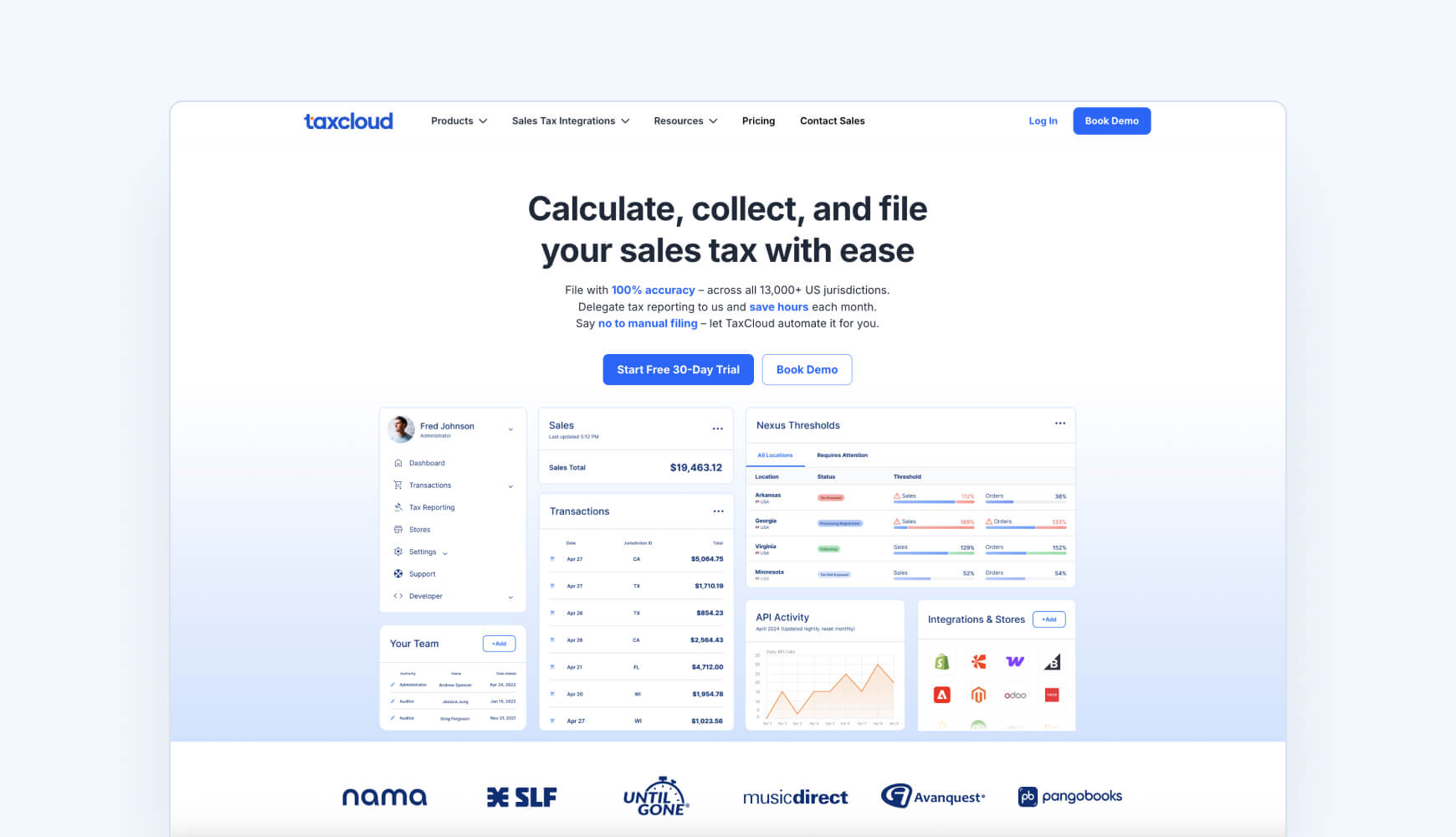
Best for: Small and midsize ecommerce brands that need accurate U.S. sales tax calculation inside a custom website or internal system.
API core strengths: A unified testing and production environment that delivers consistent results without additional setup.
Notable features:
- Real-time sales tax calculation for all 13,000 U.S. jurisdictions.
- Built-in address verification.
- Support for both sales tax TIC codes and exemption certificate management.
- Unified test and production environment.
- REST protocol for modern systems.
- Order Flow feature to capture historical transaction data.
TaxCloud is designed for ecommerce teams that need reliable U.S. sales tax calculation inside a custom-built website or internally managed system. the TaxCloud API focuses on accuracy and approachability with minimal setup requirements, making it a good option for teams who need tax calculation to “just work” inside their own code.
Unlike most tax services, TaxCloud does not separate its tax calculation logic into different sandbox and production rule sets. Instead, the same tax determination engine is used across environments to prevent discrepancies between test and live results.
Test credentials allow teams to validate calculations and integration behavior without impacting filings, remittance, or compliance reports. Many teams maintain a separate test storefront or environment while using identical tax logic, ensuring that testing accurately reflects production behavior.
From an API perspective, TaxCloud offers jurisdiction-level accuracy, built-in address verification, and support for product tax codes and exemptions. REST protocols are available, allowing for quick integration with modern systems, and the entire API connects with other TaxCloud services to create an all-in-one tax solution without unnecessary complexity.
Avalara

Best for: Large retailers and enterprise teams that need advanced tax rules, international coverage, and deep ERP integrations.
API core strengths: A comprehensive calculation engine that can support complex tax requirements for multi-merchant brands.
Notable features:
- Real-time tax calculation for U.S. and international transactions.
- Support for advanced tax scenarios.
- Certification management tools for exempt customers.
- Separate sandbox and production environments.
- Integrations with major ERP and accounting systems.
Avalara is a robust tax compliance platform designed for enterprise and ERP-heavy environments — but it comes with a steep learning curve. Reviews often cite complexity during setup, especially for teams without a dedicated tax or DevOps lead. That said, Avalara’s depth is hard to match for global brands.
The AvaTax API — the primary API for tax calculations — supports detailed sourcing rules, advanced product taxability, and international tax calculations, which makes it a strong fit for brands operating at a global scale.
However, because the API includes configuration options to account for complex tax scenarios, deployment is complex and comes with a steep learning curve. This is offset somewhat by the fact that Avalara’s API endpoints are separated and spread across 27 separate API groups, including APIs for calculations, returns, documents, fiscal, tariffs, registrations, and more.
For smaller brands working with Avalara, only one or two APIs may be useful. Larger brands, especially those leveraging Avalara to handle a greater portion of their tax compliance duties, will need to connect the appropriate API endpoints to their own internal systems. While this approach allows Avalara to connect to major ERP and financial platforms, it’s likely overkill for teams with simpler requirements.
TaxJar

Best for: Small ecommerce brands using WooCommerce, BigCommerce, or Stripe and want a simple REST API for basic U.S. sales tax calculation.
API core strengths: A straightforward REST API that’s easy to implement for basic tax calculation needs.
Notable features:
- Real-time sales tax calculations for U.S. orders.
- Simple REST endpoints with clear request and response patterns.
- Support for product tax codes.
- Separate sandbox and production environments.
- Native alignment with Stripe and common ecommerce platforms.
TaxJar is built primarily for small businesses using mainstream platforms like Stripe, WooCommerce, or BigCommerce. Its API focuses on straightforward, U.S.-based sales tax calculation, making it a good fit for teams needing REST integration without extensive configuration options.
Similar to the TaxCloud API, TaxJar API supports rooftop-level calculations and product classification (powered by AI). The API also connects with the rest of the TaxJar platform for consolidated nexus tracking and other TaxJar-offered services.
Unlike most alternative solutions, TaxJar’s API call pricing isn’t separate from its order/transaction processing. API tax calculations and rate lookups are counted as 1/10th of an order towards the monthly order total, meaning that the more calls you use, the fewer orders are available to be processed through other sales channels and integrations.
That said, TaxJar’s strength is in its simplicity. It’s easy to set up, aligns well with teams already using Stripe or platform-based ecommerce, and can be implemented quickly. Brands with more complex needs may find this simplicity limiting.
Sovos

Best for: Large organizations with complex compliance requirements or brands operating across multiple tax types and jurisdictions.
API core strengths: Features a robust compliance engine designed to handle intricate tax rules, multi-entity structures, and high-volume workflows.
Notable features:
- Works for both U.S. and international transaction taxes.
- Tools for exemption handling and certificate tracking.
- Supports high-complexity tax scenarios across multiple countries.
- Dedicated enterprise onboarding and compliance services.
- Integrations available for ERP, billing, and financial systems.
Sovos is similar to Avalara or Vertex (below) in that it’s designed for larger organizations with complex compliance requirements across multiple tax types, jurisdictions, and countries. Its API reflects those needs and helps users handle challenging scenarios like multi-entity structures and specialized tax rules. For brands in regulated industries or operating at an enterprise level, these benefits are worth high customization costs and coordination that’s generally required to implement Sovos as a solution.
Overall, Sovos’s API solutions function a little differently from Avalara. Where Avalara has 27 separate, modularized APIs, Sovos has a sales tax API, an indirect tax API, and connectors (integrations) that use specific API endpoints to connect to ERP systems like SAP and NetSuite. The right API is likely included in a specialized plan, built by a sales rep, and teams can integrate with their custom storefronts as they see fit.
These API solutions provide extensive functionality, but teams need to manage more configuration and operational details. Sovos also requires more careful oversight around billing and contract changes — including during offboarding — which adds friction for some enterprise users. While this is well-suited for enterprise teams with dedicated technical resources, it’s unlikely to work for smaller ecommerce teams with simplified or turnkey requirements.
Vertex

Best for: Enterprise brands operating across multiple states or countries that rely on ERP systems (SAP, Oracle, Microsoft Dynamics, etc.).
API core strengths: A high-capacity tax engine built to support complex global tax rules and large-scale transaction volumes.
Notable features:
- Supports both U.S. sales tax and other international tax types.
- Configurable rules for multi-entity or multi-jurisdiction brands.
- Tools for exemption and certificate management.
- Multiple deployment options (cloud, on-premise, etc.).
- Integration paths with major ERPs and financial platforms.
Vertex is built for wide-ranging enterprise brands with tax requirements spread across multiple states or countries. Like Avalara, the API has been modularized and can support detailed tax determination for U.S. sales tax, VAT, GST, communications taxes, and other global tax types. This level of depth makes Vertex best suited for teams relying on large ERP systems or in need of precise configuration across multiple jurisdictions.
Unlike lighter tax APIs that plug directly into ecommerce checkouts, Vertex was originally designed for on-premise ERP environments — and that legacy still shapes its structure and deployment model. While cloud options are now available, most implementations are still handled via middleware or ERP connectors, which makes setup more involved than with cloud-native tools. These settings can be configured to taste, and the complexity allows brands to more easily customize Vertex to align with its goals and tax obligations.
Vertex is also in the process of deprecating its older REST v1 API (sunsetting Dec 31, 2025), which means some teams may need to rework integrations to stay current.
In real-world scenarios, Vertex excels where tax rules are highly complex and can’t be solved by most other solutions. This is especially true in regulated industries like communications, energy, and manufacturing, where compliance differs greatly from other sectors. However, teams that just need a straightforward sales tax solution for a single region (like the U.S.) are likely to find Vertex far beyond what they need.
Zamp

Best for: Companies seeking automated, full-service tax compliance with minimal in-house management.
API core strengths: A calculation API that connects directly to fully managed compliance services.
Notable features:
- Real-time U.S. sales tax calculations.
- Integrated filing and remittance handled by Zamp.
- Support for multi-state nexus management.
- Tools for exemption certificate handling.
- Concierge-style onboarding and support — though some users report limitations depending on technical complexity.
Zamp is built for companies that want to offload as much sales tax work as possible, and the Zamp API functions in a similar way. Rather than offering a simple calculation engine, Zamp combines its API with fully managed compliance services. The API supplies real-time tax calculations, but the company’s primary value is handling the operational side: monitoring nexus exposure, preparing files, remitting tax, and managing state notices. This approach encourages users to hand tax duties over to the Zamp team and let them handle the rest.
The API itself is straightforward and designed to support Zamp’s managed model rather than function as a standalone tax engine. Developers can push transaction data, retrieve calculated tax, and keep the Zamp compliance team in sync with order activity. Overall, this approach reduces internal workloads, but it gives teams less flexibility to customize tax logic or reporting. The API offers limited configuration depth, which can be a constraint for teams building out custom tax logic or integrations.
For companies seeking managed services and a hands-off approach to tax compliance, the Zamp API provides a great avenue to pass data directly to the Zamp team without manual data entry or filing. If internal resources are limited and a brand is seeking managed services, Zamp is a great fit.
Ziptax

Best for: Developers seeking accurate, item level rates without the need for end-to-end sales tax compliance features.
API core strengths: Affordable and flexible lightweight rate API that returns accurate state and local sales tax rates with minimal setup.
Notable features:
- Multiple lookup options (address, lat/long, postal code).
- Simple REST-style requests.
- Comprehensive developer tools and documentation.
- Fast response times for basic queries.
- Low-cost pricing compared to kitchen sink competitors.
- Expert support from Ziptax developers.
Ziptax is a rate-lookup service aimed at developers who only need basic sales tax information and don’t require transaction-level calculations or end-to-end sales compliance. It’s a fast, lightweight solution focused entirely on data retrieval, allowing it to deploy quickly and maintain responsiveness in high-volume situations.
Unlike other solutions on our list, where the API is designed as a supplement or data channel for other services on the platform, the Ziptax API is the entire service. The company won’t assist with filing, tracking, remittance, exemptions, or other details. This is reflected in the price, which is considerably lower than multi-feature compliance suites like Avalara or TaxCloud. However, the tradeoff is that brands using Ziptax will need to seek additional support or leverage internal resources in order to fulfill other tax-related duties.
As a platform, Ziptax is unique in that it’s an API-first solution and more circumspect than other competitors. Because Ziptax is an API-only option, brands seeking help will get direct technical support from the engineers who maintain the API, rather than the generalized support offered by other platforms.
Numeral

Best for: API-first teams that want a modern, tax-focused platform for sales tax calculation, nexus tracking, and filings without legacy ERP complexity.
API core strengths: A clean, developer-friendly tax API designed to manage sales tax calculations, transaction records, and compliance workflows in a single system.
Notable features:
- Sales tax calculation with product-level tax data
- Nexus tracking and state-level filing support (flat per-state pricing)
- API resources for products, customers, transactions, and calculations
- Built-in support for exemptions and tax logic
- Modern REST API with clear schemas
- YC-backed growth and active platform development (2025)
Numeral is a sales tax-focused platform built for ecommerce teams that want a modern, API-driven alternative to legacy compliance tools. Rather than acting as a general financial operations API, Numeral concentrates on sales tax fundamentals, including calculation, nexus tracking, filings, and transaction storage.
The Numeral API exposes structured resources like Products, Customers, Transactions, and Calculations, allowing developers to manage tax logic directly within their own applications. This design aligns well with modern ecommerce data models and simplifies deployment for teams running custom storefronts or multi-channel sales environments.
Numeral has gained traction as a newer entrant in the tax compliance space, including Y Combinator–backed growth in 2025. Reviews frequently praise the cleanliness of the API and developer experience. However, some users note occasional filing-related bugs and limitations for highly complex or enterprise-grade compliance scenarios.
For teams seeking a lightweight, modern tax platform without the overhead of large ERP-centered providers, Numeral is a strong option. Brands with deep, multi-entity compliance needs may still require more mature enterprise solutions.
Stripe Tax

Best for: SaaS and ecommerce teams already using Stripe that want basic, native tax calculation without additional integrations.
API core strengths: Fully integrated with the Stripe ecosystem, Stripe Tax calculates and collects tax automatically based on transaction data — with minimal developer setup.
Notable features:
- Real-time tax calculation across 40+ countries and U.S. jurisdictions.
- Native support for digital goods, subscriptions, and SaaS billing.
- Automatic collection, location evidence, and customer tax status handling.
- Built-in Stripe dashboard support (no separate platform).
- Economic nexus tracking and transaction thresholds included.
- Easy-to-enable with one line of code or via Stripe Checkout.
Stripe Tax is built directly into the Stripe ecosystem, making it an ideal solution for SaaS brands and online sellers who already use Stripe for billing. It doesn’t require a separate integration — most users can enable it with a single line of code or via the Stripe Dashboard. Once active, Stripe Tax automatically calculates, collects, and reports tax in supported jurisdictions, including U.S. sales tax, EU VAT, and other digital services taxes.
The API is especially strong for digital goods and subscription businesses that need recurring billing, invoice-based tax calculations, and compliance across global markets. Because it’s native to Stripe, it’s easier to implement than third-party APIs — though this tight integration can also be limiting for teams with more complex or custom billing setups.
While Stripe Tax has improved significantly since its launch — especially with broader U.S. tax code support and volume-based pricing — it may lack the granular configurability or reporting depth that larger enterprise tax platforms offer. Stripe Tax allows businesses to mark customers or products as tax-exempt, but it does not collect, validate, or store exemption certificates for audit purposes. Still, for Stripe-native businesses, it’s a fast, reliable way to get compliant without building from scratch.
Quaderno

Best for: International SaaS brands who need simple tax calculation for VAT, GST, and digital goods.
API core strengths: A lightweight API focused on global digital tax rules rather than full U.S. sales tax compliance.
Notable features:
- Support for VAT, GST, and digital goods tax rules.
- Automatic tax calculation for international customers.
- Real-time validation of VAT and GST IDs.
- Simple REST API with clear documentation.
- Free developer sandbox available.
- Strongly aligned with Stripe, subscription tools, and SaaS workflows.
Quaderno is built for smaller organizations that sell internationally and need reliable tax calculations for VAT, GST, and digital services tax. Pricing and scaling is based on monthly transactions, with 2,500 transactions per month available on their highest-tier plan before climbing into the Enterprise tier.
The Quaderno API is designed to give developers a simple way to determine correct tax for cross-border transactions without managing the underlying rules themselves. The API provides endpoints for tax calculation, customer location evidence, and invoice creation. It can also verify VAT and GST IDs in real time, which is important for businesses selling to exempt customers in the EU or other regions. It also integrates cleanly with Stripe, Paddle, Chargebee, and other subscription billing tools, making it a strong choice for digital sellers.
The company’s global focus makes Quaderno an attractive solution for brands with international tax needs. However, most of Quaderno’s efforts are focused on tax regions outside the U.S. That said, as of 2025, Quaderno has introduced more robust U.S. product tax code support, improving its suitability for U.S. sellers — especially digital or SaaS brands. It’s still not a full-service U.S. sales tax solution, but recent updates make it a more viable option than in years past.
Checklist: What to ask before choosing a sales tax API
Selecting a sales tax API is largely about reducing uncertainty and clarifying capabilities.
Before making a final decision, review the questions below and work with the sales rep for your chosen service to confirm whether a provider can work reliably inside your tech stack and scale with your business operations.
- Does the API support both REST, SOAP, or both? Older systems may require SOAP, but newer applications expect rest. Confirm that the API will fit your development needs without extra work.
- How do I test tax calculations safely? You should be able to run text transactions without affecting reports or product data. Some companies offer a developer sandbox. Others, like TaxCloud, allow for duplicate storefronts so that the API in use is always “live.”
- Are test and production environments identical? If testing and production environments behave differently, teams will spend more time debugging inconsistent results. Before buying, confirm that API functionality in both environments is the same or that a similar solution is available.
- How fast is the API under heavy load? Successful checkout depends on quick call responses. If possible, check latency, timeout behavior, and any stated uptime or performance guarantees.
- Is the documentation clear? Check for real examples, error explanations, and guidance for common tax scenarios. No documentation includes guidance for every single scenario, but it should cover most common configuration errors and problems.
- How is pricing structured? APIs can be charged per call, per order, or by subscription tier. Make sure that the cost is predictable, that it can scale with your operations, and that you’re not overpaying in slow months just to handle peak traffic during seasonable swings.
- Can I talk to actual developers during onboarding? Check on response times, support hours, and whether or not the support team has experience assisting with API-related issues.
- Does the API support exemption handling and product-level tax rules? Both are essential for real compliance, as tax rules change between product codes, jurisdictions, and exemption status. Without these features, the API may only be capable of basic rate lookups.
- Does the provider offer filing and registration services? Most of the time, these services are optional. They won’t be required for everyone, but they’re useful for brands who want an all-in-one solution for tax calculation and compliance.
Getting answers to these questions will help teams better understand how each provider behaves in real development and production environments.
Strong sales tax APIs need to do more than rate lookups, and will need to fit into your architecture and workflows without becoming overbearing. By confirming these details up front, teams can avoid hidden limitations and choose APIs that will stay reliable as volume increases.
TaxCloud: a strong sales tax API for U.S.-focused custom ecommerce
Custom ecommerce stacks need a tax engine that’s accurate, flexible, and easy to embed in existing code. And while enterprise giants like Vertex might be a better fit for Fortune 500s with global tax teams, most ecommerce brands just need something that works — without six months of implementation.
TaxCloud sits in the middle. Our API provides reliable, real-time tax calculations, clear documentation, a unified testing/production environment, and straightforward pricing that works for small- and mid-sized businesses.
If you’re looking for a scalable API that supports exemptions, product tax codes, and detailed jurisdictional rules, TaxCloud is a strong fit for custom ecommerce setups.
Check out our developer guide, sign up for a free 30-day trial, or speak directly with a product expert for a live demo.
Frequently asked questions
What is a sales tax API?
A sales tax API is a set of endpoints that allow your application to request accurate tax calculations in real time.
Rather than maintaining your own tax tables and protocols, the system sends transaction details to the API and receives the correct tax amount based on state and local rules.
Developers use these APIs to keep checkout flows accurate and compliant without building (and maintaining) tax logic from scratch.
How is a sales tax API different from filing software?
While sales tax APIs calculate the correct tax during checkout, they aren’t designed to handle other aspects of the tax process, such as registering with a state, filing returns, or tracking nexus.
Many providers offer these services as part of their API bundle, and they may even work together, but they are considered separate functions. The API handles real-time accuracy. Filing services manage monthly or quarterly obligations.
As an example, TaxCloud API is available to members on TaxCloud’s Premium plan, which also includes return filing and remittance options, exemption certificate handling, access to our product tax code catalog, and more. While the API handles storefront calculations, other TaxCloud services help teams track total sales, monitor nexus obligations, and submit returns. All the systems work together to create a holistic compliance process.
Most (not all!) solutions work in a similar way, where the API is attached to auxiliary services as part of a higher-end plan.
Which sales tax API is best for small ecommerce businesses?
Smaller teams benefit most from APIs that are simple to integrate, accurate, and predictable in cost. Platforms with heavy enterprise features are often too complex or expensive.
In most cases, the best fit is an API that focuses on clear documentation, stable performance, and support for exemption and product tax codes without requiring an enterprise-level setup.
Does a sales tax API work with custom-built websites?
Yes. Sales tax APIs are designed for custom websites and internal systems.
These solutions work by receiving transaction data from your application and returning the correct tax amount, making them a good choice for teams running custom storefronts.
APIs can also work with multiple, separate storefronts and can work in tandem with turnkey integrations for global compatibility. This is useful for brands who maintain a custom storefront on their website but also sell through digital marketplaces like Amazon or Walmart.