Comparing Avalara and TaxCloud on Shopify integrations
Written by

VP of GTM, TaxCloud

Updated
Avalara vs. TaxCloud on Shopify: Which Is Right for Growing Brands?
Shopify makes it easy to launch and scale an online store, but managing sales tax across multiple states or regions introduces new operational challenges. Brands need to manage nexus thresholds, calculate tax from multi-channel sales, comply with filing requirements, and more.
For companies just starting out or who only plan to sell on Shopify, the platform’s in-house tax compliance tool — Shopify Tax — is often enough to manage these burdens. But, as companies grow and expand, compliance issues will follow the same trend. At some point, using a dedicated third party app becomes the logical next step.
In this article, we’ll take a closer look at two formidable solutions for Shopify sellers: Avalara and TaxCloud. While both can integrate with the Shopify platform and assist with tax compliance, the two vary greatly in implementation complexity, pricing transparency, filing options, and support experience.
By understanding those differences, you’ll be able to determine which platform fits your current scale and your trajectory for future growth.
Let’s dive in.
Key takeaways
- Both Avalara and TaxCloud offer settings and tools to assist with Shopify’s native tax calculation engine.
- TaxCloud emphasizes simplicity, transparent pricing, and support for growing, mid-market Shopify brands.
- Avalara provides broader configurability and global coverage for more complex tax infrastructure.
| Avalara Avatax w/ Shopify Integration | TaxCloud Starter Plan | TaxCloud Premium Plan | |
|---|---|---|---|
| Integration availability | Integration paid separately | Included with plan | Included with plan |
| Sales tax calculations | via Avatax | via Shopify Tax | via Shopify Tax |
| Address-based (rooftop) calculations | ✅ | ✅ | ✅ |
| Product categories | Avalara tax codes | TICs | TICs |
| Multi-state nexus tracking | ✅ | ✅ | ✅ |
| Nexus notifications | ✅ | ✅ | ✅ |
| Automated filing & remittance | Avalara Returns (separate product) | ✅ | ✅ |
| Streamlined Sales Tax (SST) enrollment | ✅ | ✅ | ✅ |
| Exemption certificate management | CertCapture (separate product) | ✅ | ✅ |
| Audit support | via Partner Network | ✅ | Optional add-on |
| ERP / real-time integrations | Extensive (paid connectors) | ❌ | via API |
| API Access | Depends on plan | ❌ | ✅ |
| Transaction-level reports | ✅ | ✅ | ✅ |
| Jurisdiction-level reporting | ✅ | ✅ | ✅ |
| CSV exports/imports | ✅ | ✅ | ✅ |
Note: In 2025, Shopify changed the way that third-party platforms interact with tax calculation at checkout.
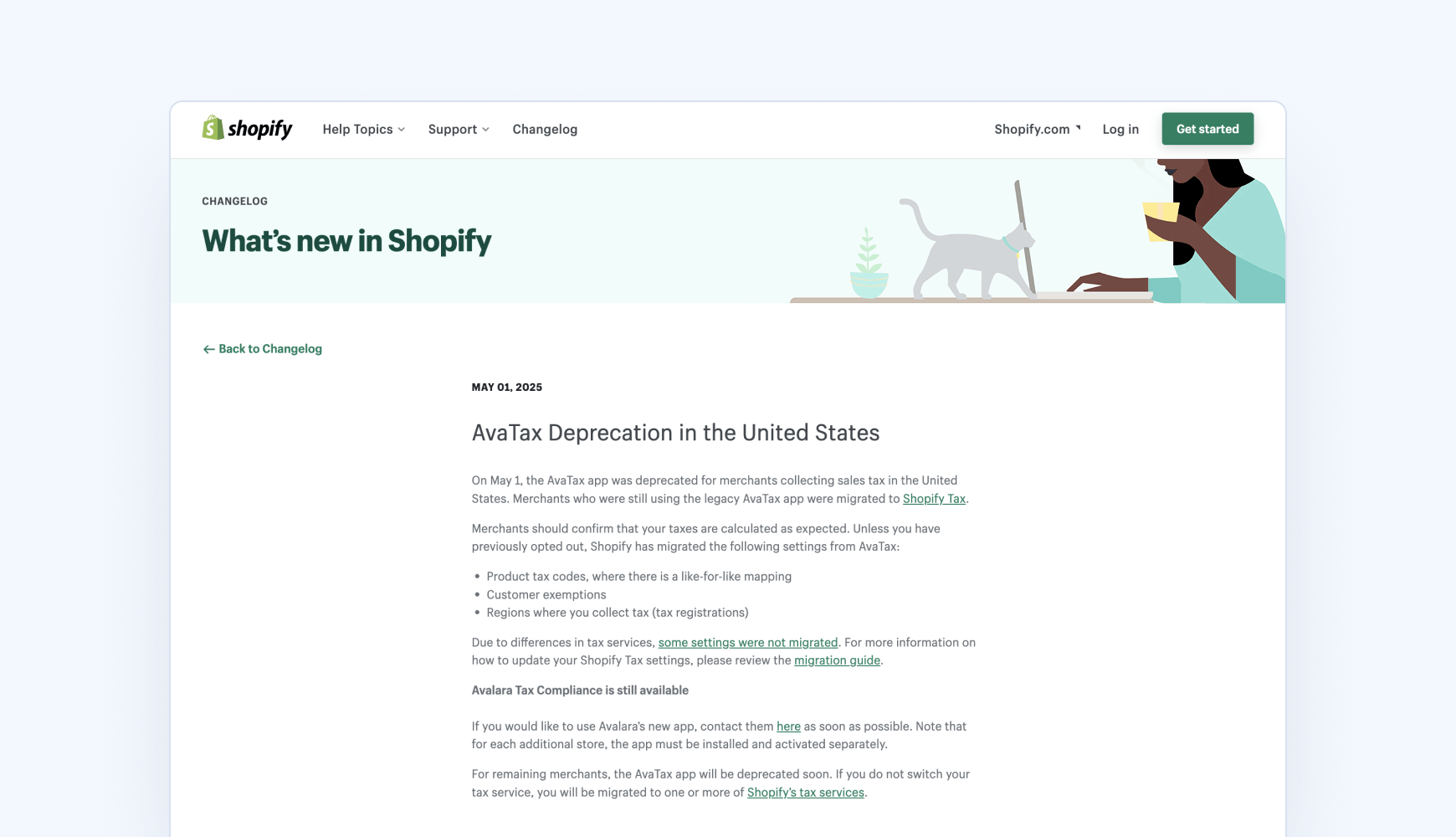
Previously, third-party tax engines could replace Shopify’s native tax calculation engine. Under the current model, Shopify Tax calculates tax at checkout on the Shopify platform. Approved third-party tax apps can continue to provide configuration, reporting, filing support, and compliance management.
This change depreciated Avalara’s AvaTax solution in the process, which could calculate tax via its one engine, but Avalara has since replaced that app with a separate solution called Avalara Tax Compliance.
However, Shopify Tax only calculates taxes processed within Shopify. If a business uses third-party tax software across additional sales channels or marketplaces, those platforms may still use their own engine outside of Shopify.
Why Shopify merchants turn to third-party integrations
Shopify Tax simplifies tax calculation and provides useful reporting tools for Shopify merchants.

For smaller businesses selling exclusively through Shopify, these capabilities may be sufficient. However, as brands expand into additional states and sales channels, compliance obligations grow more complex. At that stage, many merchants evaluate third-party tax integrations to help manage filing, reporting, and multi-channel exposure more efficiently.
Here’s a closer look at why Shopify sellers often turn to third-party sales tax solutions:
- No end-to-end compliance management. Shopify Tax calculates tax at checkout and provides reporting tools, but it doesn’t function as a centralized compliance partner. As state exposure expands, brands are still responsible for registrations, monitoring tax obligations, coordinating filings, and maintaining documentation.
- Nexus visibility is limited to Shopify transactions. With Shopify Tax, liability insights are based on activity processed within Shopify. If a business sells through other marketplaces, wholesale channels, invoicing systems, or other ecommerce platforms, Shopify won’t see it. To get a holistic view of nexus and potential exposure, companies need a third-party solution that can consolidate data from all channels.
- Multi-state filing requires coordination. While Shopify supports automated filing in select jurisdictions, businesses operating in multiple states may need to manage varying schedules, documentation requirements, and reporting standards. Shopify Tax is unable to handle this workload, forcing brands to turn elsewhere for more comprehensive solutions.
- Limited advanced compliance features. Shopify Tax is primarily a calculation engine, but it doesn’t offer support for exemption certificates, broad ERP integrations, and complex tax code configuration. Often, sellers in certain niches are forced to join with third party solutions in order to stay compliant with government regulations.
When compliance demands extend beyond what Shopify Tax can handle, third-party integrations become a practical next step.
The right integration can extend far beyond Shopify to centralize compliance management and reduce the operational burdens placed on internal teams.
Avalara on Shopify
Avalara is commonly used by companies with complex tax obligations that require configuration workflows and global tax coverage. The company’s Shopify integration connects merchants to Avalara’s broader product ecosystem.
Key features include:
- Sales tax calculation (via Avalara’s Shopify App)
- Exemption management (via Avalara Exemption Management)
- Sales tax return preparation (via Avalara Returns)
- Sales tax filing support
- Address verification
- Nexus tracking
- Access to Avalara tax codes
As a Shopify solution, Avalara brings additional features like expanded reporting, returns filing, exemption certificate management, and more into the Shopify ecosystem and can be used to modify how Shopify Tax handles its calculation.
Using Avalara, teams can set up specialized tax rules, sync product and item catalog information between Shopify and Avalara, account for exempt products or tax holidays, and consolidate Shopify calculations with tax information from other sales channels.
In the following sections, we’ll take a closer look at Avalara as a Shopify solution and what that entails for companies that use it.

Pricing and cost
Avalara pricing (full breakdown here) is quote-based and is typically structured around licensing, transaction volume, and a number of additional compliance modules.
For example, AvaTax operates as a standalone solution to handle tax calculations. Returns filing and exemption certificate management are offered through separate products, such as Avalara Returns or Avalara Exemption Certificate Management. In order to build a comprehensive solution, customers will need to purchase multiple Avalara products.
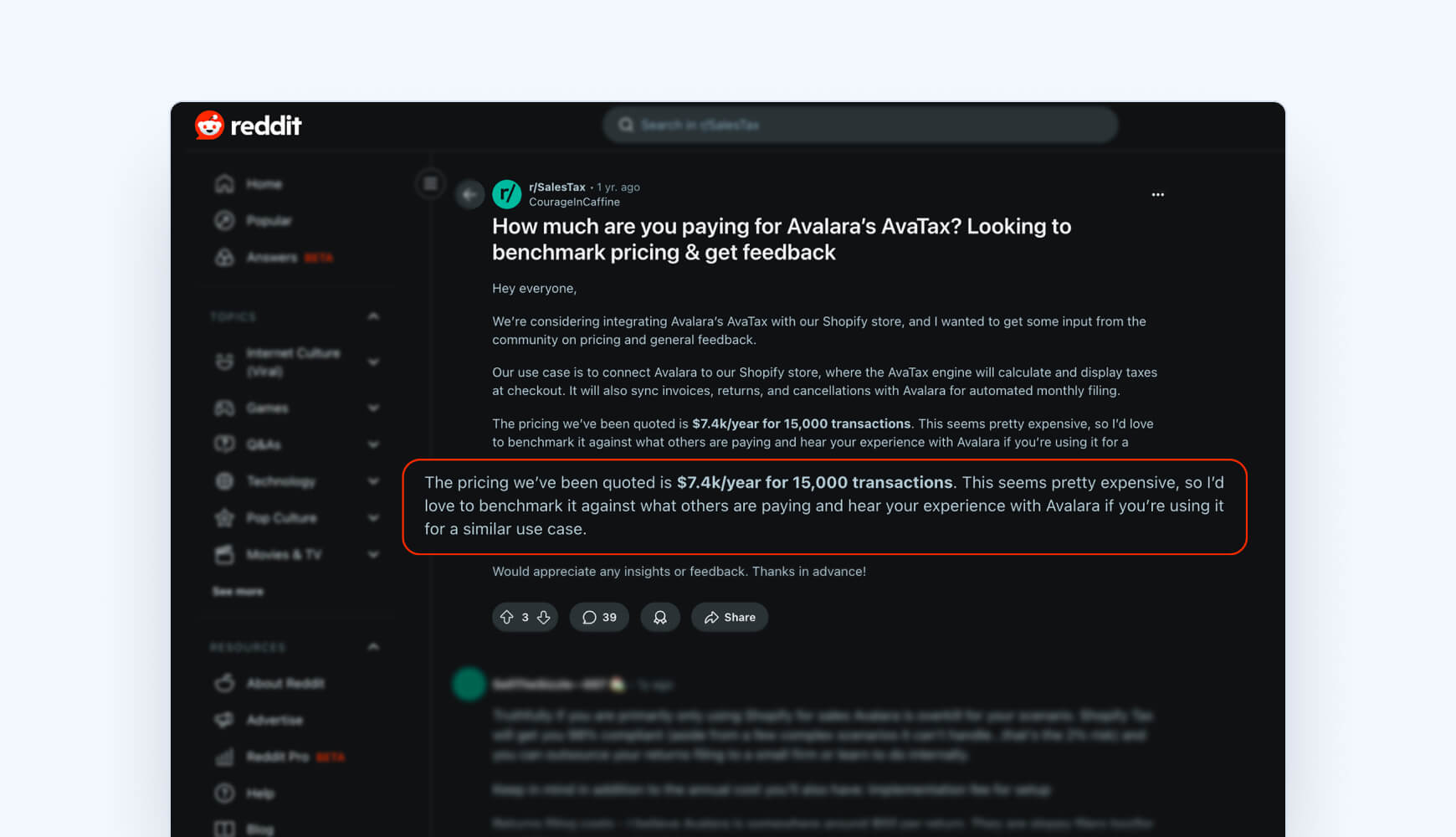
Integrations are generally included (at cost) as part of custom-configured plans. Depending on the scope of the implementation, merchants may incur additional charges for connectors, expanded transaction volume, or added compliance services.
Support is also delivered through tiered plans, with faster response times and dedicated account management attached to higher-level contracts. However, most support packages are priced for enterprise-tier organizations and may be out of reach for small- and mid-market brands.
Setup experience
Avalara implementations are largely centered on configuration and customization. This process may include mapping product tax codes to Avalara’s classification system, importing transaction data and defining nexus settings, connecting additional systems, and more.
As solutions grow more complex and additional modules are purchased, implementation scope can significantly expand. Heavily complex environments may force companies to rely on third-party integration experts in order to align all systems.
Avalara is designed to support highly configurable compliance environments. The system can scale appropriately to meet the demands of businesses with complex tax needs. Technical configurations that require coordination with multiple entities or departments allow Avalara to integrate deeply on an enterprise level and offer a high level of customization throughout the process.
But, while Avalara can connect across multiple systems and interfaces, technical teams are often required in order to keep the implementation afloat. Companies with in-house IT and tax departments can troubleshoot those issues, but smaller brands are often forced to rely on assistance from Avalara support or pay third-party specialists to maintain that connectivity.
Avalara support model
By default, Avalara delivers support through a tiered support system.
Standard support is typically ticket-based, where response times and service levels vary depending on the customer’s contract and the severity of the issue. However, from customer reviews and feedback, responses can come as quickly as a few hours or be delayed for weeks at a time.
Higher-tier plans can include prioritized support, dedicated account management, or expanded service options. For organizations at the enterprise scale, this structure can provide appropriate coverage for most issues — although technical and troubleshooting issues often require assistance from specialized technicians or third party consultants.
At the same time, for businesses without in-house tax or IT resources, navigating support tiers may be an important consideration when evaluating overall cost and fit.
When Avalara makes sense on Shopify
Avalara isn’t primarily designed for lightweight or single-channel use cases. The platform is intentionally structured to support organizations operating in more complex compliance environments where issues like configurability, integration depth, and global coverage are major considerations.
If you’re looking to deploy Avalara on Shopify, here’s where it would make the most sense to do so:
- You sell internationally and require VAT or GST support.
- You operate multiple legal entities or operate across distinct jurisdictions.
- You require deep ERP, CRM, or enterprise system integrations.
- You maintain in-house tax, finance, or IT specialists that can oversee the deployment and ongoing management of your AvaTax configuration.
For businesses operating at that scale, Avalara’s ability to connect and simultaneously integrate with multiple software systems makes it a strong integration choice. However, in that scenario, it’s likely that AvaTax would connect to several different sales channels or internal systems, not just Shopify.
TaxCloud on Shopify
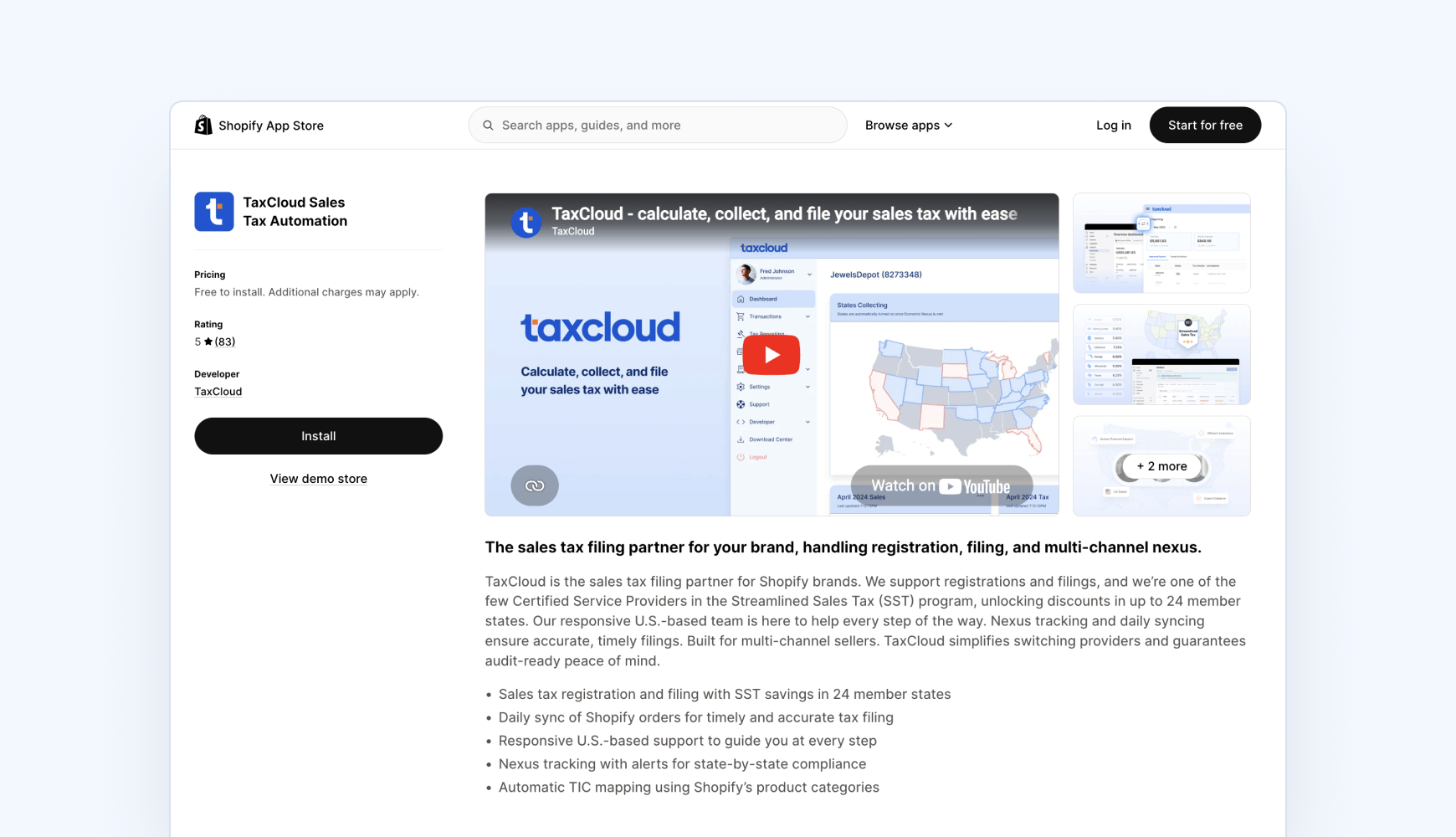
TaxCloud integrates with Shopify to support merchants who need a sales tax filing partner and more than storefront tax calculations. As with Avalara, calculation is handled by Shopify’s own tax engine while TaxCloud provides the tools to manage compliance across states and sales channels.
Key features include:
- Automated tax filing
- Automated sales tax remittance
- Streamlined Sales Tax discounts
- Automated order importing from Shopify Tax into TaxCloud
- Nexus tracking
- Return-ready reports
- Integration with Shopify stores and marketplaces
- U.S.-based expert customer support
- Exemption certificate management
- Audit support
When integrated, TaxCloud syncs with Shopify Tax on a daily basis and pulls the tax data into the TaxCloud platform. That data is then consolidated with transactions from other marketplaces and ecommerce platforms. Using this approach, merchants can track multi-state nexus exposure in one place and coordinate filing obligations across all jurisdictions.
TaxCloud also maps its taxability information codes (TICs) to Shopify’s product categories automatically, reducing manual classification work. Merchants can generate return-ready reports, enroll in the Streamlined Sales Tax program if eligible, and expand automated filing services as their exposure grows.
Critically, TaxCloud’s focus isn’t granular configurations and deep integrations with complex systems. Instead, TaxCloud aims to simplify tax obligations for growing U.S. ecommerce brands so that compliance can be handled predictably and with minimal operational overhead.
Pricing and cost
Similar to Avalara, TaxCloud’s plans are based on transaction volume and filing costs. However, there are key differences in how TaxCloud administers its pricing.
With TaxCloud, pricing is transparent and public. Merchants can review plans in advance without speaking to sales reps or receiving custom quotes. Different tiers can be used to increase transaction and filing volume as the business grows.
The TaxCloud Starter Plan includes two integrations — Shopify and WooCommerce — along with email support. Shopify sellers can also import, tag, and sync orders from 30+ marketplaces (including eBay, Etsy, Walmart, and TikTok) into Shopify to keep tax data consolidated in one place.
Premium Plan users have access to phone support, as well as additional integrations. Users can select the integrations they want to use without paying additional fees or waiting for a custom quote. API access is also available, which allows users to create custom connections and workflows across various backend systems.
Users on both plans gain access to the Streamlined Sales Tax program, which eliminates filing costs in participating states and can lead to massive savings down the road. Even though Avalara also offers SST savings, several TaxCloud users switching from Avalara have told us that they ended up paying far more in filing costs because the company refused to enroll or expand their SST coverage, despite their eligibility.
Setup experience
Like everything with TaxCloud, our Shopify integration is designed to be simple and easy. Setup includes connecting TaxCloud to the Shopify store, reviewing nexus exposure, confirming product category mapping, and selecting filing preferences.
Since TaxCloud is focused on U.S. sales tax compliance for mid-market brands, implementation generally requires less layered configuration than enterprise-oriented platforms. Because the platform is designed for non-experts, most merchants can complete onboarding in minutes, without dedicated tax or IT teams, as is commonly the case with Avalara.
After setup is complete, Shopify’s internal tax engine (Shopify Tax) will calculate tax on the Shopify platform, and TaxCloud will import that data into your internal dashboard. This approach enables users to track sales data from multiple Shopify storefronts while allowing Shopify Tax to handle platform calculations.
As businesses expand into additional states or sales channels, all of that data is imported and consolidated within the TaxCloud interface so that users have full visibility regarding tax compliance. For example, TaxCloud users can import tax data from Shopify storefronts and combine it with data from a website powered by Adobe Commerce for a cumulative view of their tax obligations.
Additional filing services and compliance tools can also be activated within the TaxCloud interface without the need to purchase additional products. For example, Avalara customers who suddenly need to handle tax exemptions will need to purchase Avalara Exemption Certificate Management, a software solution that connects to AvaTax and enables this feature. With TaxCloud, exemption certificate management is already available for all plans without the need for additional software.
Having a complete solution at your disposal, combined with minimal configuration requirements, means that getting up and running with TaxCloud is fast, simple, and easy.
TaxCloud support model
Support infrastructure is simplified with TaxCloud. Rather than offering tiered support plans, TaxCloud includes U.S.-based, human-powered support in all plans and works diligently to reply quickly when contacted. We also offer dedicated support services, such as personalized onboarding or Sales Audit Support, as an optional service for users.
Additionally, merchants can also reach out for assistance with filings, nexus exposure, reporting questions, and system configuration as part of their regular subscription. While it can take some time (usually less than a day) for the team to respond, users will get an answer from a real human rather than a runaround with AI-powered bots or redirects to different departments.
This approach is meant to provide a practical means of access for growing brands without structured assistance in a way that prefers one group of users (enterprise teams) over another.
When TaxCloud makes sense on Shopify
When mid-size ecommerce businesses want to pay less for filing and what expert support. Most TaxCloud users don’t have internal tax departments or dedicated tax teams, although some contract with external CPAs to assist with tax calculation and filing.
For Shopify users, TaxCloud makes the most sense when:
- Your sales footprint is across the U.S. and Canada
- You need to consolidate nexus tracking across your Shopify store and marketplaces.
- You want a cost effective “pay as you grow” filing expecting volume discounts.
- Your finance or operations team manages tax compliance alongside other responsibilities.
- You prefer a tax solution that runs in the background rather than requiring ongoing rule configuration and customization.
For brands in a stage of growth where automating taxes is preferable to manually customizing rates or integrating deeply with external systems, TaxCloud makes sense. Our platform can absorb that complexity, saving time and money so that teams can focus on other responsibilities within their organization.

Which integration should you choose?
Ultimately, the right Shopify tax integration will depend less on feature checklists and more on how your business operates. While Shopify Tax, Avalara, and TaxCloud can each support compliance beyond Shopify’s native tools, each is built for a different type of organization.
Keep in mind that, regardless of which option you choose, Shopify Tax will handle tax calculations. Within the current Shopify ecosystem, that’s the only way to capture tax at checkout.
| Shopify Tax | Avalara | TaxCloud | |
|---|---|---|---|
| Sell only on Shopify | ✅ | ✅ | ✅ |
| Multi-channel selling (Woo, BigCommerce, custom store, etc.) | ❌ | ✅ | ✅ |
| Selling across marketplaces | Not all | ✅ | ✅ (30+ incl. eBay, Etsy, Walmart, TikTok & others) |
| Primarily U.S. sales | ✅ | ✅ | ✅ |
| International VAT / GST support required | ❌ | ✅ | ❌ |
| Complex multi-entity structure | ❌ | ❌ | ❌ |
| Custom ERP / enterprise integrations | ❌ | ✅ | Limited |
| Dedicated in-house tax team | Not required | ✅ | Not required |
| No dedicated tax department | ✅ | ❌ | ✅ |
| Prefer transparent, published pricing | ✅ | ❌ | ✅ |
| Tax compliance handled in the background | Limited | ❌ | ✅ |
| Comfortable managing filings independently | ✅ | ❌ | ✅ |
| Need centralized multi-state compliance | Limited | ✅ | ✅ |
| Enrollment in Streamlined Sales Tax (SST) program | ❌ | Mixed results | ✅ |
For many sellers, the best choice will come down to a matter of scale.
- Shopify Tax makes sense for very early-stage merchants who are interested in selling on a single platform, are focused on sales in one or two states, and are comfortable with managing the filing through the Shopify platform or by themselves.
- TaxCloud is the best choice for mid-market U.S. brands that are managing compliance across multiple states and are actively looking to scale and automate tax compliance. In those scenarios, TaxCloud can centralize all tax data to a single platform, automatically calculate totals, and remit filings with minimal human interaction and to be a cost-effective solution that provides discounts based on volumes
- Avalara works best for enterprise organizations seeking advanced configurability with integration or international tax infrastructure. However, note that in these scenarios, Shopify is likely one part of a much larger tax compliance ecosystem, and users may need to account for other factors beyond the Shopify platform.
By matching the right solution to the current stage of growth, companies can benefit from the features most useful to them.
For the vast majority of businesses, Avalara will be a poor fit due to cost and features that simply aren’t beneficial. On the other hand, TaxCloud will offer more affordable features and automation solutions for startups and growing brands, with Shopify Tax acting as a feasible solution for very small operations with limited reach and scope.
Get Shopify tax compliance without enterprise overhead
Enterprise-grade and legacy tax systems are built for organizations with dedicated tax departments and complex global requirements. Most growing Shopify brands simply don’t need that level of infrastructure. Instead, they need reliable, centralized compliance that can scale with them.
TaxCloud provides multi-state reporting, nexus tracking, and automated filing without requiring complicated deployments or pre-negotiated contracts. Pricing is always clear, and built-in automation frees up finance and operations teams to focus on growth rather than compliance.
Explore how TaxCloud can fit into your Shopify workflow by signing up for a free 30-day trial or by booking a personalized demo with a product expert.