Anrok alternatives: Find the best option for your SaaS business

Written by

Head of DemandGen, TaxCloud

Updated
Anrok is a sales tax compliance platform built for SaaS companies with complex international operations — global teams, VAT exposure, and workforce-driven nexus across the U.S., EU, UK, and Canada.
But most SaaS businesses don’t have that problem yet. Teams scaling primarily in the U.S. face a simpler question: do you need a platform built for global workforce complexity, or one built to handle U.S. sales tax accurately and cost-effectively as you grow?
This guide breaks down what Anrok does well, where it’s often over-scoped for U.S.-focused teams, and how leading alternatives compare across pricing, features, support, and fit — so you can choose a platform aligned to your actual compliance risk, not someone else’s.
Anrok alternatives: Feature comparison table
| Anrok | TaxCloud | Stripe Tax | Avalara | Kintsugi | Numeral | |
|---|---|---|---|---|---|---|
| Best for | Global SaaS, international tax | SaaS and ecommerce, U.S and Canada | Early-stage SaaS, Stripe-only | Large enterprises, global operations | Mid-market SaaS, nexus cleanup | SMBs with limited U.S. nexus |
| Calculates tax | ✅ | ✅ | ✅ | ✅ | ✅ | ✅ |
| Files returns | ✅ | ✅ | ❌ | ✅ | ✅ | ✅ |
| Handles registrations | ✅ | ✅ | ✅ | ✅ | ✅ | ✅ |
| Multichannel support | Limited (SaaS-first, expanding) | ✅ (SaaS + ecommerce + API) | ❌ (Stripe-only focus) | ✅ | ❌ | ✅ |
| SST access | ❌ | ✅ | ❌ | ✅ | ❌ | ❌ |
| Audit support | Limited | ✅ (additional service) | ❌ | ✅ (Paid/Partner) | Limited | Limited |
| Support model | Managed services, advisory-led | Human-led onboarding and support | Self-service / Email | Ticket-based with paid support tiers | AI-assisted live chat, Email | Software-first with optional support |
| Pricing model | Revenue-based ($499+ monthly floor + 0.4% revenue fee) | Volume-based ($19 or $79 flat plans; $19–$39/filing) | Revenue-based ($90+ monthly plans for filings or 0.5% per sale) | Volume-based (Custom tiers; additional fees for registrations) | Usage-based ($75 per filing or registration) | Pay-per-use ($75/filing and $150 per registration) |
| Guided onboarding | ✅ | ✅ | ❌ | ❌ | Limited | ✅ |
| Geographic focus | Global | U.S.-first | Global (Stripe ecosystem only) | Global | U.S.-first | U.S.-first |
What is Anrok?
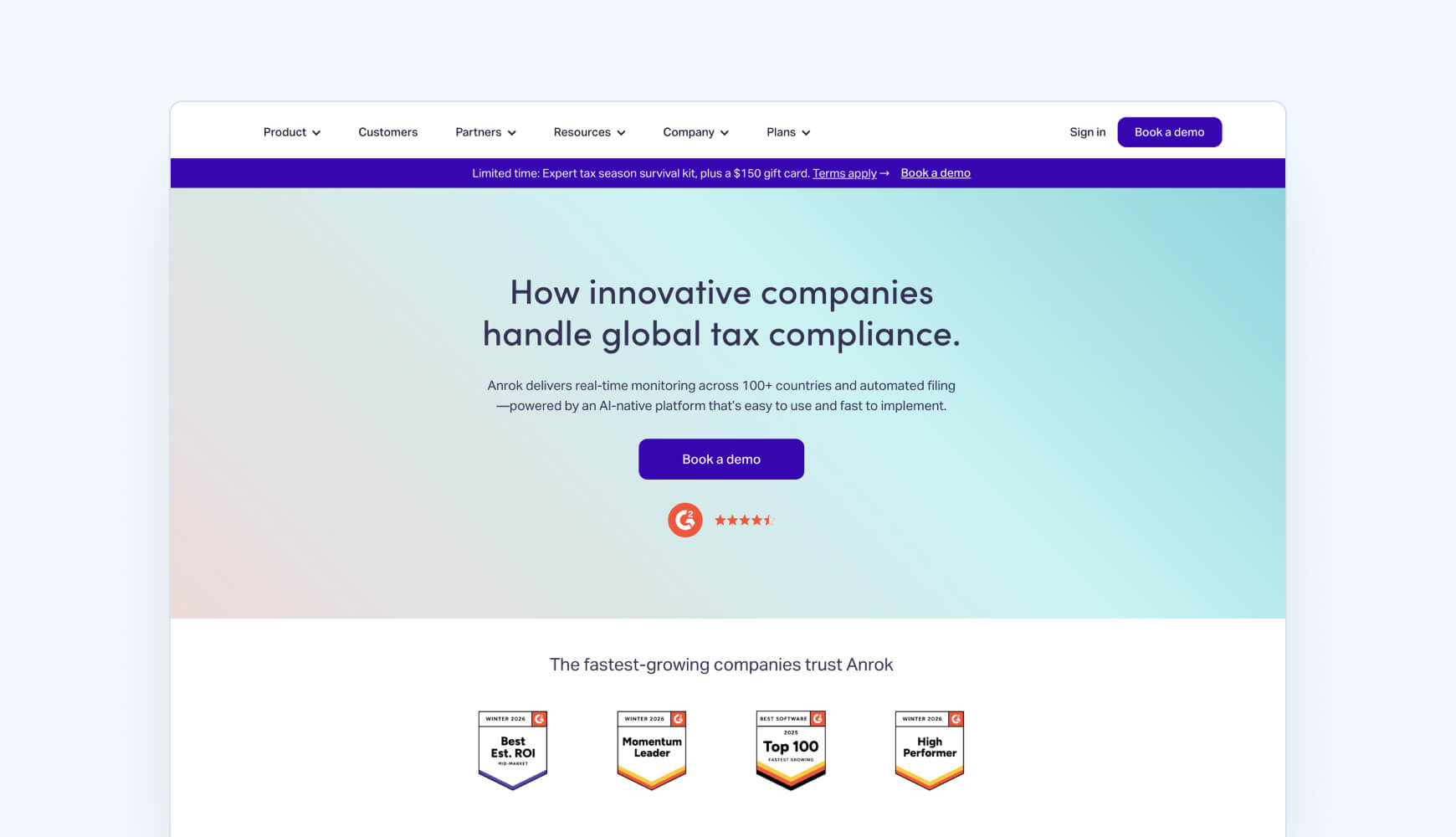
Anrok is a global sales tax compliance platform designed primarily for high-growth SaaS companies with international teams. Its focus is on companies that sell software, AI tools, and digital services, as well as hardware like chips, sensors, and devices.
Anrok tracks nexus across U.S. jurisdictions and supports VAT and GST compliance in select international markets. It also monitors physical nexus triggered by remote employees through HR software integrations, reflecting its focus on workforce-driven and cross-border tax complexity.
Who is Anrok best for?
Anrok is best suited for SaaS companies with subscription, usage-based, or API-driven revenue models that operate across multiple jurisdictions and need to manage both U.S. sales tax and international VAT or GST for digital products and services.
It’s particularly well suited to teams with globally distributed workforces, where remote employees can create physical nexus in additional jurisdictions beyond sales-driven thresholds.
Anrok also offers a Shopify integration, but its platform and pricing remain oriented toward international-first compliance. For Shopify sellers focused primarily on U.S. sales without active VAT or GST exposure, this can mean paying for capabilities they don’t need.
How does Anrok work?
Anrok connects to billing, finance, and HR systems to centralize sales tax and VAT compliance across regions. It’s designed to help global SaaS teams manage both sales-driven and workforce-driven tax exposure as they scale internationally.
At a high level, Anrok supports:
- Workforce-driven nexus monitoring. Tracks both economic nexus from sales and physical nexus created by remote employees, using integrations with HR and payroll systems.
- Sales tax, VAT, and GST compliance. Supports registration, filing, and remittance for U.S. sales tax, as well as VAT and GST obligations in select international markets.
- International registration and filing support. Provides free registration and filing services in the EU, UK, and Canada, reflecting its focus on early-stage international expansion.
- Real-time tax calculation and exposure modeling. Calculates tax at the transaction level and models cross-border exposure to help teams understand compliance risk as they scale.
- Exemption certificate management. Manages exemption documentation and taxability rules for digital products and services.
- Advisory-led compliance support. Pairs the platform with access to tax experts and technical consultants, emphasizing hands-on guidance over self-serve automation.
How much does Anrok cost?
Anrok uses a subscription-plus-revenue-percentage pricing model that combines a fixed monthly platform fee with a percentage-based charge on taxable revenue.
Anrok does not publish full pricing details on its pricing page. However, pricing disclosed elsewhere on Anrok’s site and reported by customers indicates the following structure:
| Plan | Base monthly price | Revenue-based fees | Notes |
|---|---|---|---|
| Anrok for Startups | ~$399/month | Basis-point charge on taxable revenue | Discounted program for early-stage companies under ~$5M ARR |
| Anrok Starter | $499/monthAnrok Starter | Basis-point charge on taxable revenue | Entry tier for standard Anrok customers |
| Anrok Core | $999/month | ~30 basis points (≈0.3%) of taxable revenue | Higher-touch advisory and compliance support |
| Anrok Growth | Custom pricing | Basis-point pricing | Designed for large or complex global operations |
In addition to the monthly subscription fee, Anrok applies a basis-point charge to taxable sales volume, meaning total costs fluctuate month to month based on revenue. As sales increase, compliance costs rise proportionally.
Why Anrok gets more expensive as you grow
For a growing SaaS company, one of the most significant differences between platforms is the pricing philosophy. Anrok uses a revenue-based pricing model, while TaxCloud uses a volume-based model.
This creates a stark divergence in ROI as you scale: because Anrok charges a percentage of your taxable revenue (typically 30–40 basis points), your compliance costs rise automatically as you succeed — even if your actual filing workload remains the same.
In other words: most tax platforms charge you for the work they do; Anrok charges you for the success you have.
| Pricing factor | Anrok (Revenue-Based) | TaxCloud (Volume-Based) |
|---|---|---|
| Monthly fee | $499+ | $19/month (Starter) |
| Usage-based fees | 0.40% of your revenue | $0 (Predictable flat rate) |
| Order processing | Included in % fee | 100 orders included in Starter |
| Marketplace order processing | Charged (Basis points apply) | FREE (unfiled marketplace and historical orders excluded from plan limits) |
| Filing costs | Bundled (Pay for 40+ states even if you use 1) | On-demand (Starts at $39/return; drops to $25/return with volume) |
What the pricing gap looks like in practice: Anrok vs TaxCloud
When your average contract value (ACV) is high, Anrok’s basis-point model acts as an anchor on your margins. TaxCloud scales based on your activity, not your bank account.
| Monthly Revenue | Orders / Filings | Anrok Monthly (Est.)* | TaxCloud Monthly Total** | Your Monthly Saving |
|---|---|---|---|---|
| $100,000 | 100 Orders / 1 Return | $899 | $58 | $841 |
| $500,000 | 400 Orders / 5 Returns | $2,499 | $218 | $2,281 |
| $1,000,000 | 1,000 Orders / 10 Returns | $4,499 | $408 | $4,091 |
*Anrok estimates based on a $499 floor + 0.40% revenue fee.
**TaxCloud pricing reflects the Starter/Premium order tiers + monthly filing subscriptions.
Switch to TaxCloud
TaxCloud provides real-time sales tax calculation, nexus tracking, registration, and filing for SaaS and ecommerce businesses — without enterprise-level costs. Get fully automated sales tax compliance with transparent pricing and U.S.-based expert support included in every plan.
Why businesses look for Anrok alternatives
Anrok is designed for SaaS companies with international operations and globally distributed teams. For businesses that don’t fit that profile, the platform can feel over-scoped and expensive relative to their actual compliance risk.
Here are some common reasons teams explore alternatives to Anrok:
- U.S. sales tax is the primary risk surface: Many SaaS companies sell internationally but face most of their compliance risk at the U.S. state level. These teams often prioritize broad U.S. filing coverage and audit readiness over global exposure modeling.
- International exposure extends beyond the EU, UK, and Canada: While Anrok supports VAT and GST in select markets, it doesn’t handle registration, filing, and remittance in many other international regions. Businesses selling elsewhere must work directly with tax authorities or third-party partners.
- No international remote workforce: Anrok pricing includes monitoring physical nexus created by remote employees. Companies without distributed international teams may end up paying for workforce-driven compliance features they don’t need.
- Unpredictable, revenue-based pricing: Anrok applies basis-point charges to taxable revenue, meaning costs increase during high-growth months. Some SaaS teams prefer pricing models tied to filings or usage rather than revenue.
- Limited internal tax or engineering resources: Anrok requires coordination across billing, finance, and HR systems. Teams without dedicated tax or technical resources may prefer more turnkey platforms with lighter implementation overhead.
- Need filing and audit support without premium global services: Growing SaaS teams focused on U.S. compliance often want access to filing and audit support, without paying for bundled international and advisory services that aren’t yet relevant.
Best Anrok alternatives
1. Best overall Anrok alternative: TaxCloud
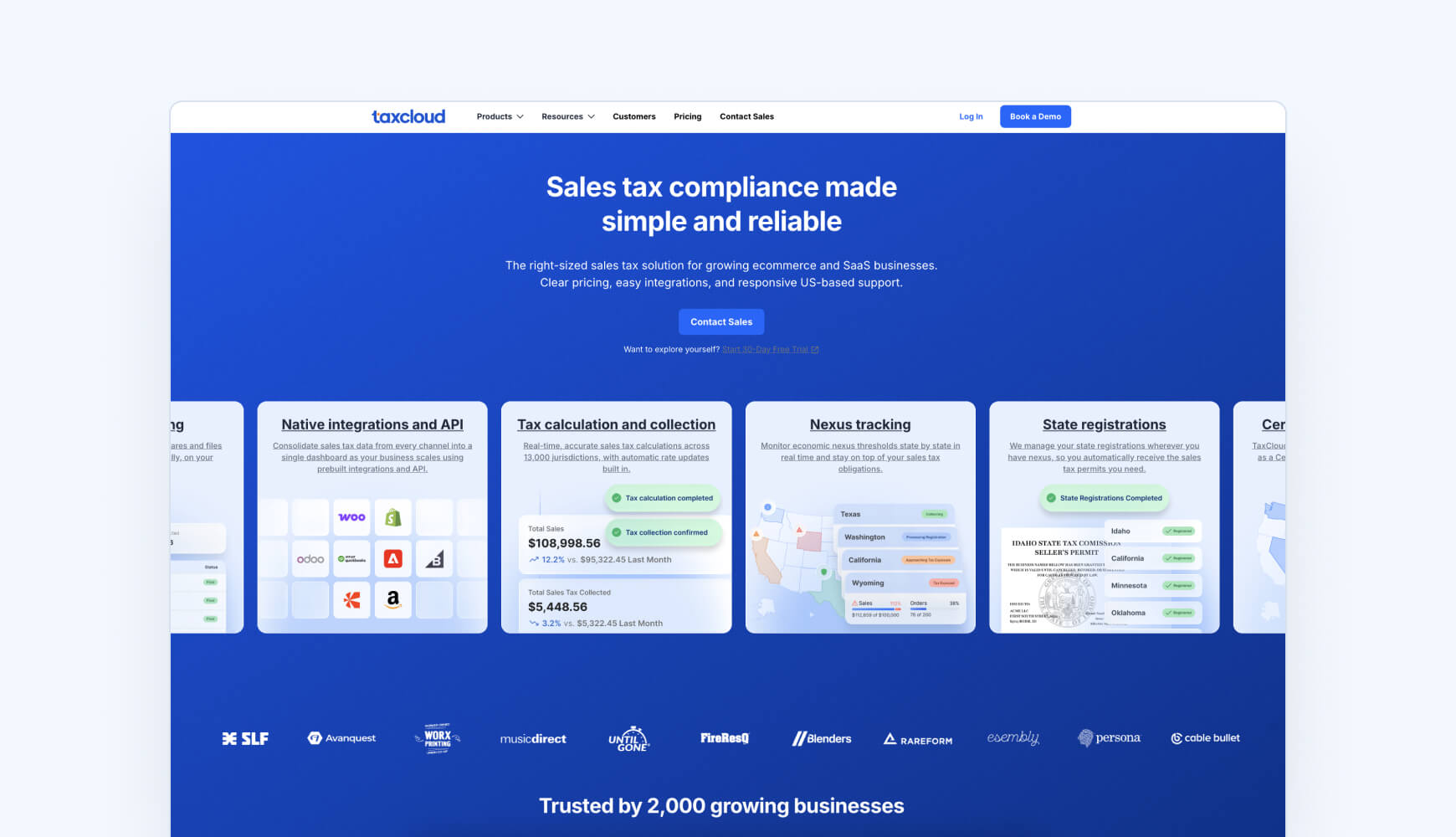
Best for: SaaS and ecommerce with U.S and Canada sales tax exposure.
Website: TaxCloud.com
Pricing:
- Starter: Starts at $19 per month
- Premium: Starts at $79 per month
- Sales tax filing: Starts at $39 per return, with volume discounts that can reduce effective filing costs at scale.
Overview: TaxCloud is a sales tax compliance platform built for SaaS and ecommerce businesses whose primary compliance exposure is U.S. sales tax. It focuses on nexus tracking, calculation, filing, and remittance across U.S. jurisdictions, with optional support for Canadian GST and PST. Unlike international-first platforms, TaxCloud does not bundle global workforce or VAT services many U.S.-focused teams don’t need at their current stage.
Why teams choose TaxCloud over Anrok:
Anrok is designed to show you what you owe — but for most U.S. SaaS teams, knowing what you owe isn’t the hard part. The hard part is filing and remitting to dozens of states every month without errors, delays, or audit exposure.
TaxCloud is built for teams that want to hand off that entire lifecycle, with calculation as the first step, not the final one.
- Predictable, volume-based pricing. Costs scale with order volume, not as a percentage of revenue.
- Lower filing costs through SST. Because TaxCloud is a Certified Service Provider (CSP) in the Streamlined Sales Tax (SST) program, we’ve integrated SST access into every plan — including Starter. For companies scaling in the U.S., the subsidized filing costs in 24+ states don’t just simplify your workflow; they reduce your tax compliance costs and offset your monthly TaxCloud subscription.
- Direct filing and remittance. Returns are filed and remitted by TaxCloud, not routed through third-party partners.
- Audit support when it matters. Optional, in-house audit support helps teams respond confidently to state audits and notices.
- Guided onboarding as complexity grows. Optional onboarding support ensures accurate setup for SaaS teams with multi-state or custom billing needs.
- Responsive U.S.-based human support. Onboarding and support are handled by in-house teams, not outsourced, offshore, or AI-only systems.
What customers say: TaxCloud reviews praise the company’s customer service and easy implementation.
For the first time, I actually feel confident we’re compliant. TaxCloud doesn’t just respond to issues. They explain what’s been filed, what’s coming next, and what we can safely ignore — that kind of proactive thinking makes a huge difference.
TaxCloud was ‘set it and forget it’ for us. It just works, and that lets me sleep at night.
2. Stripe Tax

Best for: Early-stage SaaS founders who want to stay entirely within the Stripe ecosystem and prioritize ease of setup over long-term margin control.
Website: Stripe.com/tax
Pricing:
- Tax Basic: 0.5% per transaction (no-code) or $0.50 per transaction (API) in jurisdictions where you are registered to collect tax.
- Tax Complete (tiered monthly subscriptions):
- $90/month: Up to 200 transactions and 4 filings.
- $430/month: Up to 1,000 transactions and 12 filings.
- $1,000/month: Up to 2,500 transactions and 20 filings.
Overview: Stripe Tax is an embedded compliance tool that calculates sales tax, VAT, and GST directly within the Stripe workflow. It provides basic nexus monitoring and allows users to export data to third-party partners like TaxJar or Taxually for automated filing.
What it’s good at: Stripe Tax is the easiest tool to activate for businesses already locked into Stripe Billing. It requires almost zero technical expertise to set up and provides real-time calculation without a separate integration. It’s a functional “first step” for companies with very low transaction volume and zero sales outside of the Stripe ecosystem.
Where it falls short for Anrok-evaluating teams: Stripe Tax is another platform that charges a percentage of your revenue rather than a fixed rate. This means that their fee scales automatically as you grow — even if your compliance workload remains static.
Using Stripe Tax also creates a dangerous platform lock-in. Because the compliance logic is embedded in Stripe, moving to a different payment processor or adding multichannel sales effectively breaks your tax engine.
And on the compliance front, Stripe Tax is an incomplete solution. It requires you to manage separate third-party accounts for sales tax filing and offers no native audit defense or SST cost-offsets to lower your monthly burn.
What customers say: Stripe Tax reviews highlight the convenience of the ecosystem, often offset by the high long-term cost.
While Stripe Tax is incredibly helpful, it is not perfect. The service could be further improved by offering more comprehensive support for integration with third-party tools and platforms. As the digital market continues to evolve, it’s crucial for businesses to have access to seamless integrations with various tools to streamline their operations.
3. Avalara
Best for: Enterprises and mid-sized businesses scaling globally.
Website: Avalara.com
Pricing: Volume-based pricing model. Sales tax registration costs $403 per location. Read our full Avalara pricing review.
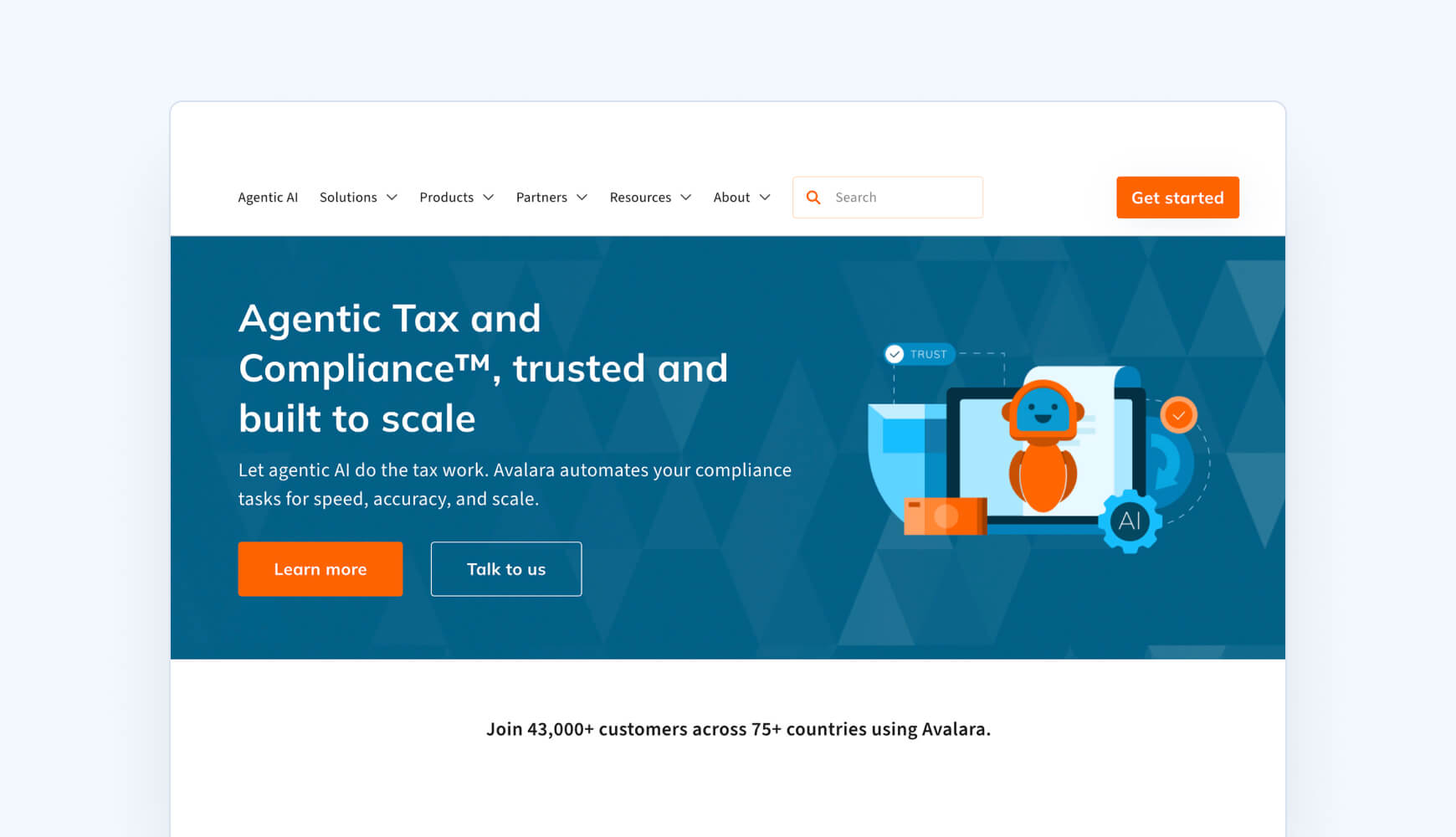
Overview: Avalara is a leading tax management solution. AvaTax is Avalara’s agentic AI-powered sales tax compliance platform. It calculates U.S. sales tax, VAT, and GST and automates registration, filing, and remittance in almost every region worldwide.
Support: Online ticket submission is included. Additional support channels and audit support cost extra.
What it’s good at: Avalara has predefined tax codes that track taxability for SaaS and digital services, regardless of the delivery method across all U.S. states. It offers more than 1,400 integrations to cater to businesses in a variety of industries. Avalara’s geospatial technology ensures that every address you sell to is accurately validated against a nationwide database of tax regions so you know you’re compliant everywhere.
Where it falls short for Anrok-evaluating teams: Avalara is built for global enterprises and comes with complexity and robust features many SMBs don’t need. Implementing and getting the most out of Avalara requires both tax and technical expertise. Volume-based pricing means that your costs go up as you grow, which means it’s not the most cost-effective option for scaleups. Free support is very limited and you have to pay for add-on support plans.
What customers say: Avalara reviews reveal that the solution saves customers time and helps them navigate ever-changing tax regulations.
I love that Avalara has experts to know all the state laws when it comes to sales tax. With the addition of economic nexus, our state collection requirements more than doubled and Avalara helped us to get compliant in all the states we needed to. They had a nice tracker and dashboard to make it easy and clear where and when we needed to get registered.
4. Kintsugi
Best for: Mid-market SaaS companies looking for an “AI-first” approach to product mapping and automated back-filing for historical exposure.
Website: TryKintsugi.com
Pricing:
- Free: $0/month. Includes nexus monitoring, address validation, and no-code integrations for Stripe, Chargebee, and QuickBooks.
- Starter: Starts at $75 per filing or registration. Includes automated tax code classification, 24/7 live chat, and a “virtual mailbox” for state notices.
- Premium: Custom/Fixed volume pricing. Includes API access, “Filing Autopilot,” and Voluntary Disclosure Agreements (VDA).
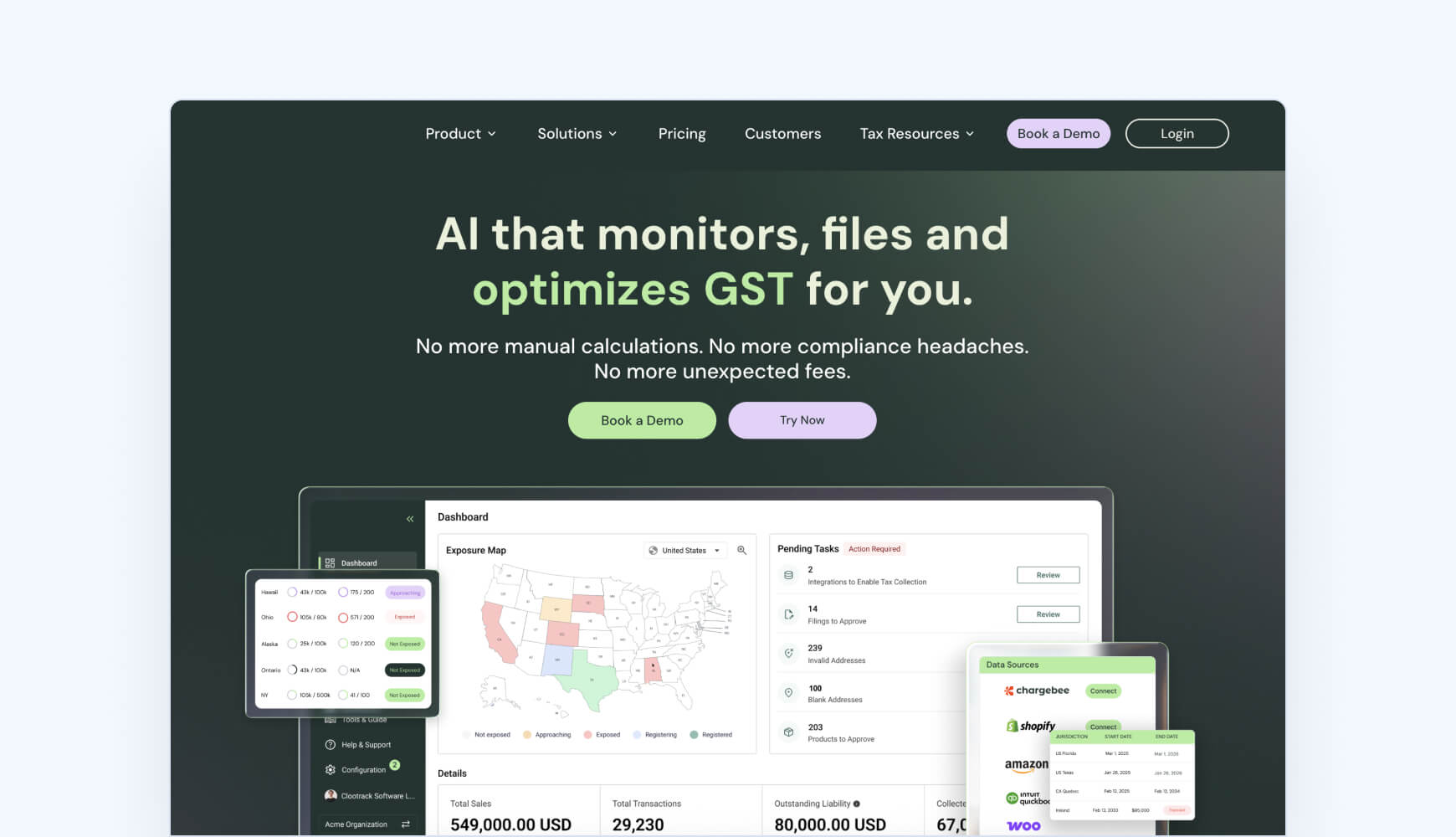
Overview: Kintsugi is a modern sales tax platform that uses AI to automate taxability research and product code mapping. It helps SaaS companies identify “quiet” nexus triggered by remote employees or historical sales and provides a “virtual mailbox” to manage physical notices from state tax authorities.
What it’s good at: Kintsugi is built for modern tech stacks, offering a sleek UI and deep integrations with billing systems like Chargebee and Stripe. Their AI-assisted product categorization is a draw for SaaS teams with complex catalogs that need to be mapped to varying state rules.
Where it falls short for Anrok-evaluating teams: As a newer, AI-native platform, Kintsugi still faces growing pains with integration depth and complex data migration. Teams moving from legacy systems often find that while the “AI mapping” is fast, the platform lacks the robust manual override features and deep ERP connectivity (like native NetSuite or complex Stripe configurations) found in more mature solutions.
Additionally, their support model is primarily AI-first. While their chatbot is responsive for basic queries, complex jurisdictional issues often require escalating to a human expert — a process that can feel slow when you’re facing a filing deadline.
Finally, the $75 per-filing pricing model can make monthly burn unpredictable for companies in high-growth phases, as filing frequency varies by state and revenue volume.
What customers say: Kintsugi reviews are generally positive regarding the automated product mapping, though some mid-market teams have reported friction with pricing, onboarding, and a lack of support for manual data overrides.
I’m maybe a bit torn on the pricing model, because I love a flat rate – $75/filing – but kind of wish it was lower for states that require monthly filings instead of quarterly. The product approval model could use some work for special use cases like ours.
Kintsugi’s intuitive interface is informative but simple and easy to navigate. We had a single, live human onboard us and he was smart, friendly, and responsive. That process was mostly smooth, and the platform’s automation capabilities helped us streamline our workflows almost immediately. I’m so glad fellow execs agreed to let me try Kintsugi instead of deferring to Avalara!
We launched Kintsugi around the same time we launched new invoicing software and we had a lot of issues. It felt like the size of our organization was a learning curve for Kintsugi. Things have much improved now that we have gotten over the hurdles from the beginning. I think the issue of loading past years’ data into Kintsugi when we had no issues in filings was handled poorly.
5. Numeral
Best for: SaaS companies with limited U.S. nexus and no monthly commitment.
Website: Numeral.com
Pricing:
- Free: U.S.-only physical and economic nexus monitoring and alerts.
- Standard: $75 per filing and $150 per registration (U.S.-only automated filing and remittance, support)
- Pro: Custom pricing (Coverage in 60+ countries, exemption certificate support, API access).
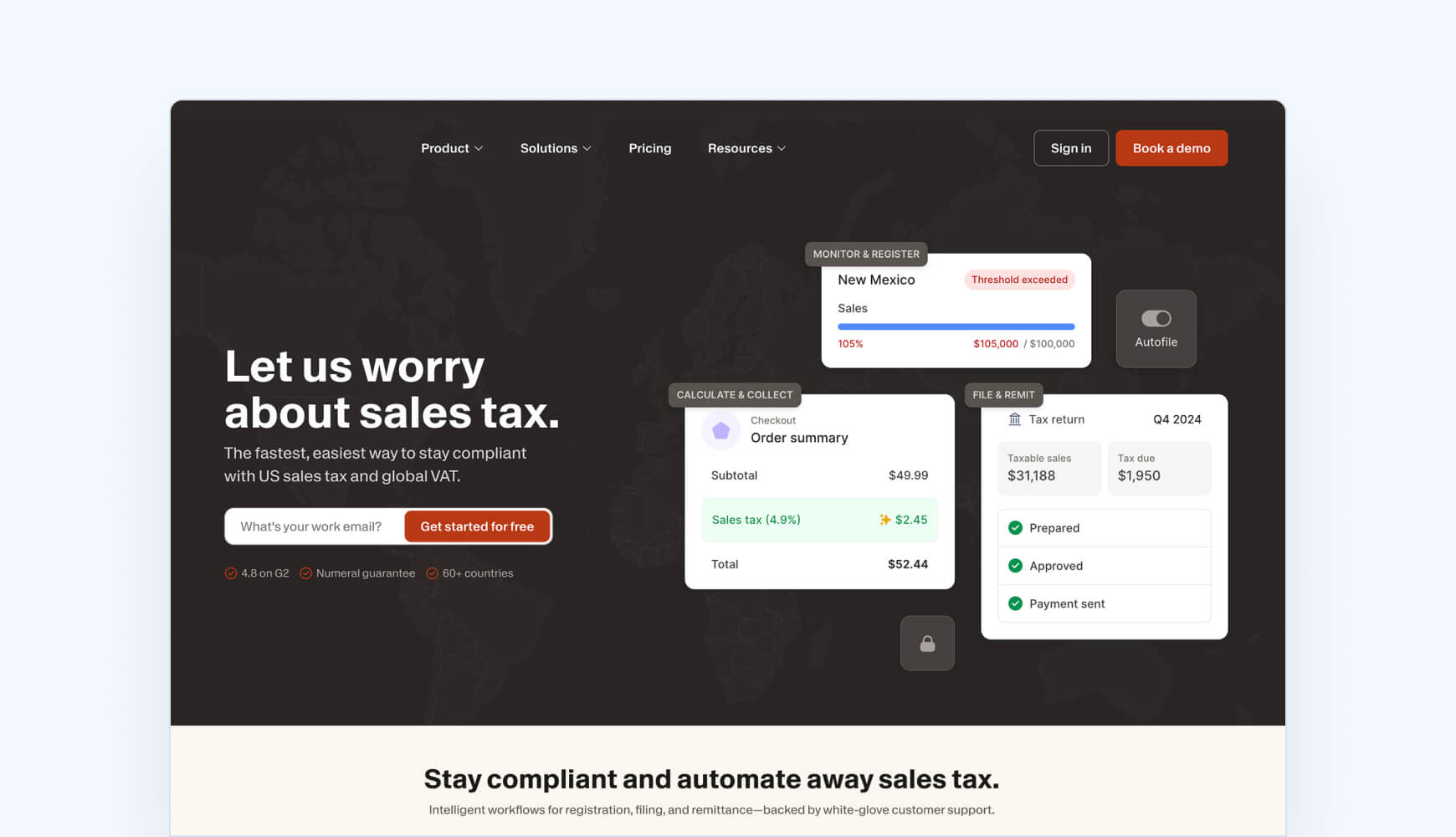
Overview: Numeral is a sales tax compliance platform that automates registration, filing, remittance, and exemption management for ecommerce and SaaS businesses. It integrates with billing systems, tracks nexus, and supports compliance in over 60 countries.
What it’s good at: Numeral supports both SaaS and ecommerce businesses with integrations including Shopify, WooCommerce, Chargebee, and Stripe. It supports both physical and economic nexus monitoring and automates registration, filing, and remittance. It also processes physical mail from state sales tax authorities.
Where it falls short for Anrok-evaluating teams: Businesses that want to expand across states will pay more for Numeral. The moment you want help with exemption certificates, you’ll need to switch to the Pro plan, which doesn’t have transparent pricing. Access to tax experts and support with backfilling or voluntary disclosure agreements is only available with the Pro plan. It offers granular tax rate calculation — down to the district level — but only through its API which requires developer expertise to set up.
What customers say: Numeral reviews are mixed, with some customers reporting easy onboarding and others airing frustration about the company’s support service.
We’ve been using Numeral for 6 months now and couldn’t be more pleased. The onboarding process really stood out – they set realistic expectations from day one and got us up and running quickly without any of the usual implementation headaches.
Numeral has been consistently incompetent when it comes to support. They repeatedly file our local state sales tax incorrectly, which has resulted in ongoing emails from tax authorities, delinquency notices, and constant cleanup on our end. This is not a one-off issue—it has been happening for months.
Which Anrok alternative is right for you?
If your primary compliance risk is U.S. sales tax — and you want predictable costs, direct filing, and support from a team that knows your account — TaxCloud is the default choice for growing SaaS and ecommerce businesses.
The alternatives above serve specific situations, but most mid-market teams scaling in the U.S. don’t need the global complexity or revenue-based pricing that comes with Anrok.
Here’s how to think about the other options:
- Stripe Tax if you’re early-stage, 100% on Stripe, and prioritize setup speed over long-term margin control.
- Avalara if you’re an enterprise with global ERP infrastructure and a dedicated tax team.
- Kintsugi if you’re a mid-market SaaS team with messy historical nexus exposure and need AI-assisted product mapping to clean it up.
- Numeral if you have very limited U.S. nexus and prefer a pure pay-per-filing model with no monthly commitment.
Ready to see how TaxCloud handles tax compliance for SaaS and ecommerce businesses?
Talk to our team for a demo and personalized onboarding.