Agentic commerce is expanding ecommerce — and your tax risk
Written by

VP of GTM, TaxCloud

Published
The next wave of commerce is here. But it’s evolution, not extinction.
Thirty years ago, hardly anyone imagined brands thriving without fighting for shelf space in big-box stores.
Twenty years ago, we wouldn’t have believed most shopping would happen on tiny computers we carry in our pockets.
Ten years ago, buying directly through social media platforms like Instagram or TikTok felt like a stretch.
Five years ago, seamless checkout experiences like Shop Pay and lightning-fast next-day delivery from Amazon felt revolutionary.
And now, in 2025, we’re talking about the rise of agentic commerce, where AI can act on your behalf to research, compare, and even purchase products with minimal human input.
When these shifts happen, there’s always a temptation to believe this is the one that will blow up the world as we know it and wipe out everything that came before. But if history has taught us anything, the truth usually sits somewhere in the middle.
Here’s what’s really going on with ChatGPT’s Instant Checkout, and what you need to do to prepare.
TL;DR: ChatGPT and other LLMs are a new storefront for your brand
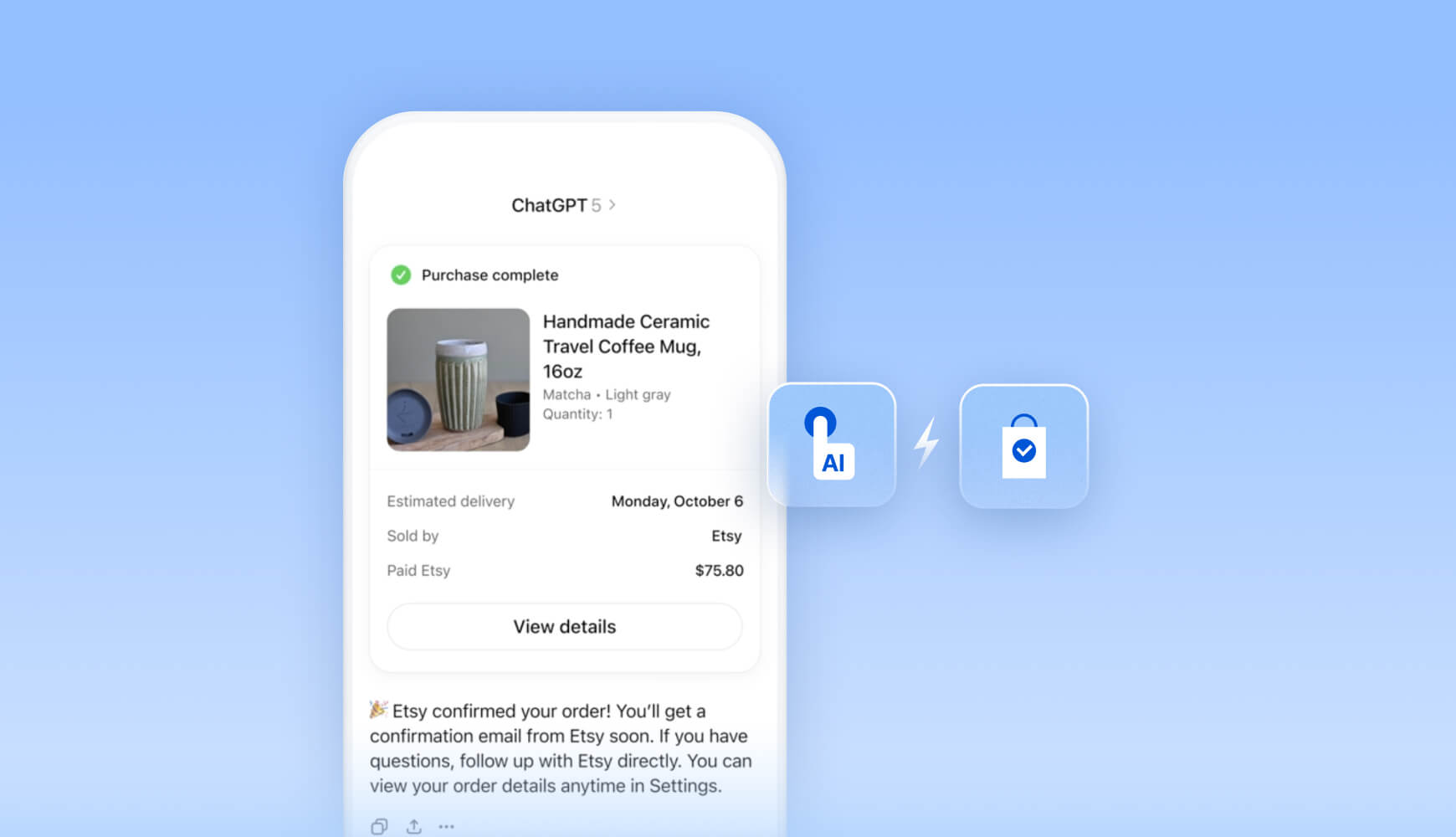
Recently, OpenAI launched Instant Checkout, a new feature that lets users buy products directly inside ChatGPT. Ask for a product, see options, click “Buy,” and you’re done—no browser hopping or abandoned carts.
For now, it’s live only in the U.S., starting with Etsy and Shopify merchants, and powered by Stripe’s new Agentic Commerce Protocol (ACP). Walmart has since announced an OpenAI partnership to build AI-first shopping experiences, and WooCommerce confirmed it’s building support next.
Here’s why merchants are paying attention to the emergence of agentic commerce:
- No listing fees — Products appear naturally in search results ranked by relevance.
- Low commission — ChatGPT takes a small cut only on completed purchases, with no pay-per-click model (for now).
- Full control of the customer relationship — Sellers keep customer data, fulfillment, returns, and support.
- Simple setup — Shopify and Etsy merchants are live by default; others can apply at chatgpt.com/merchants once connected to Stripe.
Some are calling it “the iPhone moment of commerce.” [1] Others see a hype cycle still warming up [2] . The reality is somewhere between: promising, early, and worth watching closely.
Shopping with AI isn’t new — buying through it is
AI has been changing how people shop for a while. [3] Customers already ask ChatGPT and Perplexity for product ideas, reviews, and trends. They upload a photo to find look-alike items, try on sunglasses and clothes through AI filters from the comfort of their couch, and let social feeds trained on their interests suggest what’s next.
In other words, AI has already become the first step of discovery for millions of shoppers — often without them realizing it.
By bringing a checkout experience directly into ChatGPT, OpenAI is building on this growing usage behavior and giving customers a seamless shopping experience that doesn’t require them to visit an external website to make a purchase.
Your customers already find you through AI. Now they can buy through it, too.
AI is simply the next test for commerce and compliance
The future isn’t about one channel dominating or AI obliterating everything. It’s about having a strong multi-channel strategy. Whether you’re selling on your own ecommerce site, through marketplaces like Amazon, via social platforms, or through an AI assistant, visibility across all these channels is key.
Every new channel widens your reach and your compliance footprint.
Each sale ChatGPT facilitates is still your sale: your customer, your revenue, your responsibility.
That sounds fine in theory. Until you realize what happens in practice.
A few stray orders — one in Texas, one in New York, a handful in California — can quietly push you past a state’s economic nexus threshold. Hit those limits during the holiday rush, and you’ll start the new year with filing obligations you never planned for.
Each new platform reshapes how customers find you — and how your obligations follow them.

BFCM 2025: The first glimpse of what’s next (and how to prepare)
This holiday season will be the first real test of agentic commerce.
We’ll see how many shoppers actually turn to AI to find gifts — and how those transactions ripple through sellers’ systems.
Even if only a fraction of orders flow through ChatGPT or similar assistants, many businesses will enter 2026 with new tax exposure they don’t yet realize exists.
The best move right now is to understand how it works and make sure you’re ready to benefit and stay compliant as agentic commerce evolves and AI sales volume increases.
- Make sure your products are eligible to appear on ChatGPT. If you’re on Etsy or Shopify, you’re covered. Everyone else can apply to add their store and enable Instant Checkout at chatgpt.com/merchants.
- Audit your discoverability. Check that your product feeds and website are current, complete, and structured the way AI understands them.
- Familiarize yourself with AI shopping from the consumer perspective. Don’t guess what your customers see. Open ChatGPT, type “find me eco-friendly candles under $40,” and see which brands appear. Notice what details stand out — price, images, reviews, language. This isn’t going away. The merchants who understand how AI surfaces products will adapt fastest.
- Keep a single source of truth for your sales data. Now that sales can happen across Shopify, Etsy, your website, and ChatGPT, you need a single view of all your sales channels — ecommerce, marketplaces, and AI. Fragmented data is the fastest way for compliance gaps to form..
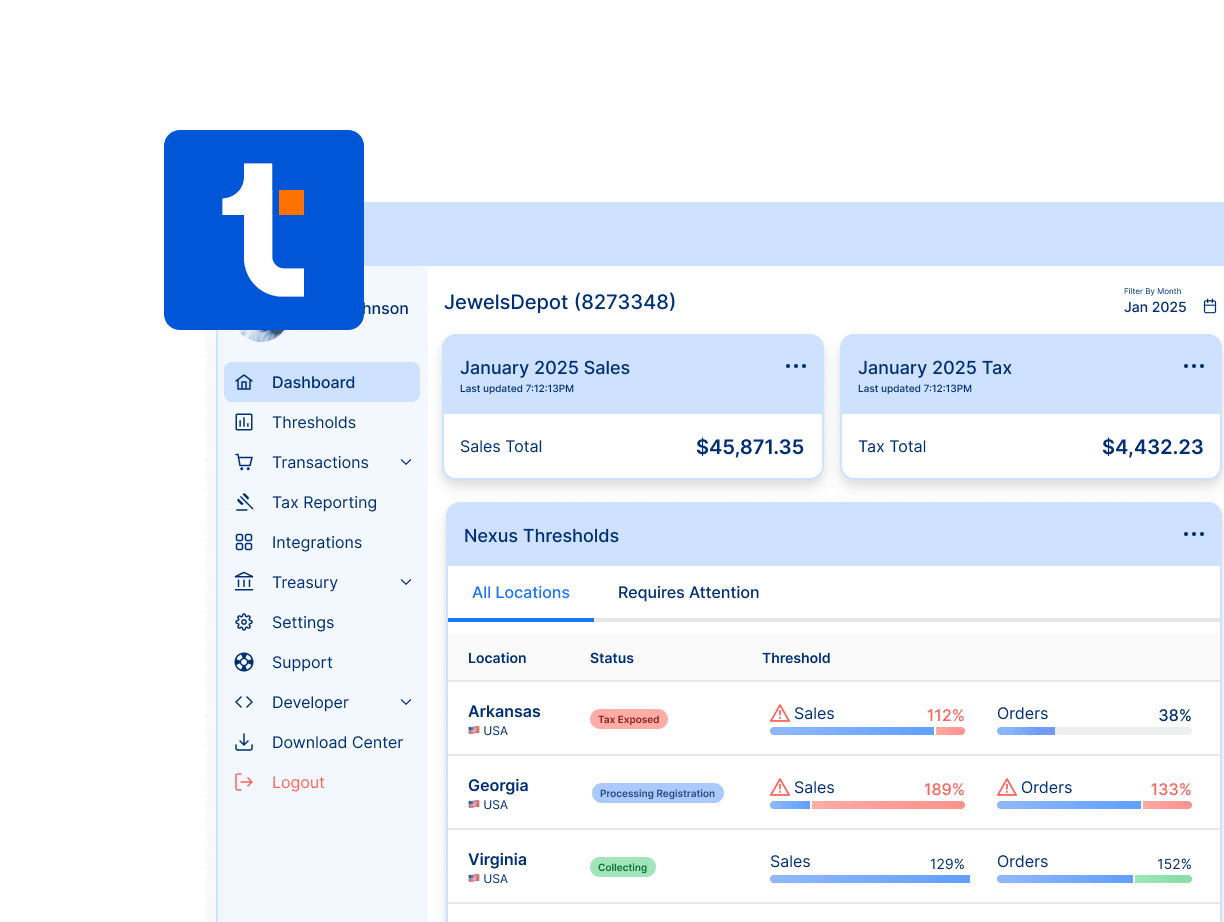
- Automate your nexus tracking. With AI-driven reach, manual tracking doesn’t cut it. Use tools that monitor nexus thresholds across all states and alerts you when you’re approaching nexus limits. Once you cross a threshold, register before the state finds you first.
Don’t panic. Prepare.
The coming months will give us a perfect baseline to see where we’re headed with agentic commerce.
If past shifts have taught us anything, it’s that with each wave of change, brand identity and connection matter even more. People will still seek out brands they trust, whether for their values, their story, their sustainability, their local roots, or simply because they love the product.
They’ll still click ads, open emails and texts, and buy things they’re not sure they need after being fed the same Instagram Reel 17 times.
They’ll still read those “About Us” pages. And yes — some will even venture into the world of humans and try things on in physical stores.
That doesn’t mean you can ignore it. It just means you need to be ready for the ripple effects.
Agentic commerce will expand your reach fast, often into new states and tax jurisdictions before you even notice. The sales look great until a few out-of-state checkouts quietly tip you over a nexus threshold and into a tax mess you never saw coming.
At TaxCloud, we’ve built for exactly this moment: automatic nexus tracking, real-time sales tax rate calculation, Streamlined Sales Tax program participation and filing, and unified visibility across every channel you sell on.
Whether your next order comes from Shopify, Etsy, or ChatGPT, we keep your compliance clean and your focus where it belongs: on growth.
The sellers who stay steady and compliant through this next curve will win the long game.
Stay ready for what’s next
TaxCloud helps you track economic nexus, automate multi-state filings, and stay compliant no matter where your next sale comes from — Shopify, WooCommerce, or ChatGPT.
Sources:
- 1.
- 2.
-
3.
Harvard Business Review AI Agents Are Changing How People Shop. Here’s What That Means for Brands. Source link